L'Australia Meridionale è lo Stato dove l'Australia fa quasi metà del suo vino: Wine Australia le attribuisce «quasi il 50%» della produzione nazionale, e nella vendemmia 2026 le sue cantine hanno pigiato 573.252 tonnellate d'uva su 73.151 ettari vitati. Ma il numero che racconta davvero questo territorio è un altro, ed è doppio: il Riverland, la fascia irrigua sul fiume Murray, vale il 59% del raccolto dello Stato e il 24% del suo valore; la Barossa Valley vale il 7% del raccolto e il 18% del valore. Fra queste due misure sta tutto il resto — diciotto regioni registrate che vanno dai banchi di calcare della costa sud-orientale alle colline fresche alle spalle di Adelaide.South Australia is the state where Australia makes almost half of its wine: Wine Australia credits it with 'almost 50%' of national production, and in the 2026 vintage its wineries crushed 573,252 tonnes of grapes from 73,151 hectares of vineyard. But the figure that really explains this place is a different one, and it comes in a pair: the Riverland, the irrigated belt along the Murray River, accounts for 59% of the state's crush and 24% of its value; the Barossa Valley accounts for 7% of the crush and 18% of the value. Everything else lives between those two measures — eighteen registered regions running from the limestone banks of the south-east coast to the cool hills behind Adelaide.
Il territorioThe territory
La terraThe land
Il calcare è il filo che tiene insieme il sud dello Stato. A Coonawarra i vignaioli raccontano la regione attraverso un'unica striscia di terra rossa a forma di sigaro, lunga venti chilometri e larga fino a due, posata sul banco calcareo: argilla nata dal disfacimento del calcare e colorata dagli ossidi di ferro, spessa fra i cinque e i cento centimetri, e sotto la roccia bianca. Più a nord la geologia cambia mestiere. La Clare Valley poggia su un mosaico di suoli antichi — terre rosse, calcare, ardesia e scisto: a Polish Hill il banco è ardesia dura, a Watervale una terra rossa sottile sul calcare — e la sua media estiva inganna, perché sono le brezze del pomeriggio a rallentare la maturazione. A McLaren Vale il clima è mediterraneo e trenta chilometri di costa disegnano il confine della regione; verso l'interno il suolo diventa sabbia profonda, quella in cui affondano gli alberelli di Grenache piantati nel 1946. A Langhorne Creek i suoli sono limi alluvionali profondi, e l'acqua arriva per un metodo tutto suo: fra inverno e primavera le piene del Bremer vengono deviate sui vigneti più vecchi con chiuse, argini e paratoie.Limestone is the thread that ties the south of the state together. At Coonawarra the growers tell their region through a single cigar-shaped strip of terra rossa, twenty kilometres long and up to two wide, laid over the limestone bank: clay weathered out of the limestone and coloured by iron oxide, between five and a hundred centimetres deep, with white rock beneath. Further north the geology changes its trade. The Clare Valley sits on a mosaic of ancient soils — red loams, limestone, slate and shale: at Polish Hill the bedrock is hard slate, at Watervale a thin red loam over limestone — and its summer average is misleading, because it is the afternoon breezes that slow the ripening. At McLaren Vale the climate is Mediterranean and thirty kilometres of coastline draw the region's boundary; inland the soil turns to deep sand, the sand the Grenache bush vines planted in 1946 reach down into. At Langhorne Creek the soils are deep alluvial loams, and the water arrives by a method all its own: between winter and spring the Bremer's high flows are diverted over the older vineyards by weirs, levee banks and floodgates.
Il vitignoThe grape
Due uve rosse fanno quasi tre quarti del raccolto rosso: nel 2026 lo Shiraz ha pesato 134.712 tonnellate — il 41% dei rossi dello Stato — e il Cabernet Sauvignon 100.702, il 31%. Fra i bianchi comanda lo Chardonnay con 124.533 tonnellate, la metà della raccolta bianca — 246.892 tonnellate, contro le 326.359 dei rossi — seguito dal Sauvignon Blanc. Il Riesling si ferma a 11.714 tonnellate, il 5% dei bianchi, e tuttavia è l'uva su cui poggiano la reputazione della Clare Valley e dell'Eden Valley: qui il peso di una varietà non si misura in tonnellate. Vale lo stesso per il Grenache, poco più di diecimila tonnellate in tutto lo Stato, e per il Mataro — il nome australiano del Mourvèdre — che ne fa meno di tremila.Two red grapes make up almost three quarters of the red crush: in 2026 Shiraz weighed in at 134,712 tonnes — 41% of the state's reds — and Cabernet Sauvignon at 100,702, or 31%. Among the whites Chardonnay leads with 124,533 tonnes, half the white harvest — 246,892 tonnes, against 326,359 for the reds — followed by Sauvignon Blanc. Riesling stops at 11,714 tonnes, 5% of the whites, and yet it is the grape on which the reputations of the Clare Valley and the Eden Valley rest: here a variety's weight is not measured in tonnes. The same goes for Grenache, a little over ten thousand tonnes across the whole state, and for Mataro — the Australian name for Mourvèdre — which makes less than three thousand.
L'uomoThe human hand
La fillossera non è mai arrivata. Vinehealth Australia, l'ente di biosicurezza viticola dello Stato, classifica South Australia fra i territori designati «phylloxera-free», e la movimentazione di uve, mezzi e materiale di propagazione è regolata di conseguenza. Wine Australia lo dice senza giri di parole: le vecchie viti della Barossa Valley, di McLaren Vale, della Clare Valley e delle Adelaide Hills sono sopravvissute alle grandi epidemie che hanno azzerato i vigneti d'Europa, del Nord America e dell'Australia orientale grazie al loro isolamento, e furono le restrizioni di quarantena a salvarle. È per questo che qui esistono ancora ceppi ottocenteschi in produzione, coltivati oggi da 3.143 proprietari di vigneto registrati.Phylloxera never arrived. Vinehealth Australia, the state's vine biosecurity agency, lists South Australia among the territories designated 'phylloxera-free', and the movement of grapes, machinery and propagation material is regulated accordingly. Wine Australia puts it plainly: the old vines of the Barossa Valley, McLaren Vale, the Clare Valley and the Adelaide Hills survived the great plagues that wiped out the vineyards of Europe, North America and eastern Australia thanks to their isolation, and it was quarantine restrictions that saved them. That is why nineteenth-century vines are still in production here, farmed today by 3,143 registered vineyard owners.
La mappaThe map
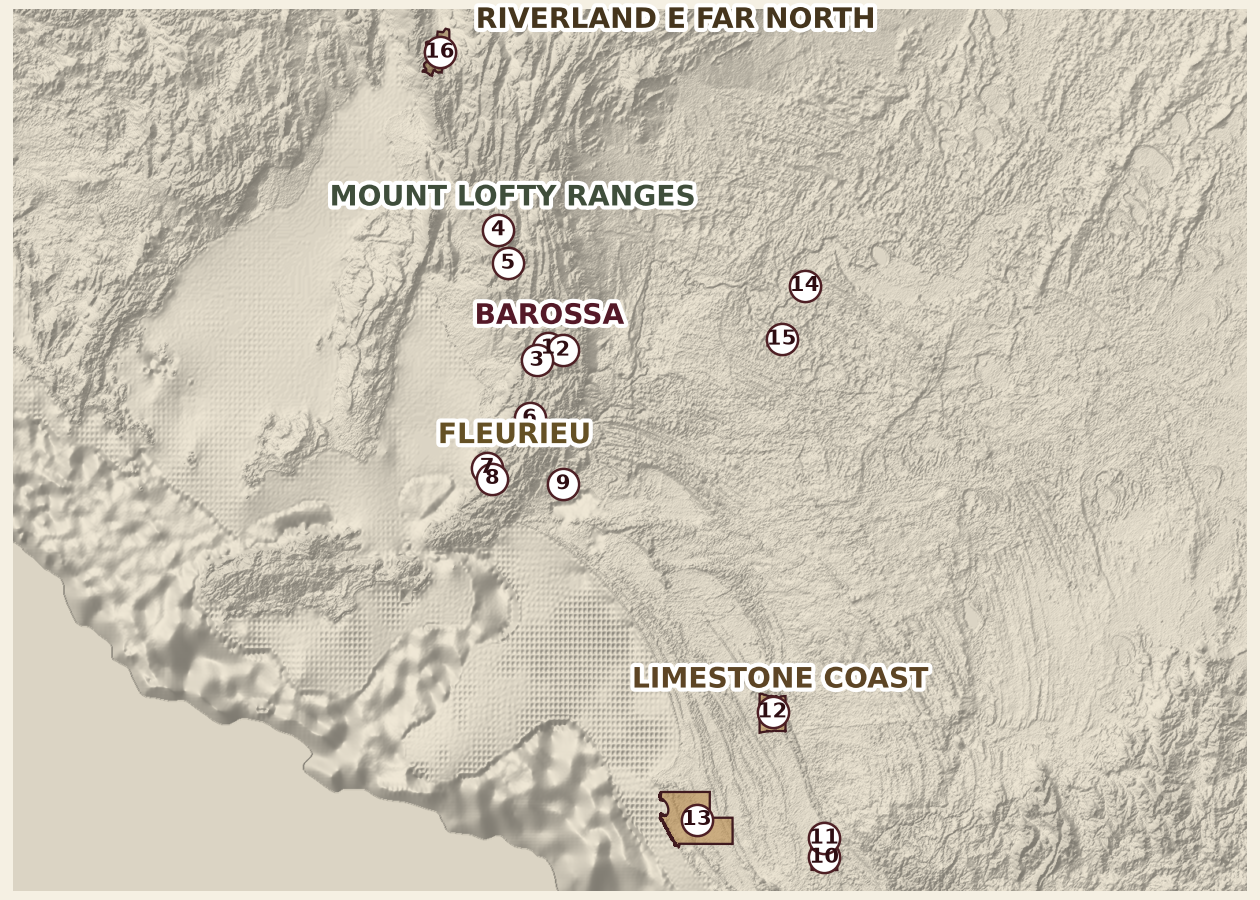
Il raggruppamento in cinque distretti è nostro, per rendere leggibile la mappa: le zone ufficiali sono sette. Sedici centri li rappresentano, e gli stessi colori tornano nell'elenco delle denominazioni.The grouping into five districts is ours, to make the map readable: the official zones are seven. Sixteen towns stand for them, and the same colours return in the list of appellations.
- 1 Tanunda
- 2 Angaston
- 3 Lyndoch
- 4 Clare
- 5 Auburn
- 6 Lenswood
- 7 McLaren Vale
- 8 Willunga
- 9 Langhorne Creek
- 10 Penola
- 11 Coonawarra
- 12 Padthaway
- 13 Robe
- 14 Renmark
- 15 Loxton
- 16 Melrose
Zone e sottozoneZones and subzones
I vitigni del territorioThe grapes of the territory
Le denominazioniThe denominations
A tavolaAt the table
La tavola sudaustraliana ha due accenti che si sentono ancora: quello tedesco della Barossa, portato dai coloni luterani di lingua tedesca arrivati dalla Slesia prussiana negli anni Quaranta dell'Ottocento, e quello del mare — i gamberoni dello Spencer Gulf, le ostriche allevate nelle baie della penisola di Eyre, il pescato del Coorong.The South Australian table has two accents you can still hear: the German one of the Barossa, brought by German-speaking Lutheran settlers who arrived from Prussian Silesia in the 1840s, and that of the sea — Spencer Gulf king prawns, oysters farmed in the bays of the Eyre Peninsula, fish from the Coorong.
Con i salumi affumicati e speziati della Barossa, il mettwurst da spalmare e la carne di maiale arrosto, sta bene uno Shiraz della valle: di frutto scuro, con tannino maturo e il calore dell'alcol che asciugano l'unto dei salumi e il sugo dell'arrosto senza appesantire il boccone. L'agnello, che qui è di casa, chiede invece un Cabernet Sauvignon di Coonawarra — tannino fine e teso, acidità viva, il frutto che resta scuro e composto.With the Barossa's smoked, spiced smallgoods, spreadable mettwurst and roast pork, a Shiraz from the valley works well: dark-fruited, with ripe tannin and alcoholic warmth that dry out the oiliness of the smallgoods and the juices of the roast without weighing the mouthful down. Lamb, very much at home here, calls instead for a Coonawarra Cabernet Sauvignon — fine, taut tannin, lively acidity, fruit that stays dark and composed.
Sul pesce e sui crostacei crudi il Riesling secco della Clare Valley è la scelta più naturale dello Stato: acidità dritta, sapidità marcata, nessun legno di mezzo. Con il canguro — carne magra, di sapore netto e ferroso — funziona meglio un Grenache di McLaren Vale, di tannino sottile e frutto rosso, servito appena fresco. E per aprire, uno spumante metodo classico delle Adelaide Hills: bollicina fine e finale asciutto, che pulisce il palato prima ancora che si cominci.On fish and raw shellfish, dry Clare Valley Riesling is the state's most natural choice: straight acidity, marked salinity, no oak in the way. With kangaroo — lean meat with a clear, iron-edged flavour — a McLaren Vale Grenache does better, with fine tannins and red fruit, served lightly chilled. And to begin, a traditional-method sparkling wine from the Adelaide Hills: fine bubbles and a dry finish that clean the palate before anything has even started.
La storiaHistory
Nel 1948 Max Schubert diventa il primo enologo capo della Penfolds. Tre anni dopo, tornato in Australia da un viaggio in Europa durante il quale aveva visto come si facevano i grandi rossi da invecchiamento, prova a farne uno anche lui: prende Shiraz da Magill Estate e da Morphett Vale, e nel 1951 firma il primo Grange sperimentale — il nome viene da Grange Cottage, la casa di famiglia dei Penfold. L'obiettivo che si era dato era semplice da dire e difficilissimo da ottenere: un vino australiano «capace di restare vivo per almeno vent'anni».In 1948 Max Schubert became Penfolds' first Chief Winemaker. Three years later, back in Australia from a European trip on which he had seen how great ageworthy reds were made, he tried making one himself: he took Shiraz from Magill Estate and Morphett Vale and, in 1951, produced the first experimental Grange — the name came from Grange Cottage, the Penfold family home. The goal he set himself was easy to state and extremely hard to reach: an Australian wine 'capable of staying alive for a minimum of twenty years'.
Nel 1957 lo presenta ai dirigenti dell'azienda. La degustazione va male. Le prime annate di Grange, assaggiate giovani, sono dure, chiuse, quasi respingenti: non somigliano a nulla di ciò che il mercato australiano dell'epoca si aspettava da un rosso. Il giudizio è netto e la decisione conseguente: il progetto si chiude, la produzione si ferma.In 1957 he presented it to the company's senior management. The tasting went badly. The early Granges, tasted young, were hard, closed, almost forbidding: they resembled nothing the Australian market of the day expected from a red. The verdict was blunt and the decision followed: the project was shut down, production ordered to cease.
Schubert non si ferma. Continua a fare Grange di nascosto, nelle cantine sotterranee di Magill, e nascono così le tre annate che tutti chiamano ancora oggi le «hidden Granges»: 1957, 1958, 1959. Sono vini che ufficialmente non esistono, fatti da un dipendente che sta disobbedendo a un ordine, e messi via ad aspettare l'unica cosa che avrebbe potuto dargli ragione — il tempo.Schubert did not stop. He carried on making Grange in secret, in the underground cellars at Magill, and so were born the three vintages everyone still calls the 'hidden Granges': 1957, 1958, 1959. Wines that officially did not exist, made by an employee disobeying an order, and put away to wait for the only thing that could prove him right — time.
Il tempo arriva nel 1960. Una seconda degustazione mette sul tavolo le annate più vecchie, quelle che nel 1957 erano state bocciate, e con qualche anno di bottiglia il vino ha aperto: ciò che sembrava durezza era struttura. La direzione fa marcia indietro e ordina di riprendere la produzione. Nel 2001, cinquant'anni dopo quella prima prova, il Grange entra nella lista dei beni di interesse storico dell'Australia Meridionale — un vino iscritto fra i monumenti.Time arrived in 1960. A second tasting put the older vintages on the table, the ones rejected in 1957, and with a few years in bottle the wine had opened up: what had seemed hardness was structure. Management reversed itself and ordered production to restart. In 2001, fifty years after that first trial, Grange was listed among South Australia's heritage icons — a wine entered on the register of monuments.
La parte istruttiva della storia non è il lieto fine. È che il Grange nasce da un errore di prospettiva perfettamente ragionevole: nel 1957 quei dirigenti non stavano sbagliando ad assaggiare, stavano assaggiando troppo presto. In un territorio dove la fillossera non è mai arrivata e le viti dell'Ottocento sono ancora in produzione, la lezione ha finito per assomigliare al posto stesso: qui certe cose vanno lasciate stare, e si giudicano dopo.The instructive part of the story is not the happy ending. It is that Grange came out of a perfectly reasonable error of perspective: in 1957 those managers were not tasting badly, they were tasting too early. In a place where phylloxera never arrived and nineteenth-century vines are still in production, the lesson has ended up resembling the place itself: here some things are best left alone, and judged later.
Numero, nomi e gerarchia delle denominazioni vengono dal Register of Protected GIs and Other Terms di Wine Australia, l'agenzia federale australiana. I dati di vendemmia (573.252 tonnellate, ripartizione per regione e per varietà) sono del SA Winegrape Crush Survey 2026, pubblicato da Wine Australia nel luglio 2026; gli ettari vitati e il numero di proprietari di vigneto derivano dal registro dei vigneti di Vinehealth Australia al 30 aprile 2026. Lo stato «phylloxera-free» dell'Australia Meridionale è dichiarato da Vinehealth Australia. Le note sui vini descrivono il profilo caratteristico e ricorrente, non la degustazione di una specifica annata.The number, names and hierarchy of the appellations come from Wine Australia's Register of Protected GIs and Other Terms — Wine Australia is the Australian federal agency. The vintage figures (573,252 tonnes, and the breakdown by region and variety) are from the SA Winegrape Crush Survey 2026, published by Wine Australia in July 2026; vineyard hectares and the number of vineyard owners come from the Vinehealth Australia vineyard register as at 30 April 2026. South Australia's 'phylloxera-free' status is declared by Vinehealth Australia. The tasting notes describe the characteristic, recurring profile of each wine, not a tasting of a specific vintage.