La California fa vino su una fascia lunga più di settecento chilometri, dalle colline di Mendocino ai vigneti alle spalle di San Diego. A tenerla insieme non è un vitigno comune né una tradizione condivisa, ma un meccanismo climatico: l'aria fredda dell'oceano Pacifico entra dalle aperture della catena costiera e abbassa la temperatura delle valli, e ogni valle ne riceve una dose diversa. Da quella differenza nascono i 154 territori delimitati che qui si chiamano AVA, e la distanza che separa un Cabernet di Napa da un Pinot Nero della Sonoma Coast o da uno Zinfandel di Lodi.California makes wine along a strip more than seven hundred kilometres long, from the hills of Mendocino to the vineyards behind San Diego. What holds it together is not a shared grape or a shared tradition but a climatic mechanism: cold air off the Pacific pushes in through the gaps in the coastal ranges and cools the valleys, and every valley gets a different dose of it. That difference is the reason there are 154 delimited territories here — AVAs, as they are called — and the reason a Napa Cabernet, a Sonoma Coast Pinot Noir and a Lodi Zinfandel have so little in common.
Il territorioThe territory
La terraThe land
La catena costiera californiana è giovane e spezzata, e le sue interruzioni contano più della sua altezza: dove la montagna si apre, l'aria fredda del Pacifico passa. Una di queste aperture ha dato il nome a una denominazione, il Petaluma Gap. Alle spalle della costa il calore si fa subito continentale, e verso l'interno il terreno cambia natura — dalle rocce sollevate dei rilievi ai suoli profondi delle pianure alluvionali fino ai graniti delle pendici della Sierra Nevada. La stessa varietà spiega perché a poche decine di chilometri di distanza si coltivino uve che altrove starebbero a mille chilometri l'una dall'altra.California's coastal range is young and broken, and its interruptions matter more than its height: where the mountains open, cold Pacific air comes through. One of those openings has given its name to an appellation, the Petaluma Gap. Behind the coast the heat turns continental within a few kilometres, and inland the ground itself changes — from the uplifted rock of the ranges to the deep soils of the alluvial plains and on to the granite of the Sierra Nevada foothills. That same variety explains why grapes that elsewhere would be a thousand kilometres apart are grown here within a short drive of each other.
Il vitignoThe grape
Due varietà comandano per superficie e non se lo contendono nemmeno: Cabernet Sauvignon fra le rosse e Chardonnay fra le bianche, secondo il censimento ufficiale degli ettari vitati pubblicato dal Dipartimento dell'agricoltura della California con l'agenzia statistica federale. Dietro vengono Pinot Nero, Zinfandel e Merlot, e fra i bianchi Sauvignon Blanc e Pinot Grigio. Lo Zinfandel merita un discorso a parte: arrivato nell'Ottocento e per decenni considerato americano, è la stessa varietà del Primitivo pugliese e del Tribidrag croato — un'identità stabilita dall'analisi del DNA, non dalla tradizione orale.Two varieties lead by acreage and it is not even close: Cabernet Sauvignon among the reds and Chardonnay among the whites, according to the official vineyard acreage survey published by the California Department of Food and Agriculture with the federal statistics agency. Behind them come Pinot Noir, Zinfandel and Merlot, and among the whites Sauvignon Blanc and Pinot Gris. Zinfandel deserves a note of its own: it arrived in the nineteenth century and was long taken for an American grape, but it is the same variety as Puglia's Primitivo and Croatia's Tribidrag — an identity established by DNA analysis, not by oral tradition.
L'uomoThe human hand
La vite arriva coi frati francescani nel Settecento, si diffonde nell'Ottocento con le fortune della corsa all'oro e viene azzerata dal proibizionismo, che dal 1920 al 1933 chiude quasi tutto. La ricostruzione è recente, e ha una data che la riassume: il 1976, quando i vini californiani fecero notizia a Parigi. È un vigneto senza disciplinari che dicano cosa piantare, dove la scelta del vitigno e dello stile resta al produttore — con tutti i rischi e le libertà che comporta.The vine arrived with the Franciscan friars in the eighteenth century, spread in the nineteenth on the fortunes of the Gold Rush, and was wiped out by Prohibition, which closed almost everything between 1920 and 1933. The rebuilding is recent, and one date sums it up: 1976, when Californian wines made headlines in Paris. This is a vineyard with no rulebook telling growers what to plant — the choice of grape and of style stays with the producer, with all the freedom and all the risk that implies.
La mappaThe map
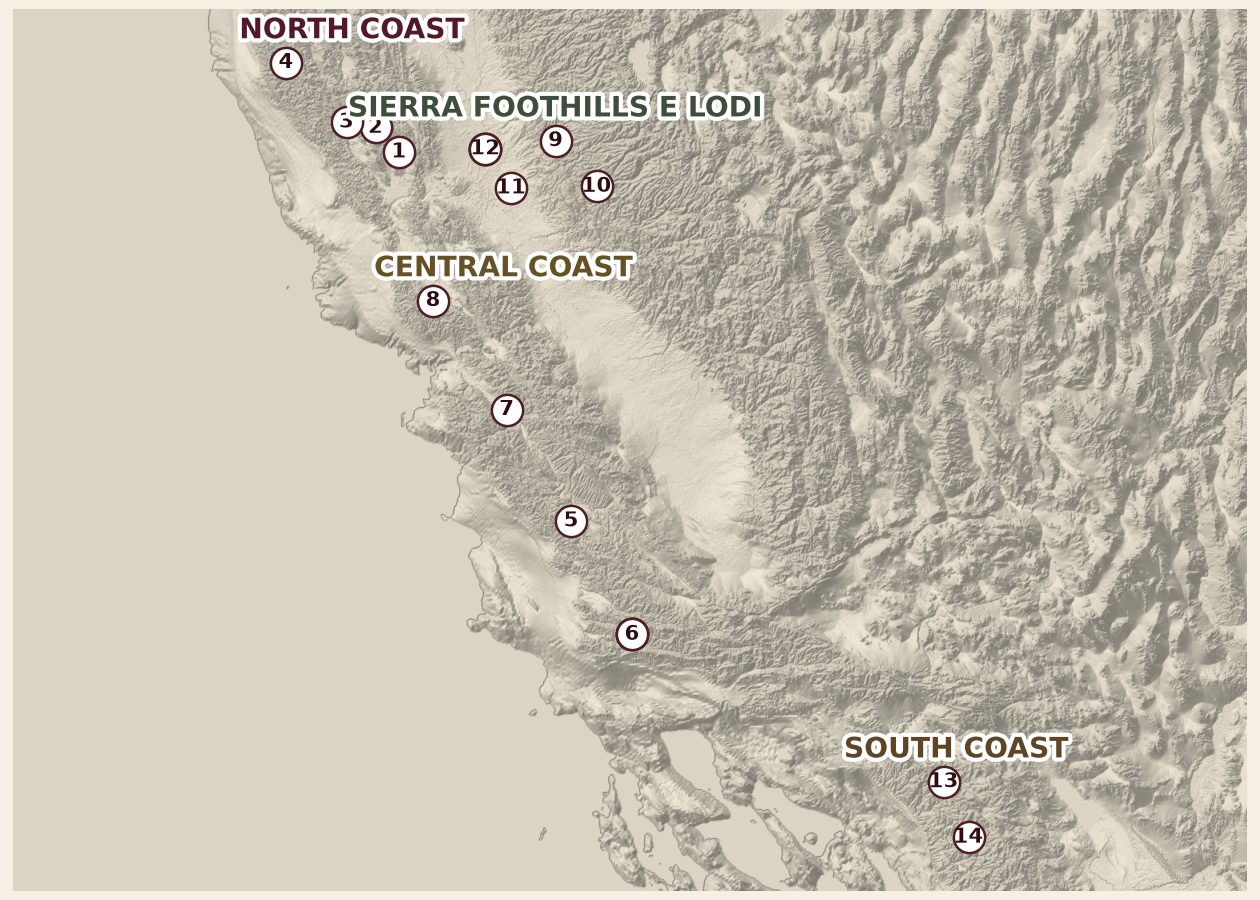
I quattro distretti del vino californiano e quattordici comuni che li rappresentano. Gli stessi colori tornano nell'elenco delle denominazioni.California's four wine districts and fourteen towns that stand for them. The same colours return in the list of appellations.
- 1 Yountville (Napa)
- 2 Calistoga (Napa)
- 3 Healdsburg (Sonoma)
- 4 Philo (Mendocino)
- 5 Templeton (Paso Robles)
- 6 Los Olivos (Santa Barbara)
- 7 Soledad (Monterey)
- 8 Saratoga (Santa Cruz Mountains)
- 9 Plymouth (Amador)
- 10 Murphys (Calaveras)
- 11 Lodi (San Joaquin)
- 12 Clarksburg (Yolo)
- 13 Temecula (Riverside)
- 14 Ramona (San Diego)
Zone e sottozoneZones and subzones
I vitigni del territorioThe grapes of the territory
Le denominazioniThe denominations
A tavolaAt the table
La cucina della California non nasce da un ricettario ma dall'incrocio fra il pescato del Pacifico, l'ortofrutta della Valle Centrale e le comunità che ci sono passate — messicane, italiane, cinesi, giapponesi. Nel 1971 Alice Waters apre Chez Panisse a Berkeley e mette per iscritto il criterio che poi il mondo chiamerà cucina californiana: si cucina quello che c'è, di stagione, del posto.California's cooking comes not from a recipe book but from the meeting of Pacific seafood, Central Valley produce and the communities that have passed through — Mexican, Italian, Chinese, Japanese. In 1971 Alice Waters opened Chez Panisse in Berkeley and wrote down the principle the world would later call California cuisine: cook what is there, in season, from nearby.
Il piatto più identitario è il barbecue in stile Santa Maria, nella contea di Santa Barbara: un taglio di manzo chiamato tri-tip cotto sulla brace di quercia rossa locale, con contorno di fagioli pinquito. La Camera di commercio della Santa Maria Valley ne ha fissato il menù ufficiale nel 1978. La carne è saporita ma non grassa e la brace lascia un ritorno affumicato: chiede un rosso con acidità viva e tannino presente ma non ruvido — un Syrah della stessa contea, o uno Zinfandel di Paso Robles.The most distinctive dish is Santa Maria style barbecue, in Santa Barbara County: a cut of beef called tri-tip cooked over local red oak coals, with pinquito beans on the side. The Santa Maria Valley Chamber of Commerce set down its official menu in 1978. The meat is savoury rather than fatty and the coals leave a smoky finish: it asks for a red with live acidity and firm but unaggressive tannin — a Syrah from the same county, or a Paso Robles Zinfandel.
Sulla costa nord il piatto è il cioppino, la zuppa di pesce nata a San Francisco fra i pescatori di origine italiana: si fa con quello che è entrato in porto, di solito granchio, vongole, cozze, gamberi e pesce bianco, in un fondo di pomodoro. Il gusto salato del crostaceo e il pomodoro vanno d'accordo con uno Chardonnay della Sonoma Coast poco legnoso, oppure con un Pinot Nero leggero servito fresco. D'inverno il granchio di Dungeness si mangia semplicemente lessato: lì il metodo classico di Carneros o di Anderson Valley è la scelta più naturale, perché la bolla pulisce il palato e il vino non copre la dolcezza della polpa.On the north coast the dish is cioppino, the fish stew born in San Francisco among fishermen of Italian descent: it is made from whatever came into port, usually crab, clams, mussels, prawns and white fish in a tomato base. The salt of the shellfish and the tomato go well with a lightly oaked Sonoma Coast Chardonnay, or with a light Pinot Noir served cool. In winter Dungeness crab is simply boiled: there the traditional-method sparkling wines of Carneros or Anderson Valley are the natural choice, because the bubbles clean the palate and the wine does not cover the sweetness of the meat.
Un avvertimento onesto sui carciofi di Castroville, capitale californiana del carciofo: contengono una sostanza che rende dolce quasi ogni vino bevuto dopo. Serve un bianco molto secco e teso — un Sauvignon Blanc, meglio se della costa — e conviene non aprire la bottiglia importante con quel piatto.An honest warning about the artichokes of Castroville, California's artichoke capital: they contain a compound that makes almost any wine drunk afterwards taste sweet. You want a very dry, taut white — a Sauvignon Blanc, ideally from the coast — and it is wise not to open the special bottle with that dish.
La storiaHistory
Il 24 maggio 1976, in una sala d'albergo a Parigi, un commerciante di vino inglese di nome Steven Spurrier organizza una degustazione per festeggiare il bicentenario degli Stati Uniti. Spurrier gestisce una bottiglieria e una scuola di vino in città; l'idea di guardare alla California è della sua collaboratrice americana Patricia Gallagher. Il piano è semplice e, nelle intenzioni, innocuo: far assaggiare sei Cabernet e sei Chardonnay californiani a una giuria francese, aggiungendo quattro Bordeaux e quattro Borgogna bianchi come termini di paragone. I giudici sono tutti francesi e tutt'altro che dilettanti — fra loro Aubert de Villaine della Romanée-Conti, Odette Kahn direttrice della Revue du vin de France, Pierre Bréjoux dell'Istituto delle denominazioni d'origine.On 24 May 1976, in a Paris hotel room, an English wine merchant named Steven Spurrier organised a tasting to mark the American bicentennial. Spurrier ran a wine shop and a wine school in the city; the idea of looking to California came from his American colleague Patricia Gallagher. The plan was simple and, in intent, harmless: put six Californian Cabernets and six Chardonnays in front of a French jury, adding four Bordeaux and four white Burgundies as reference points. The judges were all French and anything but amateurs — among them Aubert de Villaine of Romanée-Conti, Odette Kahn, editor of the Revue du vin de France, and Pierre Bréjoux of the French appellation institute.
La degustazione è alla cieca. Alla fine dei conteggi il miglior rosso è il Cabernet Sauvignon S.L.V. 1973 di Stag's Leap Wine Cellars, con 14,14 punti, davanti allo Château Mouton-Rothschild 1970 fermo a 14,09: cinque centesimi. Il miglior bianco è lo Chardonnay 1973 di Chateau Montelena. Il Monte Bello 1971 di Ridge Vineyards arriva quinto. Nella sala non c'è quasi nessuno: l'unico giornalista presente è George M. Taber, corrispondente di Time, che scrive un pezzo di poche righe. Quelle poche righe cambiano il mercato mondiale del vino.The tasting was blind. When the scores were added up, the best red was the 1973 S.L.V. Cabernet Sauvignon from Stag's Leap Wine Cellars, with 14.14 points, ahead of Château Mouton-Rothschild 1970 on 14.09: five hundredths. The best white was the 1973 Chardonnay from Chateau Montelena. Ridge Vineyards' 1971 Monte Bello came fifth. Almost nobody was in the room: the only journalist present was George M. Taber of Time, who filed a few lines. Those few lines changed the world wine market.
La reazione francese è che si tratta di un incidente: vini fatti per piacere subito, che nel giro di pochi anni sarebbero crollati mentre i Bordeaux si sarebbero aperti. Era una previsione precisa e verificabile, e trent'anni dopo qualcuno l'ha verificata. Il 24 maggio 2006 Spurrier organizza la controprova con le stesse bottiglie di rosso, ormai ultratrentenni, degustate in contemporanea a Londra e in California da nove esperti per sede. Il vino che vince in entrambe le sale è il Ridge Monte Bello 1971 — quinto nel 1976 — primo anche nel conteggio combinato, davanti allo Stag's Leap S.L.V. 1973. Dietro di loro si piazzano altri californiani.The French response was that it had been an accident: wines built to please immediately, which would collapse within a few years while the Bordeaux opened up. That was a precise and testable prediction, and thirty years later someone tested it. On 24 May 2006 Spurrier staged the rematch with the same red bottles, now over thirty years old, tasted simultaneously in London and in California by nine experts at each venue. The wine that won in both rooms was Ridge Monte Bello 1971 — fifth in 1976 — and first in the combined result as well, ahead of the 1973 Stag's Leap S.L.V. Behind them came more Californians.
Delle due bottiglie vincitrici del 1976 restano gli esemplari raccolti dallo Smithsonian, il museo nazionale di storia americana di Washington: sono entrati nel 1996 in collezione permanente, nella sezione dedicata alla trasformazione della tavola americana. È un finale adatto: la California non ha vinto quel giorno un premio di qualità assoluta — nove giudici, dieci rossi, un pomeriggio — ma il diritto di essere presa sul serio. Nel 1976 le cantine californiane erano poche centinaia; oggi sono migliaia.Of the two winning bottles of 1976, examples survive at the Smithsonian's National Museum of American History in Washington: they entered the permanent collections in 1996, in the section on the transformation of the American table. It is a fitting ending: what California won that day was not a verdict on absolute quality — nine judges, ten reds, one afternoon — but the right to be taken seriously. In 1976 there were a few hundred Californian wineries; today there are thousands.
Numero e nomi delle denominazioni dal TTB, l'agenzia federale statunitense che istituisce le AVA (elenco degli AVA istituiti, 27 CFR Part 9, aggiornato al 29 aprile 2026). Superfici e classifica dei vitigni dal California Grape Acreage Report — raccolto 2025, compilato e pubblicato dal Dipartimento dell'agricoltura della California con il servizio statistico nazionale del Dipartimento dell'agricoltura degli Stati Uniti. Un'AVA delimita un territorio e non impone vitigni né metodi: le indicazioni di uve e stile in questa pagina descrivono la pratica prevalente, non una regola. Le fonti verificate restano archiviate in redazione.The number and names of the appellations come from the TTB, the US federal agency that establishes AVAs (list of established AVAs, 27 CFR Part 9, updated 29 April 2026). Acreage figures and variety rankings come from the California Grape Acreage Report — 2025 crop, compiled and published by the California Department of Food and Agriculture with the National Agricultural Statistics Service of the US Department of Agriculture. An AVA delimits a territory and imposes neither grapes nor methods: the notes on varieties and style on this page describe prevailing practice, not a rule. Verified sources are kept on file in the newsroom.