La Coastal Region è la regione del vino che raccoglie i nomi che il Sudafrica esporta da tre secoli: Stellenbosch, Paarl, Swartland, Franschhoek, Constantia. L'elenco ufficiale delle aree di produzione del Wine of Origin, aggiornato a febbraio 2026, le riconosce nove distretti, una sottoregione e trentadue ward. Le quattro aree statistiche che il SAWIS usa per contarla — Stellenbosch, Paarl (che comprende anche Franschhoek e Wellington), Swartland e Cape Town — valgono da sole 39.628 ettari vitati sugli 86.544 di tutto il Paese: quasi la metà del vigneto sudafricano sta qui, in una fascia larga un centinaio di chilometri fra l'Atlantico e le prime montagne.The Coastal Region is the wine region that gathers the names South Africa has been exporting for three centuries: Stellenbosch, Paarl, Swartland, Franschhoek, Constantia. The official register of Wine of Origin production areas, updated in February 2026, recognises nine districts, one subregion and thirty-two wards. The four statistical areas SAWIS uses to count it — Stellenbosch, Paarl (which also takes in Franschhoek and Wellington), Swartland and Cape Town — account on their own for 39,628 hectares of vineyard out of the country's 86,544: almost half of South Africa's vines are here, in a belt some hundred kilometres wide between the Atlantic and the first mountains.
Il territorioThe territory
La terraThe land
Il disegno della regione lo fanno due cose: il granito e l'oceano. Le montagne che chiudono a est — Simonsberg, Drakenstein, Kasteelberg — sono massicci di granito decomposto, e sulle loro pendici i suoli restano poveri e drenanti; Kanonkop, a Simonsberg-Stellenbosch, descrive esattamente questo, granito decomposto e vigne ad alberello. Più a nord, nello Swartland, il substrato cambia: le vigne di Porseleinberg poggiano su uno scisto micaceo durissimo, e quelle vicine, sul versante sud-ovest del Kasteelberg, su scisto bruno mescolato ad arenaria della Table Mountain dilavata dalla montagna. A ovest fa il resto l'Atlantico: la corrente del Benguela porta aria fredda dentro le valli aperte verso la baia, ed è la ragione per cui Constantia, Durbanville e Hout Bay, che stanno praticamente dentro Città del Capo, danno vini di tutt'altro passo rispetto alle pianure interne.Two things draw this region: granite and the ocean. The mountains that close it to the east — Simonsberg, Drakenstein, Kasteelberg — are massifs of decomposed granite, and on their slopes the soils stay poor and free-draining; Kanonkop, in Simonsberg-Stellenbosch, describes exactly that: decomposed granite and bush vines. Further north, in the Swartland, the bedrock changes: the Porseleinberg vineyards sit on extremely hard mica-schist, and those next door, on the south-west slopes of the Kasteelberg, on brown schist mixed with Table Mountain sandstone washed down from the mountain. To the west the Atlantic does the rest: the Benguela current pushes cold air into the valleys that open toward the bay, which is why Constantia, Durbanville and Hout Bay — effectively inside Cape Town — give wines of a completely different tempo from the inland plains.
Il vitignoThe grape
Qui il Sudafrica concentra i suoi rossi internazionali e la sua uva d'invenzione. Sommando le quattro aree statistiche del SAWIS che coprono la regione, nel 2024 il Cabernet Sauvignon ci stava con 6.169 ettari sugli 8.749 nazionali e lo Shiraz con 5.494 sugli 8.340: circa sette ettari su dieci di queste due varietà stanno in questa fascia di terra. Il Pinotage, l'incrocio nato a Stellenbosch nel 1924, ne ha 3.754 ettari sui 6.605 di tutto il Paese. Fra i bianchi comanda lo Chenin blanc con 6.248 ettari, seguito dal Sauvignon blanc con 4.433 e dallo Chardonnay con 2.997. E resiste il Cinsaut, l'altro genitore del Pinotage: 934 ettari qui su 1.627 nazionali, quasi sempre su vigne vecchie.This is where South Africa concentrates its international reds and its home-made grape. Adding up the four SAWIS statistical areas that cover the region, in 2024 Cabernet Sauvignon stood at 6,169 hectares out of a national 8,749 and Shiraz at 5,494 out of 8,340: about seven hectares in ten of those two varieties lie in this strip of land. Pinotage, the crossing made in Stellenbosch in 1924, has 3,754 hectares here out of the country's 6,605. Among the whites Chenin blanc leads with 6,248 hectares, followed by Sauvignon blanc with 4,433 and Chardonnay with 2,997. And Cinsaut holds on — the other parent of Pinotage — with 934 hectares here out of 1,627 nationally, almost always on old vines.
L'uomoThe human hand
Il vino sudafricano è un mestiere regolato per legge da molto tempo. Il Wine of Origin, introdotto nel 1973, è oggi regolato dal Liquor Products Act 60 del 1989 e stabilisce che l'indicazione d'origine in etichetta vada certificata: dal 1º agosto 2023 l'autorità che definisce e modifica unità geografiche, regioni, distretti e ward si chiama Wine Certification Authority (prima era il Wine and Spirit Board), mentre il SAWIS ne cura l'amministrazione quotidiana. È un impianto che si muove davvero: fra l'elenco del giugno 2022 e quello del febbraio 2026 sono comparsi ward nuovi, e già il 26 maggio 2017 erano stati revocati due distretti, Cape Peninsula e Tygerberg, sostituiti dal distretto Cape Town. Dietro le denominazioni ci sono persone: nel 2024 le quattro aree della regione contavano 902 produttori d'uva sui 2.255 del Paese e 285 cantine private sulle 437 nazionali.South African wine has long been a trade governed by statute. The Wine of Origin scheme, introduced in 1973, is now governed by the Liquor Products Act 60 of 1989 and requires that the origin claim on a label be certified: since 1 August 2023 the authority that defines and amends geographical units, regions, districts and wards is called the Wine Certification Authority (formerly the Wine and Spirit Board), while SAWIS handles the day-to-day administration. It is a framework that genuinely moves: between the June 2022 register and the February 2026 one, new wards appeared, and as early as 26 May 2017 two districts — Cape Peninsula and Tygerberg — had been repealed and replaced by the Cape Town district. Behind the appellations there are people: in 2024 the region's four areas counted 902 grape growers out of the country's 2,255, and 285 private cellars out of 437 nationally.
La mappaThe map
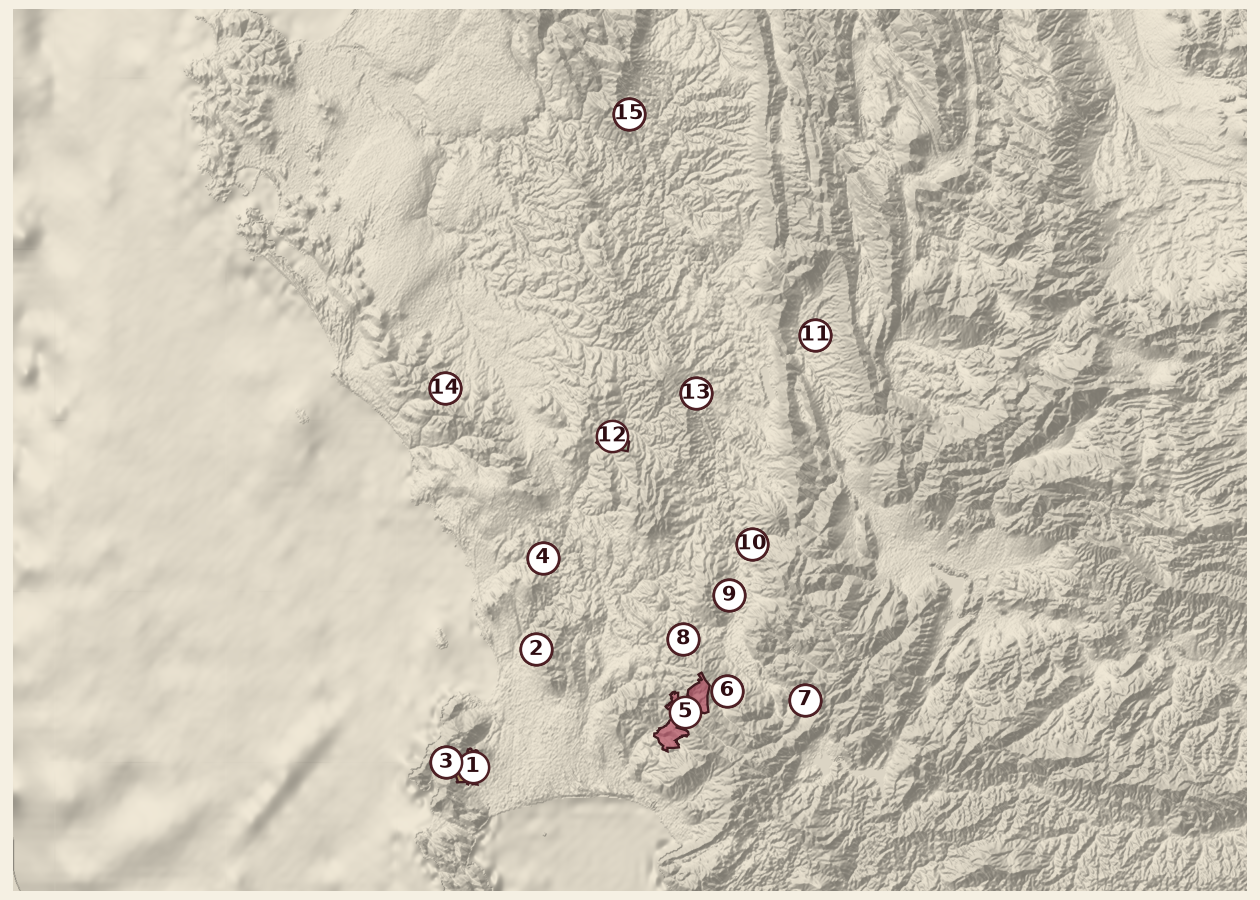
Quindici centri della Coastal Region, dal Capo allo Swartland. I numeri rimandano alla legenda qui sotto, che li raggruppa nelle quattro zone di lettura; gli stessi colori tornano nell'elenco delle denominazioni.Fifteen towns of the Coastal Region, from the Cape to the Swartland. The numbers key to the legend below, which groups them into four reading zones; the same colours return in the list of appellations.
- 1 Constantia
- 2 Durbanville
- 3 Hout Bay
- 4 Philadelphia
- 5 Stellenbosch
- 6 Pniel
- 7 Franschhoek
- 8 Klapmuts
- 9 Paarl
- 10 Wellington
- 11 Tulbagh
- 12 Malmesbury
- 13 Riebeek-Kasteel
- 14 Darling
- 15 Piketberg
Zone e sottozoneZones and subzones
I vitigni del territorioThe grapes of the territory
Le denominazioniThe denominations
A tavolaAt the table
La cucina del Capo è nata dall'incrocio fra le dispense olandesi, le spezie che la Compagnia delle Indie portava dall'Asia e la cucina delle comunità malesi deportate al Capo. Il risultato è una tavola dove il dolce e la spezia stanno dentro i piatti salati — ed è esattamente lì che i vini della regione trovano il loro posto.Cape cooking was born from the crossing of Dutch larders, the spices the East India Company brought from Asia, and the cuisine of the Malay communities deported to the Cape. The result is a table where sweetness and spice sit inside savoury dishes — and that is exactly where the region's wines find their place.
Il bobotie, lo sformato di carne macinata speziata con curry, uvetta e una copertura di uovo, chiede un rosso morbido e non troppo tannico: il Pinotage giovane, o un Cape blend, regge il fondo dolce dell'uvetta senza irrigidirsi. Il braai — la brace, che al Capo è un rito prima che un modo di cuocere — porta in tavola boerewors a spirale e sosaties di agnello marinato al curry: qui vanno lo Shiraz dello Swartland, con la sua nota affumicata, e il Cabernet di Stellenbosch sui tagli di manzo. Lo snoek, il pesce grasso e saporito che si cuoce sulla brace spennellato di confettura d'albicocche, si trova bene con lo Chenin blanc: la freschezza taglia il grasso del pesce, la sua stoffa regge la confettura. La waterblommetjiebredie, lo stufato di agnello coi fiori di ninfea del Capo, e il potjiekos cotto lentamente nel paiolo di ghisa chiedono rossi di struttura media e acidità viva.Bobotie, the bake of spiced minced meat with curry, raisins and an egg topping, calls for a supple red without heavy tannin: young Pinotage, or a Cape blend, carries its sweet edge without stiffening. The braai — the coals, which at the Cape are a ritual before they are a way of cooking — brings coiled boerewors and sosaties of curry-marinated lamb: here Swartland Shiraz works, with its smoky note, and Stellenbosch Cabernet on cuts of beef. Snoek, the rich, savoury fish grilled over coals and brushed with apricot jam, sits well with Chenin blanc: the freshness cuts the fat, the body stands up to the glaze. Waterblommetjiebredie, the lamb stew with Cape water-lily flowers, and potjiekos slow-cooked in a cast-iron pot ask for medium-bodied reds with lively acidity.
Sul dolce vale la pena fermarsi: il malva pudding, tiepido e imbevuto di salsa alla panna, e i koeksisters, trecce fritte sciroppate, stanno con un vino dolce di uve appassite in vigna — l'accostamento di casa è quello con il Vin de Constance di Constantia, purché il vino resti almeno altrettanto dolce del piatto.Dessert is worth a pause: malva pudding, warm and soaked in cream sauce, and koeksisters, syrup-soaked fried plaits, go with a sweet wine from grapes dried on the vine — the local match is Constantia's Vin de Constance, provided the wine stays at least as sweet as the dish.
La storiaHistory
Il primo vino del Capo è del 1659, ma la storia che ha reso famosa questa regione comincia una generazione dopo, con un uomo che manda dei cavalieri a raccogliere terra. Simon van der Stel arriva al Capo nel 1679, mandato dalla Compagnia olandese delle Indie orientali a governare la stazione di rifornimento; in Olanda aveva imparato il mestiere del vino nelle sue vigne di Muiderberg, e al Capo comincia a spedire uomini in giro a prelevare campioni di suolo. Nel 1685 sceglie: 891 morgen — circa 763 ettari — dietro la Table Mountain, ottenuti in proprietà il 13 luglio di quell'anno. Chiama la fattoria Constantia, forse dal nome della figlia del commissario che gli aveva procurato la terra, forse da una nave della Compagnia, forse — è la lettura che gli somiglia di più — dal latino constantia, la costanza.The Cape's first wine dates from 1659, but the story that made this region famous starts a generation later, with a man sending riders out to collect soil. Simon van der Stel reached the Cape in 1679, dispatched by the Dutch East India Company to govern the supply station; back in Holland he had learned the wine trade in his own vineyards at Muiderberg, and at the Cape he began sending men out to take soil samples. In 1685 he chose: 891 morgen — about 763 hectares — behind Table Mountain, granted to him on 13 July of that year. He named the farm Constantia, perhaps after the daughter of the commissioner who had secured him the land, perhaps after a Company ship, perhaps — the reading that suits him best — after the Latin constantia, steadfastness.
Quello che esce da quelle vigne diventa nel giro di un secolo uno dei vini più cari d'Europa. Il «Constantia Wyn» è un vino dolce da uve lasciate appassire sulla pianta, e viene comprato alle aste del continente da Federico il Grande di Prussia e da Luigi Filippo, re dei Francesi. La sua fama entra nella letteratura: Jane Austen lo cita in Ragione e sentimento come rimedio per un cuore spezzato, Charles Dickens lo mette nel Mistero di Edwin Drood per tirare su di morale un personaggio, Baudelaire lo nomina nei Fiori del male. La cantina di Klein Constantia, che oggi produce il Vin de Constance sulla stessa collina, elenca nella propria cronologia i suoi bevitori storici: da Casanova a Federico il Grande, da Jefferson a Napoleone in esilio, fino a Nelson Mandela.Within a century, what came out of those vineyards became one of the most expensive wines in Europe. 'Constantia Wyn' is a sweet wine from grapes left to shrivel on the vine, and it was bought at continental auctions by Frederick the Great of Prussia and Louis Philippe, King of the French. Its fame entered literature: Jane Austen cites it in Sense and Sensibility as a cure for a broken heart, Charles Dickens puts it in The Mystery of Edwin Drood to lift a character's spirits, Baudelaire names it in Les Fleurs du mal. Klein Constantia, which today makes Vin de Constance on the same hill, lists its historical drinkers in its own timeline: from Casanova to Frederick the Great, from Jefferson to Napoleon in exile, all the way to Nelson Mandela.
Poi la storia si interrompe. La fillossera arriva al Capo alla fine dell'Ottocento e cancella le vigne; il vino dolce di Constantia sparisce dal mercato per quasi un secolo e per generazioni resta soltanto un nome nei libri. Il ritorno è recente: le vigne di Muscat sono state ripiantate e il Vin de Constance è di nuovo in produzione — si compra oggi, non è un ricordo.Then the story breaks off. Phylloxera reached the Cape at the end of the nineteenth century and wiped out the vineyards; Constantia's sweet wine vanished from the market for almost a century and for generations survived only as a name in books. The return is recent: the Muscat vines have been replanted and Vin de Constance is in production again — you can buy it today, it is not a memory.
Nel frattempo, a una quarantina di chilometri di distanza, la regione si era inventata un'altra cosa. Il 17 novembre 1924 Abraham Izak Perold, che dirigeva viticoltura ed enologia all'Università di Stellenbosch, incrocia Pinot noir e Hermitage — il nome sudafricano del Cinsaut. L'anno dopo pianta quattro semi nel giardino della sua casa alla fattoria sperimentale di Welgevallen, poi lascia l'università e se ne dimentica. Le piantine vengono ritrovate nel giardino ormai abbandonato e salvate; il primo vino da quell'incrocio si fa nel 1941, e la prima bottiglia con scritto «Pinotage» in etichetta esce nel 1961, dall'annata 1959 di Lanzerac. Quattro semi in un orto: è la sola uva nata al Capo ad aver fatto il giro del mondo, e oltre la metà dei suoi ettari sta ancora dentro questa regione.Meanwhile, some forty kilometres away, the region had invented something else. On 17 November 1924 Abraham Izak Perold, head of viticulture and oenology at Stellenbosch University, crossed Pinot noir with Hermitage — the South African name for Cinsaut. The following year he planted four seeds in the garden of his house at the Welgevallen experimental farm, then left the university and forgot about them. The seedlings were found in the by-then abandoned garden and rescued; the first wine from that crossing was made in 1941, and the first bottle labelled 'Pinotage' appeared in 1961, from Lanzerac's 1959 vintage. Four seeds in a garden: it is the one Cape-bred grape that travelled the world, and more than half its hectares are still inside this region.
Distretti, sottoregione e ward sono contati da noi sull'elenco ufficiale «Production areas defined in terms of the Wine of Origin Scheme» (WOSA/SAWIS) del febbraio 2026. Gli ettari e i numeri di produttori vengono dalla pubblicazione SAWIS «SA Wine Industry Statistics nr 49» (dati 2024): attenzione, le aree statistiche del SAWIS non coincidono esattamente con i confini del Wine of Origin — la sua area «Paarl» comprende anche i distretti Franschhoek e Wellington, e non dichiara dove finiscano Tulbagh, Darling e Lutzville Valley. Le somme che citiamo vanno quindi lette come una misura per difetto della regione. Le descrizioni delle cantine sono nostre e nascono da quanto i produttori dichiarano sui propri siti.Districts, subregion and wards are counted by us from the official register 'Production areas defined in terms of the Wine of Origin Scheme' (WOSA/SAWIS), February 2026. Hectares and producer numbers come from the SAWIS publication 'SA Wine Industry Statistics nr 49' (2024 data): note that SAWIS statistical areas do not exactly match Wine of Origin boundaries — its 'Paarl' area also takes in the Franschhoek and Wellington districts, and it does not state where Tulbagh, Darling and Lutzville Valley are counted. The totals we quote should therefore be read as a conservative measure of the region. Winery descriptions are our own and are based on what the producers state on their own websites.