In Spagna quasi ogni denominazione sta dentro una sola comunità autonoma. Quattro no: Cava, Rioja, Jumilla e Ribera del Queiles hanno il vigneto a cavallo di due o più comunità e per questo la legge le affida allo Stato invece che a un governo regionale. Non sono una regione geografica e non fingono di esserlo: sono il modo in cui la Spagna ammette che il vigneto, qualche volta, ha ignorato i confini amministrativi.In Spain nearly every denomination sits inside a single autonomous community. Four do not: Cava, Rioja, Jumilla and Ribera del Queiles have vineyards straddling two or more communities, and for that reason the law places them under the State rather than a regional government. They are not a geographical region and do not pretend to be one: they are Spain's way of admitting that the vineyard, now and then, has ignored administrative borders.
Il territorioThe territory
La terraThe land
Non c'è un paesaggio solo. Ci sono i suoli calcarei e poco fertili del Penedès, la valle dell'Ebro fra Haro e Alfaro, l'altiplano di Jumilla che porta le vigne dai 320 ai 900 metri, e le poche centinaia di ettari del Queiles ai piedi del Moncayo, dove il cierzo allarga l'escursione fra il giorno e la notte. Quello che questi luoghi hanno in comune non è la contiguità: è una frontiera regionale attraversata dallo stesso vigneto.There is no single landscape. There are the chalky, poor soils of the Penedès, the Ebro valley between Haro and Alfaro, the Jumilla plateau that lifts vines from 320 to 900 metres, and the few hundred hectares of the Queiles at the foot of the Moncayo, where the cierzo wind widens the day-to-night swing. What these places share is not contiguity: it is one vineyard reaching across a regional border.
Il vitignoThe grape
Macabeo, Xarel·lo e Parellada valgono da soli l'85% della produzione del Cava; nel Rioja comandano Tempranillo e Garnacha; a Jumilla il disciplinare indica la Monastrell come varietà principale; sul Queiles convivono Tempranillo, Garnacha, Graciano e le francesi Cabernet Sauvignon, Merlot e Syrah. Quattro grammatiche diverse: la sola uva ammessa in tutte e quattro è la Garnacha tinta, e comanda soltanto nel Rioja.Macabeo, Xarel·lo and Parellada alone account for 85% of Cava production; Rioja is led by Tempranillo and Garnacha; in Jumilla the specification names Monastrell as the principal variety; on the Queiles you find Tempranillo, Garnacha, Graciano alongside Cabernet Sauvignon, Merlot and Syrah. Four different grammars: the only grape authorised in all four is Garnacha tinta, and it leads only in Rioja.
L'uomoThe human hand
La legge 6/2015 stabilisce che una DOP o IGP il cui territorio si estende su più di una comunità autonoma passa sotto il regime giuridico e il controllo dello Stato. È una scelta amministrativa con conseguenze concrete: il consejo regulador tratta con Madrid e non con un solo governo regionale. Le dimensioni, però, restano lontanissime fra loro: nella campagna 2023/2024 il Rioja contava 752 cantine iscritte, il Cava 343, Jumilla 41, la Ribera del Queiles una sola.Law 6/2015 establishes that a PDO or PGI whose territory extends across more than one autonomous community falls under the legal regime and official control of the State. It is an administrative choice with concrete consequences: the regulatory council deals with Madrid, not with a single regional government. The scale, however, remains wildly uneven: in the 2023/2024 season Rioja counted 752 registered wineries, Cava 343, Jumilla 41, Ribera del Queiles just one.
La mappaThe map
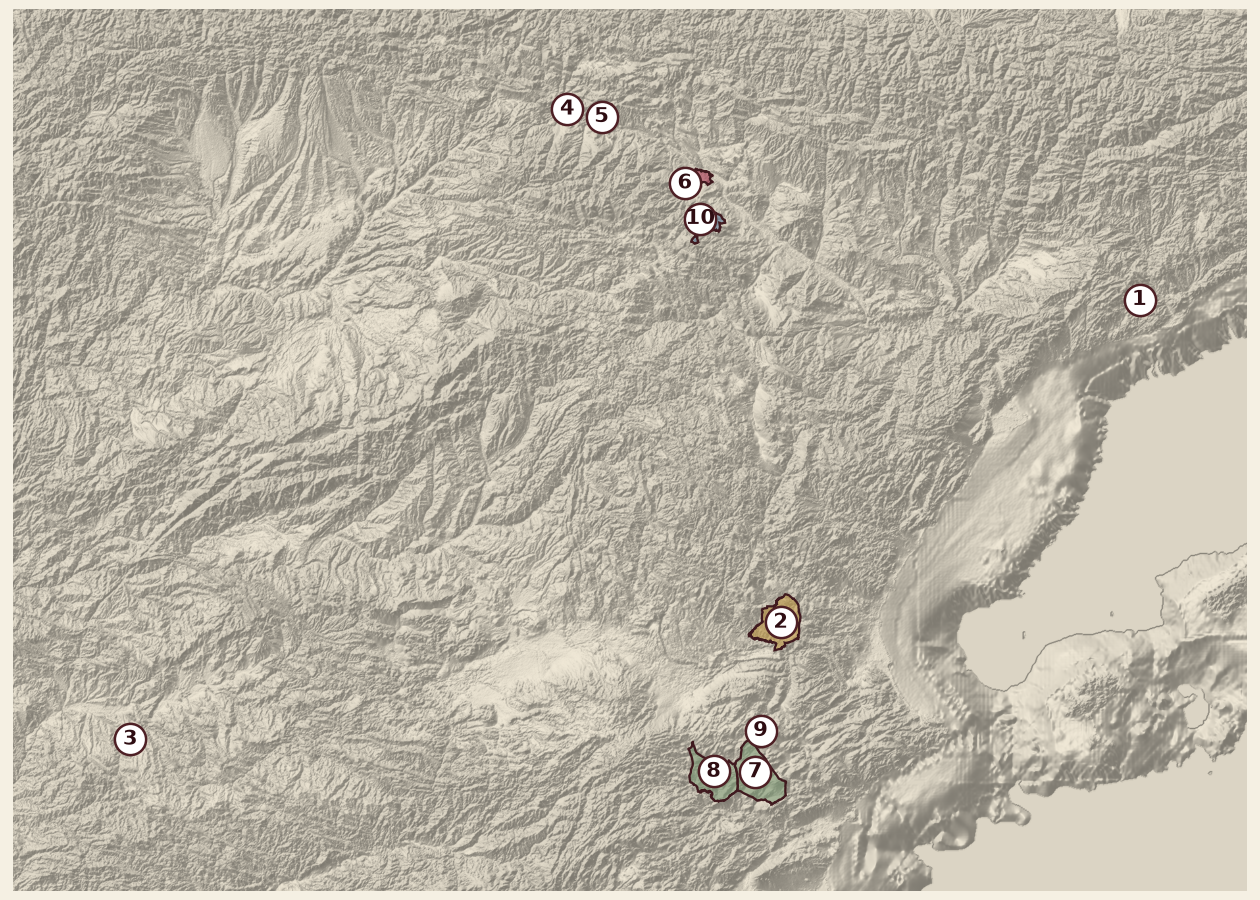
I quattro territori sovraregionali alla scala della penisola: è la distanza fra i punti a spiegare che cosa significa «sovraregionale».The four cross-regional territories at peninsular scale: the distance between the pins is what «cross-regional» actually means.
- 1 Sant Sadurní d'Anoia
- 2 Requena
- 3 Almendralejo
- 4 Haro
- 5 Laguardia
- 6 Alfaro
- 7 Jumilla
- 8 Hellín
- 9 Montealegre del Castillo
- 10 Tarazona
Zone e sottozoneZones and subzones
I vitigni del territorioThe grapes of the territory
Le denominazioniThe denominations
A tavolaAt the table
La tavola qui non è una sola, e si vede. Con il Cava Brut Nature, secco e senza zucchero aggiunto, funzionano il pesce fritto e le crocchette: la bollicina e l'acidità ripuliscono la bocca dopo il fritto e fanno tornare la voglia del boccone successivo. A quel repertorio — tapas fritte, paella, gazpacho — abbiamo dedicato Tapas, paella e gazpacho. Sulla paella di mare e sui gamberi alla piastra sta bene un Cava Reserva, che ha passato più tempo sui lieviti e aggiunge le note di crosta di pane senza coprire il crostaceo.There is no single table here, and it shows. Brut Nature Cava — dry, with no added sugar — works with fried fish and croquettes: the bubbles and the acidity clear the palate after the fried bite and make you want the next one. That whole repertoire is the subject of Tapas, paella and gazpacho. With seafood paella and grilled prawns a Cava Reserva fits well: it has spent longer on the lees, adding bread-crust notes without covering the shellfish.
L'agnello arrostito lentamente è il piatto del Rioja: un Reserva a base Tempranillo, con tannino fine e sentori di rovere, risponde al succo che unge il boccone e lascia la bocca pulita. Lo stesso vale per le costine e per i peperoni ripieni di carne.Slow-roasted lamb is Rioja's dish: a Tempranillo-based Reserva, fine-grained and marked by oak, answers the juices that coat each mouthful and leaves the palate clean. The same goes for ribs and for peppers stuffed with meat.
A Jumilla si mangia più forte: stufati di carne, coniglio all'aglio, formaggi di pecora stagionati. La Monastrell dà vini caldi e di frutto scuro, tannici, che chiedono piatti saporiti e sostanziosi, di quelli che lasciano il boccone succoso. Sui rossi del Queiles, balsamici e di frutto nero, il produttore suggerisce l'arrosto d'agnello e i legumi per il vino più strutturato, gli stufati e le carni bianche per quello d'entrata: abbinamenti di casa, di quelli che funzionano perché nascono nello stesso posto.In Jumilla the cooking is louder: meat stews, rabbit with garlic, aged sheep's cheeses. Monastrell gives warm, dark-fruited wines with firm tannins that call for savoury, substantial dishes, the kind that leave each mouthful juicy. With the balsamic, dark-fruited reds of the Queiles the producer suggests roast lamb and pulses for the more structured wine, stews and white meats for the entry-level one: local pairings, the kind that work because they were born in the same place.
La storiaHistory
Nel 1872, a Sant Sadurní d'Anoia, alcune famiglie di viticoltori misero in bottiglia i primi spumanti fatti con la seconda fermentazione in bottiglia. Le bottiglie riposavano in grotte scavate sotto le case — le cave, in catalano — dove l'umidità era giusta e la temperatura restava fresca e costante tutto l'anno. Con il tempo il nome del luogo passò al vino, e il vino si chiamò cava.In 1872, in Sant Sadurní d'Anoia, a few grower families bottled the first sparkling wines made with a second fermentation in the bottle. The bottles rested in cellars dug beneath the houses — caves, in Catalan — where the humidity was right and the temperature stayed cool and steady all year. In time the name of the place passed to the wine, and the wine came to be called cava.
Quindici anni dopo la fillossera arrivò nel Penedès e cancellò i vigneti. Chi ripiantò scelse in molti casi le uve bianche locali al posto delle rosse, e quella decisione — presa per necessità — diede allo spumante catalano le tre varietà che ancora oggi ne fanno l'ossatura: Macabeo, Xarel·lo, Parellada. Il metodo, intanto, viaggiava con le famiglie e con i loro affari: dove c'erano parenti, cantine e ferrovia, si cominciava a produrre bollicine. Alla metà del Novecento si faceva spumante nel Penedès, ma anche sull'Ebro, in Estremadura, a Requena.Fifteen years later phylloxera reached the Penedès and wiped out the vineyards. Many of those who replanted chose local white grapes instead of red ones, and that decision — taken out of necessity — gave Catalan sparkling wine the three varieties that still form its backbone: Macabeo, Xarel·lo, Parellada. Meanwhile the method travelled with the families and their business: wherever there were relatives, cellars and a railway, bubbles began to be made. By the mid-twentieth century sparkling wine was being produced in the Penedès, but also on the Ebro, in Extremadura, in Requena.
La parola cava comparve per la prima volta in un documento ufficiale nel 1959; nel 1972 nacque il Consejo Regulador de los Vinos Espumosos e il nome fu adottato per lo spumante spagnolo. Il passo decisivo arrivò però nel 1986, l'anno dell'ingresso della Spagna nella Comunità europea: l'ordine ministeriale del 27 febbraio riservò la denominazione «Cava» agli spumanti di qualità elaborati con il metodo tradizionale e delimitò quella che il testo chiamava la Región Determinada del Cava. Fu allora che accadde la cosa curiosa: dovendo mettere su carta un territorio, l'amministrazione non poté disegnare un cerchio attorno a una collina. Dovette scrivere un elenco — comune per comune, provincia per provincia — dei posti dove quelle bottiglie si facevano già. Oggi quell'elenco conta 157 comuni in dieci province e sette comunità autonome, dalla costa di Barcellona ad Almendralejo.The word cava first appeared in an official document in 1959; in 1972 the Consejo Regulador de los Vinos Espumosos was founded and the name was adopted for Spanish sparkling wine. The decisive step, however, came in 1986, the year Spain joined the European Community: the ministerial order of 27 February reserved the name «Cava» for quality sparkling wines made by the traditional method and delimited what the text called the Región Determinada del Cava. That is when the curious thing happened: having to put a territory on paper, the administration could not draw a circle around a hill. It had to write a list — municipality by municipality, province by province — of the places where those bottles were already being made. Today that list runs to 157 municipalities in ten provinces and seven autonomous communities, from the Barcelona coast to Almendralejo.
La storia non è finita nel 1986. Nel 2020 il Consejo Regulador ha approvato la zonizzazione che ha diviso il Cava in quattro zone e sette sottozone; e Requena, il comune della provincia di Valencia che una prima decisione aveva lasciato fuori, vi è entrato come quarta zona solo dopo una sentenza del Tribunal Superior de Justicia de Madrid del 2022, recepita nella modifica del disciplinare pubblicata nel 2024. Trentotto anni dopo, la mappa di una denominazione senza mappa si stava ancora scrivendo — in tribunale.The story did not end in 1986. In 2020 the Consejo Regulador approved the zoning that divided Cava into four zones and seven subzones; and Requena, the Valencian municipality left out by an earlier decision, joined as the fourth zone only after a 2022 ruling of the Tribunal Superior de Justicia de Madrid, carried into the amendment of the specification published in 2024. Thirty-eight years on, the map of a denomination without a map was still being written — in court.
Numeri e denominazioni provengono da fonti ufficiali: elenco MAPA delle DOP/IGP di vini registrate nell'UE (2 luglio 2026), Informe DOPs e Informe IGPs 2023/2024 del MAPA, documento unico della DOP Cava pubblicato nella Gazzetta ufficiale dell'Unione europea, disciplinari di Jumilla e Ribera del Queiles, legge spagnola 6/2015 sulle DOP e IGP di ambito sovraregionale. «Spagna sovraregionale» non è una regione vitivinicola: è la categoria con cui l'amministrazione spagnola raggruppa le denominazioni che attraversano più di una comunità autonoma, ed è il criterio con cui questa scheda le racconta insieme. Le note sui vini descrivono il profilo tipico di ciascuna denominazione, non una specifica annata.Figures and denominations come from official sources: MAPA's list of wine PDOs/PGIs registered in the EU (2 July 2026), MAPA's Informe DOPs and Informe IGPs 2023/2024, the single document of PDO Cava published in the Official Journal of the European Union, the specifications of Jumilla and Ribera del Queiles, and Spanish law 6/2015 on cross-regional PDOs and PGIs. «Cross-regional Spain» is not a wine region: it is the category the Spanish administration uses to group denominations spanning more than one autonomous community, and it is the criterion by which this page tells their story together. Tasting notes describe the typical profile of each denomination, not a specific vintage.