Sulle due rive dell'Ebro, riparata a nord dalla Sierra de Cantabria, la Rioja è tra le denominazioni più note di Spagna. Non è un mosaico di tante denominazioni di origine, ma un'unica grande DOCa letta su tre zone, con una cultura del tempo — quella della barrica e del lungo affinamento — nata da un dialogo antico con Bordeaux.On both banks of the Ebro, sheltered to the north by the Sierra de Cantabria, Rioja is among the best-known wine names of Spain. It is not a mosaic of many appellations of origin but a single great DOCa read across three zones, with a culture of time — of the barrel and long ageing — born of an old dialogue with Bordeaux.
Il territorioThe territory
La terraThe land
Il filo conduttore è l'Ebro, che scorre verso sud-est e disegna tre anime climatiche. A ovest, Rioja Alta e Rioja Alavesa stanno in quota e risentono dell'influenza atlantica: clima più fresco, suoli argillo-calcarei e ferrosi. A est, Rioja Oriental scende verso il Mediterraneo, più calda e secca, con terreni alluvionali ricchi di ferro. La Sierra de Cantabria fa da muro ai venti freddi del nord.The thread is the Ebro, flowing south-east and shaping three climatic souls. To the west, Rioja Alta and Rioja Alavesa sit at altitude and feel the Atlantic influence: a cooler climate, clay-limestone and iron-rich soils. To the east, Rioja Oriental drops towards the Mediterranean, warmer and drier, with iron-rich alluvial ground. The Sierra de Cantabria walls off the cold northern winds.
Il vitignoThe grape
L'anima è il Tempranillo — non per obbligo di legge, ma per scelta e tradizione — affiancato da Garnacha, Graciano e Mazuelo, che danno colore, struttura e spina dorsale. Tra i bianchi domina la Viura (Macabeo), con Malvasía e Tempranillo Blanco.The soul is Tempranillo — not by law, but by choice and tradition — joined by Garnacha, Graciano and Mazuelo, which lend colour, structure and backbone. Among the whites Viura (Macabeo) leads, with Malvasía and Tempranillo Blanco.
L'uomoThe human hand
La firma è il tempo: la cultura della barrica e del lungo affinamento, eredità del dialogo ottocentesco con Bordeaux. Da qui le menzioni Crianza, Reserva e Gran Reserva, che fissano per legge i mesi nel legno e in bottiglia prima dell'uscita.The signature is time: the culture of the barrel and long ageing, an inheritance of the 19th-century dialogue with Bordeaux. Hence the mentions Crianza, Reserva and Gran Reserva, which set by law the months in oak and in bottle before release.
La mappaThe map
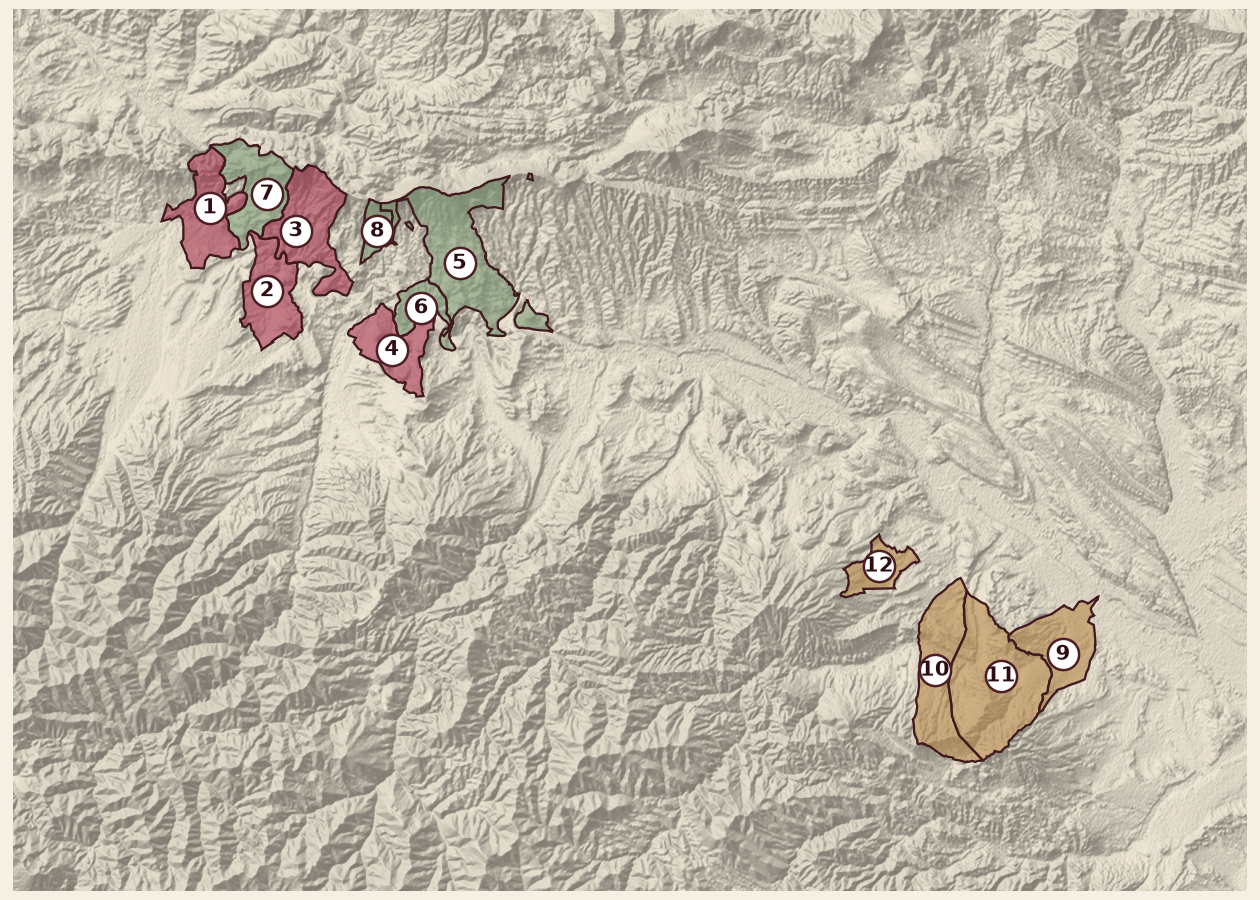
Le tre zone della DOCa Rioja lungo la valle dell'Ebro, con alcuni dei paesi del vino.The three zones of DOCa Rioja along the Ebro valley, with some of the wine villages.
- 1 Haro
- 2 Briones
- 3 San Vicente de la Sonsierra
- 4 Cenicero
- 5 Laguardia
- 6 Elciego
- 7 Labastida
- 8 Samaniego
- 9 Aldeanueva de Ebro
- 10 Quel
- 11 Autol
- 12 Tudelilla
Zone e sottozoneZones and subzones
I vitigni del territorioThe grapes of the territory
Le denominazioniThe denominations
A tavolaAt the table
La cucina riojana è fatta di carni alla brace, patate in umido e verdure dell'orto, e trova un vino per ogni piatto. Le chuletillas al sarmiento — costolette d'agnello grigliate sui tralci di vite, con una nota affumicata — chiedono un Reserva dal tannino vellutato e dalla buona freschezza. Le patatas a la riojana, patate stufate con chorizo e paprika, leggermente piccanti, si accompagnano a un Crianza fruttato e di media struttura. La menestra de verduras, tenera e delicata, preferisce un bianco di Viura, fresco e dal sorso pulito. E l'agnello arrosto, ricco e succoso, si accompagna bene a un Gran Reserva, morbido, persistente e segnato dal lungo legno.Riojan cooking is built on grilled meat, stewed potatoes and garden vegetables, and it finds a wine for every dish. Chuletillas al sarmiento — lamb chops grilled over vine shoots, with a smoky note — sit well with a Reserva of velvety tannin and good freshness. Patatas a la riojana, potatoes stewed with chorizo and paprika, mildly spicy, go with a fruity Crianza of medium structure. The menestra de verduras, tender and delicate, prefers a Viura white, fresh and clean on the palate. And roast lamb, rich and juicy, goes well with a Gran Reserva, supple, persistent and marked by long oak.
La storiaHistory
La Rioja moderna nasce da una sventura altrui. Dalla fine degli anni 1860 la fillossera devasta i vigneti di Bordeaux: i négociants francesi, rimasti senza vino da vendere al mercato inglese, varcano i Pirenei e scoprono la valle dell'Ebro. Trovano un terreno già pronto. Due nobili lungimiranti avevano cominciato a guardare a nord: Luciano de Murrieta, marchese di Murrieta, che nel 1852 firma a Logroño i primi vini affinati alla maniera bordolese e più tardi porta la sua bodega nella tenuta di Ygay; e Camilo Hurtado de Amézaga, marchese di Riscal, che nel 1858 fonda la sua cantina a Elciego, in Rioja Alavesa, e si affida al tecnico francese Jean Pineau, formatosi allo Château Lanessan, che insegna la barrica e il metodo bordolese. È l'incontro che cambia tutto: ai vini rustici e di pronta beva si sostituiscono rossi capaci di reggere il legno e i lunghi viaggi per mare. Quando la ferrovia raggiunge Haro, nel 1863, attorno alla stazione nasce il Barrio de la Estación: López de Heredia vi si insedia nel 1877, seguita da una schiera di cantine storiche — La Rioja Alta e CVNE — e, molto più tardi, dalla Muga, che vi si trasferisce nel 1970. Oggi il quartiere riunisce alcune delle cantine più antiche della Rioja, e la barrica resta la firma della denominazione.Modern Rioja was born of someone else's misfortune. From the late 1860s phylloxera ravaged the vineyards of Bordeaux: French négociants, left with no wine to sell to the English market, crossed the Pyrenees and discovered the Ebro valley. They found ground already prepared. Two far-sighted noblemen had begun to look north: Luciano de Murrieta, Marqués de Murrieta, who in 1852 made at Logroño the first wines aged in the Bordeaux manner and later moved his bodega to the Ygay estate; and Camilo Hurtado de Amézaga, Marqués de Riscal, who in 1858 founded his winery at Elciego, in Rioja Alavesa, and turned to the French technician Jean Pineau, trained at Château Lanessan, who taught the barrel and the Bordeaux method. That encounter changed everything: rustic, drink-young wines gave way to reds able to take oak and long sea voyages. When the railway reached Haro, in 1863, the Barrio de la Estación grew up around the station: López de Heredia settled there in 1877, followed by a line of historic houses — La Rioja Alta and CVNE — and, much later, by Muga, which moved there in 1970. Today the district brings together some of Rioja's oldest wineries, and the barrel remains the appellation's signature.
Profilo caratteristico e ricorrente del territorio, non la degustazione di una specifica annata o cantina.A characteristic, recurring profile of the territory, not the tasting of a specific vintage or winery.