Mendoza è la provincia con la maggior superficie vitata dell'Argentina: 140.682 ettari, il 71,7% del vigneto nazionale, secondo l'Instituto Nacional de Vitivinicultura. Ma il numero racconta solo metà della storia. L'altra metà è che qui piove pochissimo, che la vite cresce fra i 430 e i 2.000 metri di quota, e che il vigneto storico esiste perché qualcuno, secoli fa, ha scavato un canale per portarci l'acqua di scioglimento delle Ande. Mendoza non è una pianura coltivata: è una serie di oasi separate dal deserto, e il Malbec è la cifra che le tiene insieme.Mendoza is the Argentine province with the largest vineyard area: 140,682 hectares, 71.7% of the national vineyard, according to the Instituto Nacional de Vitivinicultura. But the figure tells only half the story. The other half is that it rains very little here, that the vine grows between 430 and 2,000 metres, and that the historic vineyard exists because someone, centuries ago, dug a channel to bring it the meltwater of the Andes. Mendoza is not a cultivated plain: it is a series of oases separated by desert, and Malbec is the thread that holds them together.
Il territorioThe territory
La terraThe land
È un deserto d'altura. La media delle piogge è di 220 millimetri l'anno — circa un quarto di quelle di Bordeaux — e la vite vive di irrigazione, dai canali storici scavati sui corsi del Río Mendoza e del Río Tunuyán al goccia a goccia delle piantagioni recenti. I suoli sono conoidi alluvionali: ciottoli, sabbie e sedimenti scesi dalla cordigliera, spesso rivestiti da carbonato di calcio. Salendo di quota l'aria si raffredda e l'escursione fra giorno e notte si allarga: è questo, più della latitudine, a decidere il carattere dei vini.It is a high-altitude desert. Average rainfall is 220 millimetres a year — about a quarter of Bordeaux's — and the vine lives on irrigation, from the historic channels cut along the Río Mendoza and Río Tunuyán to the drip lines of recent plantings. The soils are alluvial fans: pebbles, sands and sediments carried down from the cordillera, often coated in calcium carbonate. As you climb, the air cools and the day-night swing widens: this, more than latitude, decides the character of the wines.
Il vitignoThe grape
Il Malbec è la varietà più coltivata della provincia, con il 28,3% della superficie. Arrivato dalla Francia a metà Ottocento, in Argentina ha trovato luce intensa, notti fredde e assenza di pioggia in vendemmia, e ha cambiato indole — grappoli più piccoli, tannino più fitto, frutto più maturo. Accanto crescono Bonarda, Cabernet Sauvignon, Syrah e un Cabernet Franc in forte espansione; fra i bianchi Chardonnay, Semillon, Chenin Blanc e Torrontés Riojano. Le uve a bacca nera valgono il 65,0% del vigneto da vino.Malbec is the province's most planted variety, at 28.3% of the area. It arrived from France in the mid-nineteenth century and in Argentina it found intense light, cold nights and no rain at harvest, and changed its nature — smaller bunches, denser tannin, riper fruit. Alongside grow Bonarda, Cabernet Sauvignon, Syrah and a fast-expanding Cabernet Franc; among the whites Chardonnay, Semillon, Chenin Blanc and Torrontés Riojano. Black-skinned grapes account for 65.0% of the wine vineyard.
L'uomoThe human hand
Tutto qui è costruito. L'acqua è amministrata da un sistema di turni e diritti che risale all'epoca coloniale e regge ancora oggi il disegno delle oasi. Il vigneto è passato dal parral, la pergola alta che protegge i grappoli dal sole, alla spalliera: oggi il 58,9% della superficie è allevato a spalliera e il 39,9% a parral. E il paesaggio è giovane: il 54,8% delle viti mendocine è stato piantato dopo il 2000, quando l'irrigazione in pressione permise di spingere il vigneto oltre i mille metri, in terre che nessuno aveva mai coltivato.Everything here is built. Water is administered by a system of turns and rights dating back to colonial times, and it still shapes the oases today. The vineyard has moved from the parral, the high pergola that shields bunches from the sun, to the trellis: today 58.9% of the area is trained to trellis and 39.9% to parral. And the landscape is young: 54.8% of Mendoza's vines were planted after 2000, when pressurised irrigation made it possible to push the vineyard above a thousand metres, onto land nobody had ever farmed.
La mappaThe map
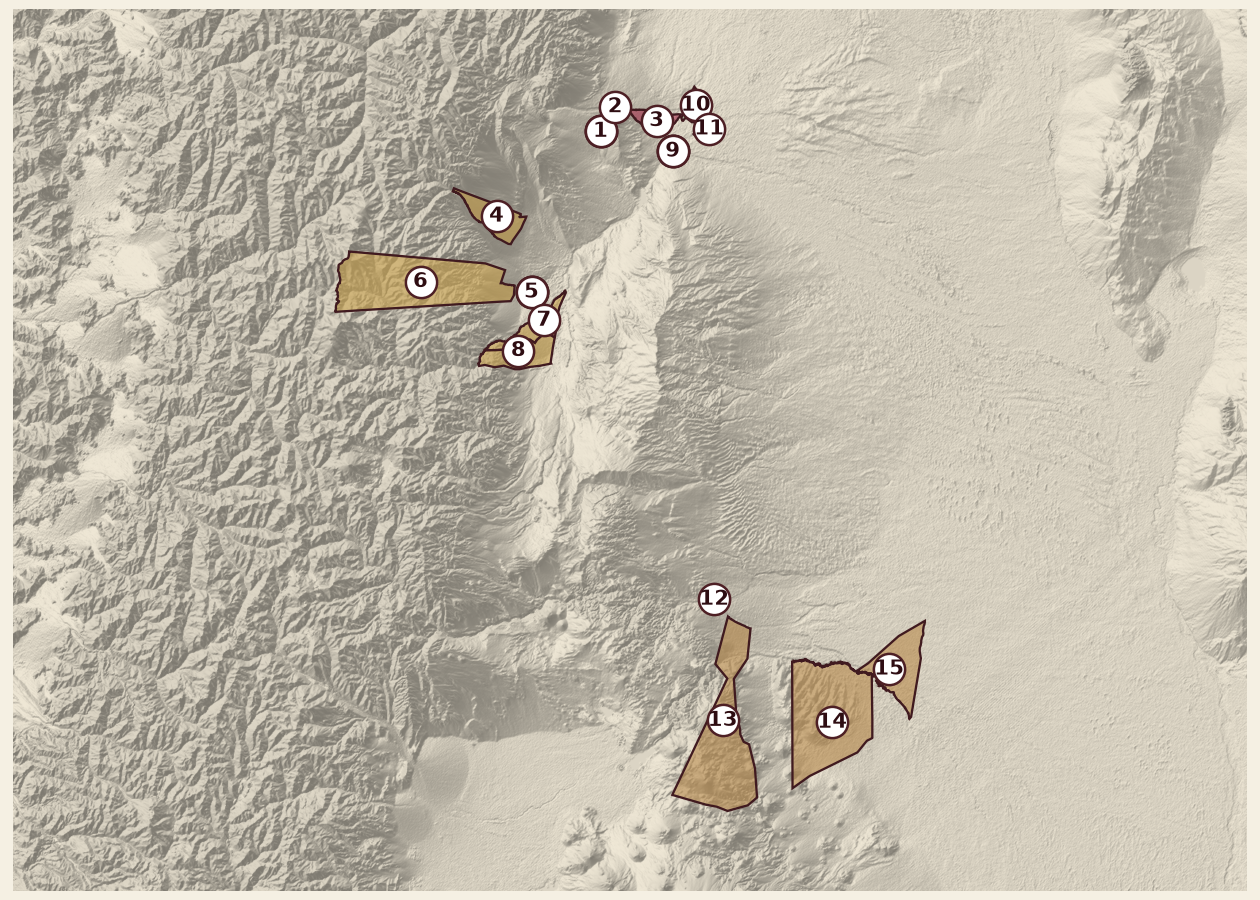
Le oasi vitivinicole di Mendoza fra deserto e cordigliera: quattro distretti di lettura e quindici comuni e distretti reali.Mendoza's wine oases between desert and cordillera: four reading districts and fifteen real towns and districts.
- 1 Agrelo
- 2 Lunlunta
- 3 Barrancas
- 4 Gualtallary
- 5 Vista Flores
- 6 Los Chacayes
- 7 La Consulta
- 8 Eugenio Bustos
- 9 Medrano
- 10 Palmira
- 11 La Colonia
- 12 Las Paredes
- 13 Rama Caída
- 14 Villa Atuel
- 15 Real del Padre
Zone e sottozoneZones and subzones
I vitigni del territorioThe grapes of the territory
Le denominazioniThe denominations
A tavolaAt the table
La cucina mendocina è cucina di fuoco e di orto. L'asado non è un piatto ma un modo di stare a tavola: la carne va sulla brace intera e si taglia via via, e il Malbec di Luján de Cuyo — frutto scuro, tannino maturo, corpo saldo — asciuga il boccone succoso della costola senza coprire l'affumicato.Mendoza's cooking is a cooking of fire and vegetable garden. The asado is not a dish but a way of sitting at table: the meat goes whole onto the embers and is carved as it cooks, and Malbec from Luján de Cuyo — dark fruit, ripe tannin, firm body — dries the juicy bite of the rib without covering the smoke.
Le empanadas mendocine si distinguono per il ripieno abbondante di cipolla e più succoso che altrove, spesso cotto nel forno di argilla. Un Bonarda o un Malbec giovane del quadrante orientale, meno legnoso e più fruttato, sta bene con la pasta sfoglia e la carne tagliata al coltello.Mendoza's empanadas stand out for their generous onion filling, juicier than elsewhere, often baked in a clay oven. A Bonarda or a young Malbec from the eastern quadrant, less oaky and more fruit-driven, suits the pastry and the knife-cut beef.
Dal sud della provincia arriva il chivito, il capretto di Malargüe cotto lentamente alla brace o allo spiedo aperto: carne magra, saporita, delicata. Qui funziona meglio un rosso di quota — un Malbec del Valle de Uco, teso e verticale — che asseconda la finezza della carne invece di sovrastarla.From the south of the province comes chivito, Malargüe kid goat cooked slowly over embers or on an open spit: lean, flavourful, delicate meat. Here a high-altitude red works better — a Malbec from the Uco Valley, taut and vertical — following the fineness of the meat rather than overwhelming it.
Sul versante degli orti restano l'humita en chala, crema di mais fresco cotta nelle sue stesse brattee, e il locro, la zuppa densa di mais, fagioli e carne che si cucina d'inverno. Sono piatti morbidi, dal sapore dolce del mais: chiedono la freschezza di un Chardonnay del Valle de Uco o di un Torrontés, o le bollicine di uno spumante metodo tradizionale mendocino, che ripuliscono il palato fra un cucchiaio e l'altro.On the garden side there remain humita en chala, a cream of fresh corn cooked in its own husks, and locro, the thick winter soup of corn, beans and meat. These are soft dishes with the sweetness of corn: they ask for the freshness of an Uco Valley Chardonnay or a Torrontés, or the bubbles of a Mendoza traditional-method sparkling wine, which clean the palate between one spoonful and the next.
La storiaHistory
A metà Ottocento Domingo Faustino Sarmiento — futuro presidente della Repubblica, allora scrittore ed esule in Cile — aveva un'idea fissa: l'Argentina non sarebbe cresciuta senza agricoltura moderna, e l'agricoltura moderna non si improvvisa, si insegna. Serviva una scuola, e serviva qualcuno che avesse imparato il mestiere altrove.In the mid-nineteenth century Domingo Faustino Sarmiento — future president of the Republic, then a writer in exile in Chile — had one fixed idea: Argentina would not grow without modern agriculture, and modern agriculture cannot be improvised, it has to be taught. A school was needed, and someone who had learned the trade elsewhere.
Quel qualcuno lo trovò in Cile. Michel Aimé Pouget, nato a Tours nel 1821, era un agronomo francese che in Cile coltivava un podere di viti e alberi da frutto ed era stato messo a capo della Quinta Normal di Santiago: conosceva le viti europee, le sapeva propagare e sapeva farle attecchire in un clima secco. Con l'appoggio del governatore di Mendoza, Pedro Pascual Segura, il progetto per fondare una Quinta Normal e una Escuela de Agricultura — un podere-scuola con vivaio annesso — fu presentato alla Legislatura provinciale il 17 aprile 1853 e approvato come legge dalla Camera dei Rappresentanti il 6 settembre dello stesso anno.He found that someone in Chile. Michel Aimé Pouget, born in Tours in 1821, was a French agronomist who farmed an estate of vines and fruit trees in Chile and had been put in charge of the Quinta Normal of Santiago: he knew European vines, knew how to propagate them and how to make them take in a dry climate. With the support of Mendoza's governor, Pedro Pascual Segura, the project to found a Quinta Normal and an Escuela de Agricultura — a teaching estate with an attached nursery — was presented to the provincial Legislature on 17 April 1853 and passed into law by the Chamber of Representatives on 6 September of the same year.
Pouget accettò di dirigere la nuova scuola mendocina e arrivò dal Cile con un'ampia collezione di piante e semi che il governo cileno gli consegnò perché la portasse a Mendoza; fra le viti c'erano varietà francesi che lì nessuno aveva mai visto, e fra queste il Malbec, l'uva scura del Sud-Ovest francese, quella di Cahors.Pouget agreed to head the new Mendoza school and arrived from Chile with a wide collection of plants and seeds that the Chilean government handed him to take to Mendoza; among the vines were French varieties nobody there had ever seen, and among them Malbec, the dark grape of south-west France, the grape of Cahors.
A Mendoza trovò l'esatto contrario di casa: sole intenso, notti fredde, nessuna pioggia in vendemmia, acqua solo quando gliela si dava. Il Malbec smise di essere l'uva che stenta e diventò l'uva che riesce. Ci vollero però altri centoquarant'anni perché qualcuno lo prendesse sul serio: fino agli anni Ottanta il Malbec mendocino era soprattutto materia prima da taglio, e migliaia di ettari furono espiantati quando i consumi interni crollarono. La riconversione degli anni Novanta lo riportò al centro, questa volta con rese basse, spalliera e vigneti d'altura.In Mendoza it found the exact opposite of home: intense sun, cold nights, no rain at harvest, water only when it was given. Malbec stopped being the grape that struggles and became the grape that succeeds. It took another hundred and forty years, though, for anyone to take it seriously: until the 1980s Mendoza Malbec was mostly blending material, and thousands of hectares were pulled up when domestic consumption collapsed. The reconversion of the 1990s put it back at the centre, this time with low yields, trellising and high-altitude vineyards.
Oggi il 17 aprile — la data della presentazione di quel progetto alla Legislatura di Mendoza — si celebra come Malbec World Day. Non è l'anniversario di una legge né di una vendemmia: è la data in cui una provincia desertica decise di imparare a coltivare, e per farlo chiamò un francese con una cassa di talee.Today 17 April — the date that project was presented to Mendoza's Legislature — is celebrated as Malbec World Day. It is not the anniversary of a law or of a harvest: it is the date on which a desert province decided to learn how to farm, and to do so called in a Frenchman with a crate of cuttings.
Conteggi e denominazioni vengono dal registro dell'Instituto Nacional de Vitivinicultura; i dati di superficie, di vitigno e di allevamento dall'Informe Anual de Superficie 2025 dell'INV, con base al 31 dicembre 2025. Altitudini, piovosità e temperature medie sono quelle pubblicate da Wines of Argentina su dati INV. Niente punteggi, premi o classifiche: le descrizioni sono profili di stile, non degustazioni di annata.Counts and denominations come from the register of the Instituto Nacional de Vitivinicultura; area, variety and training data from the INV's Informe Anual de Superficie 2025, based on 31 December 2025. Altitudes, rainfall and average temperatures are those published by Wines of Argentina on INV data. No scores, awards or rankings: the descriptions are style profiles, not vintage tastings.