È la regione più piccola d'Italia e quella che fa meno vino di tutte: il suo vigneto sta per intero in circa quattrocento ettari, il 95% dei quali su terreni di montagna e collina. Eppure in meno di novanta chilometri di valle, fra il confine piemontese e il Monte Bianco, tiene dentro una varietà che regioni cento volte più grandi non hanno. Una sola denominazione — Valle d'Aosta o Vallée d'Aoste DOC — che al suo interno si spezza in sette sottozone e in diciannove indicazioni di vitigno, e che sale con la vite fino a milleduecento metri, dove il Prié Blanc cresce ancora su piede franco perché lassù la fillossera non è mai arrivata. Qui il vino non si è mai fatto per il mercato: si è fatto perché una valle chiusa aveva bisogno del suo. Ed è per questo che, quando negli anni Cinquanta la viticoltura valdostana stava per sparire, a salvarla non fu un'azienda ma una scuola.It is Italy's smallest region and the one that makes the least wine of all: its entire vineyard fits into about four hundred hectares, 95% of them on mountain and hillside ground. And yet in under ninety kilometres of valley, between the Piedmont border and Mont Blanc, it holds a diversity that regions a hundred times bigger do not have. A single denomination — Valle d'Aosta or Vallée d'Aoste DOC — that breaks internally into seven subzones and nineteen varietal mentions, and that climbs with the vine to twelve hundred metres, where Prié Blanc still grows ungrafted because phylloxera never reached that high. Here wine was never made for the market: it was made because a closed valley needed its own. Which is why, when Valdostan viticulture was about to disappear in the 1950s, what saved it was not a company but a school.
Il territorioThe territory
La terraThe land
La Valle d'Aosta è un solco unico scavato dalla Dora Baltea fra le montagne più alte d'Europa, e la vite ci sta dentro come una striscia sottile appoggiata ai fianchi. Il disciplinare fotografa questa geometria meglio di qualunque descrizione: definisce la zona per quota, non per confini di paese — dall'alveo del fiume fino a 600, 700, 800, 850, 1.000 metri a seconda del tratto e del versante, e fino a 1.300 nell'ultimo pezzo di valle sopra La Salle. Sotto sta l'ombra e il freddo che ristagna, sopra comincia il bosco. Quello che resta in mezzo è l'adret, il fianco al sole: terrazze di pietra a secco, coni di deiezione ghiaiosi, morene, suoli sassosi e poverissimi che di giorno immagazzinano calore e di notte lo restituiscono alla vite. Il clima è endoalpino — asciutto, ventilato, con pochissime piogge e un'escursione fra giorno e notte che poche zone d'Italia conoscono: è quella che tiene l'acidità dentro uve maturate a fatica. Il Consorzio Vini Valle d'Aosta, costituito nel 2022, riunisce quarantotto aziende che rappresentano circa il 97% della produzione regionale a denominazione: un vigneto piccolo, e molto compatto.The Aosta Valley is a single trench carved by the Dora Baltea among the highest mountains in Europe, and the vine sits inside it as a thin strip laid against the flanks. The production rules capture this geometry better than any description: they define the zone by altitude, not by parish boundaries — from the riverbed up to 600, 700, 800, 850, 1,000 metres depending on the stretch and the side, and up to 1,300 in the last piece of valley above La Salle. Below lies the shade and the cold that pools there; above, the forest begins. What remains in between is the adret, the sunny flank: dry-stone terraces, gravelly alluvial fans, moraines, stony and very poor soils that store heat by day and give it back to the vine at night. The climate is endo-alpine — dry, windy, with very little rain and a day-night swing few Italian areas know: it is what keeps the acidity inside grapes that ripen with effort. The Consorzio Vini Valle d'Aosta, set up in 2022, brings together forty-eight estates accounting for around 97% of the region's appellation wine: a small vineyard, and a very tight-knit one.
Il vitignoThe grape
Diciannove indicazioni di vitigno per quattrocento ettari: è una delle densità ampelografiche più alte d'Italia, e cinque di esse al mondo esistono solo qui. Il Petit Rouge è la spina dorsale dei rossi di mezza valle — è lui, per disciplinare, la base di Torrette, Enfer d'Arvier e Chambave. Accanto stanno il Fumin, tannico e serbevole, il Cornalin, il Vuillermin, il Mayolet, il Vien de Nus e la Prëmetta (o Prié Rouge), a buccia sottilissima. Nei bianchi comanda il Prié Blanc, unico autoctono a bacca bianca della regione, coltivato a Morgex e La Salle su pergole bassissime sorrette da pilastri monolitici di pietra — un sistema nato per difendere i tralci dal vento e dal gelo, e per rubare calore al terreno sassoso. La Petite Arvine, arrivata dal Vallese svizzero negli anni Sessanta, è diventata in due generazioni il bianco d'identità della valle. E poi ci sono le uve che nella Valle hanno trovato casa senza esserci nate: Nebbiolo (qui Picotendro) in bassa valle, Pinot Grigio che a Nus si chiama Malvoisie, Moscato bianco che a Chambave diventa Muscat, Chardonnay, Gamay, Pinot Nero, Syrah. Alle quote e ai vitigni della denominazione abbiamo dedicato una guida a parte: Valle d'Aosta DOC, i vini d'alta quota.Nineteen varietal mentions for four hundred hectares: it is one of the highest ampelographic densities in Italy, and five of them exist nowhere else on earth. Petit Rouge is the backbone of the mid-valley reds — under the production rules it is the base of Torrette, Enfer d'Arvier and Chambave. Beside it stand Fumin, tannic and long-lived, Cornalin, Vuillermin, Mayolet, Vien de Nus and Prëmetta (or Prié Rouge), with its paper-thin skin. Among the whites, Prié Blanc rules — the region's only native white grape, grown at Morgex and La Salle on very low pergolas held up by monolithic stone pillars, a system built to shield the canes from wind and frost and to steal heat from the stony ground. Petite Arvine, brought over from the Swiss Valais in the 1960s, has become in two generations the valley's signature white. Then come the grapes that found a home here without being born here: Nebbiolo (locally Picotendro) in the lower valley, Pinot Gris which at Nus is called Malvoisie, Moscato bianco which at Chambave becomes Muscat, Chardonnay, Gamay, Pinot Noir, Syrah. We devoted a separate guide to the appellation's altitudes and grapes: Valle d'Aosta DOC, high-altitude wines.
L'uomoThe human hand
Poche regioni italiane devono la propria viticoltura moderna a una singola istituzione quanto la Valle d'Aosta all'Institut Agricole Régional di Aosta, nato nel 1951 come École pratique d'agriculture quando la Regione ne affidò la fondazione ai Canonici del Gran San Bernardo. È da lì che sono usciti i viticoltori, le selezioni delle uve autoctone recuperate nei vigneti vecchi e i vitigni che oggi paiono da sempre valdostani. L'altra metà del lavoro l'hanno fatta le cooperative: la Cave des Onze Communes, La Crotta di Vegneron a Chambave, le Caves Coopératives de Donnas, la Cave Mont Blanc a Morgex — nate fra gli anni Settanta e Ottanta per rimettere insieme centinaia di micro-appezzamenti che da soli non avrebbero mai fatto una bottiglia. Perché è questa la vera cifra della valle: si vendemmia a mano su terrazze dove non sale nessun mezzo, e l'unità produttiva media si misura in filari, non in ettari.Few Italian regions owe their modern viticulture to a single institution as much as the Aosta Valley owes it to the Institut Agricole Régional in Aosta, founded in 1951 as the École pratique d'agriculture when the regional government entrusted its creation to the Canons of the Great St Bernard. That is where the growers came from, along with the selections of native grapes recovered in old vineyards and the varieties that today look as if they had always been Valdostan. The other half of the work was done by the cooperatives: Cave des Onze Communes, La Crotta di Vegneron at Chambave, Caves Coopératives de Donnas, Cave Mont Blanc at Morgex — founded between the 1970s and the 1980s to put back together hundreds of micro-plots that alone would never have made a bottle. Because that is the valley's real signature: harvesting is done by hand on terraces no machine can reach, and the average holding is measured in vine rows, not in hectares.
La mappaThe map
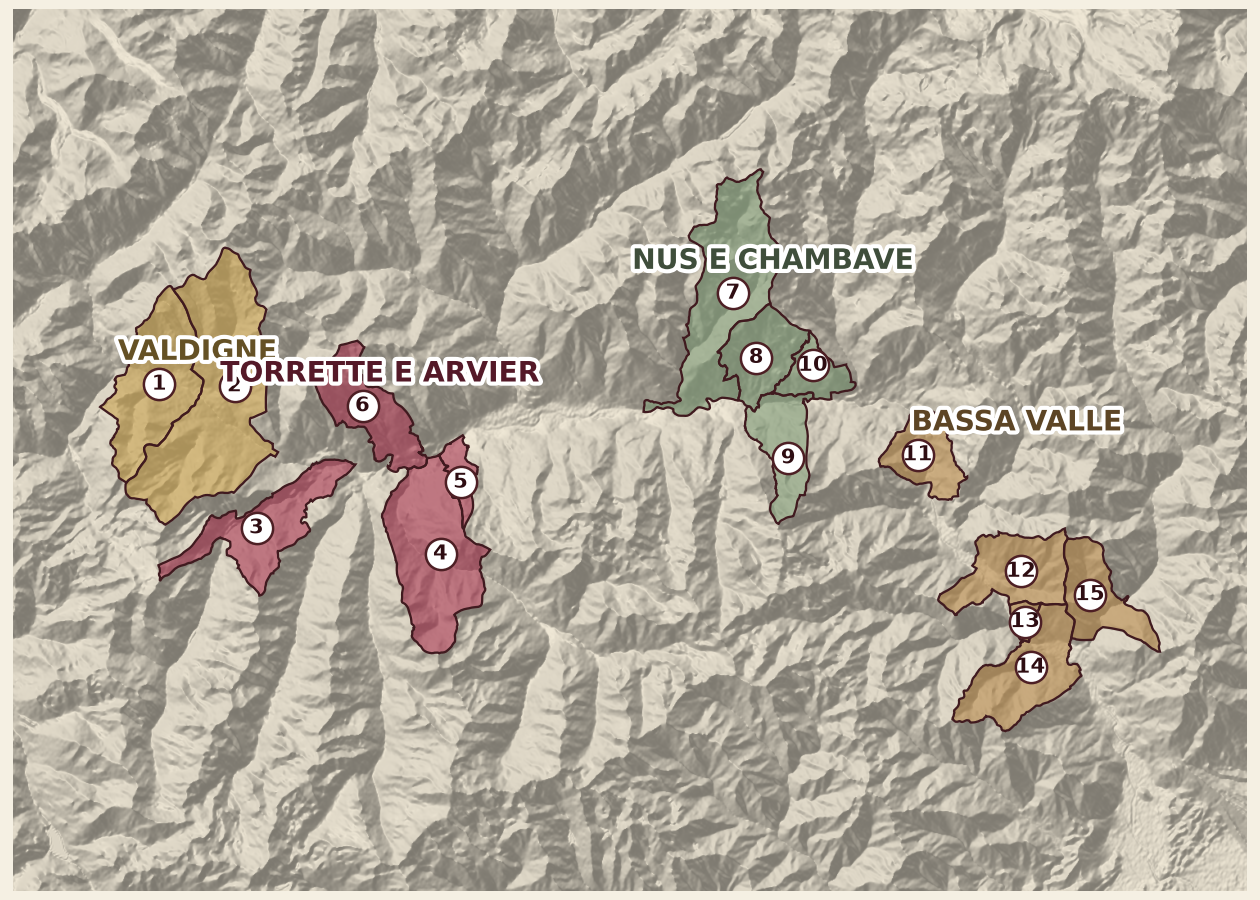
I quattro distretti del vigneto valdostano lungo la Dora Baltea, dal Monte Bianco al confine piemontese: i comuni colorati sono quelli citati nelle schede qui sotto.The four districts of the Valdostan vineyard along the Dora Baltea, from Mont Blanc to the Piedmont border: the coloured municipalities are those referred to in the sections below.
- 1 Morgex
- 2 La Salle
- 3 Arvier
- 4 Aymavilles
- 5 Jovençan
- 6 Saint-Pierre
- 7 Nus
- 8 Verrayes
- 9 Chambave
- 10 Saint-Denis
- 11 Montjovet
- 12 Arnad
- 13 Bard
- 14 Donnas
- 15 Perloz
Zone e sottozoneZones and subzones
I vitigni del territorioThe grapes of the territory
Le denominazioniThe denominations
A tavolaAt the table
La cucina valdostana nasce dal freddo e dalla conservazione, e ha un ingrediente che sta dentro quasi tutto: la Fontina DOP. La seupa à la vapelenentse — pane raffermo, cavolo verza, Fontina e brodo, gratinata al forno — è il piatto delle feste della Valpelline, nato povero e diventato solenne; chiede un rosso di media struttura e buona acidità che tagli il grasso, e il Torrette è la risposta di casa. Stessa logica per la polenta concia e per la fonduta: qui però un bianco alpino tesissimo funziona altrettanto bene, e il Blanc de Morgex et de La Salle, con la sua acidità, pulisce il palato boccone dopo boccone.Valdostan cooking is born of cold and of preserving, and it has one ingredient inside almost everything: Fontina PDO. The seupa à la vapelenentse — stale bread, savoy cabbage, Fontina and broth, gratinated in the oven — is the feast-day dish of the Valpelline, born poor and turned solemn; it asks for a medium-bodied red with good acidity to cut the fat, and Torrette is the local answer. The same logic applies to polenta concia and to fondue: here, though, a very taut alpine white works just as well, and Blanc de Morgex et de La Salle, with its acidity, cleans the palate bite after bite.
Sulla carbonada, manzo salato brasato lentamente nel vino, e sul civet di camoscio serve invece struttura e tannino: Fumin o un Donnas di qualche anno, che al Nebbiolo alpino aggiungono la nota balsamica giusta per la selvaggina. I salumi hanno ciascuno il proprio registro: il Jambon de Bosses DOP, profumato di erbe di montagna, e la mocetta vogliono un rosso leggero e floreale — la Prëmetta è fatta apposta —, mentre il Lard d'Arnad DOP, dolce e grasso, chiede una bollicina di montagna o la Petite Arvine, salina e agrumata.With carbonada, salted beef braised slowly in wine, and with civet of chamois, you need structure and tannin instead: Fumin, or a Donnas with a few years on it, which add to alpine Nebbiolo the balsamic note game meat wants. The cured meats each have their own register: Jambon de Bosses PDO, scented with mountain herbs, and mocetta call for a light, floral red — Prëmetta is made for the job — while Lard d'Arnad PDO, sweet and fat, asks for a mountain sparkling wine or for Petite Arvine, saline and citrussy.
In chiusura la Valle d'Aosta ha due dolci con due vini già scritti accanto: le tegole di nocciole e mandorle e la crema di Cogne vanno a nozze con il Chambave Muscat flétri o con il Nus Malvoisie flétri, passiti alpini che tengono insieme dolcezza e nervo. Alla fine arriva la coppa dell'amicizia col caffè alla valdostana — e lì il vino, giustamente, si mette da parte.To finish, the Aosta Valley has two desserts with two wines already written beside them: the hazelnut-and-almond tegole and the crema di Cogne are a perfect match for Chambave Muscat flétri or Nus Malvoisie flétri, alpine sweet wines that hold sweetness and nerve together. At the very end comes the coppa dell'amicizia with Valdostan coffee — and there, quite rightly, wine steps aside.
La storiaHistory
Il 20 maggio 1800 Napoleone Bonaparte arrivò al Colle del Gran San Bernardo alla testa di quarantamila uomini, accompagnato lungo la salita dai canonici Murith e Terrettaz. All'ospizio lo accolse il priore Berenfaller, che gli offrì un pasto modesto; la sera Napoleone dormì a Étroubles, il giorno dopo era ad Aosta, e più a valle l'Armata di Riserva si sarebbe impantanata per giorni sotto il forte di Bard, che resistette fino al 1° giugno. La memoria di quel passaggio è rimasta attaccata alla valle come poche altre: a Donnas, dove le cronache raccontano che Napoleone si fermò ad assaggiare il vino del posto, la cooperativa locale ha battezzato «Napoléon» una delle sue etichette di Nebbiolo. Ma la parte importante di questa storia non è il generale. Sono i canonici.On 20 May 1800 Napoleon Bonaparte reached the Great St Bernard Pass at the head of forty thousand men, escorted up the climb by canons Murith and Terrettaz. At the hospice he was received by prior Berenfaller, who offered him a modest meal; that evening Napoleon slept at Étroubles, the next day he was in Aosta, and further down the valley the Reserve Army would bog down for days beneath the fort of Bard, which held out until 1 June. The memory of that crossing stuck to the valley as few others have: at Donnas, where the chronicles say Napoleon stopped to taste the local wine, the village cooperative has named one of its Nebbiolo labels «Napoléon». But the important part of this story is not the general. It is the canons.
Centocinquantun anni dopo, nel 1951, la Giunta regionale della Valle d'Aosta si trovò davanti a un problema che non aveva niente di epico: l'agricoltura di montagna stava morendo, e con essa la viticoltura. I vigneti terrazzati venivano abbandonati perché rendevano meno di una giornata in fabbrica; le uve locali sparivano una dopo l'altra, e nessuno sapeva più nemmeno come si chiamassero. La Regione decise di affidare la fondazione e la gestione di una École pratique d'agriculture alla stessa istituzione che nel 1800 aveva rifocillato l'esercito francese: la Congregazione dei Canonici del Gran San Bernardo.A hundred and fifty-one years later, in 1951, the regional government of the Aosta Valley faced a problem with nothing epic about it: mountain farming was dying, and viticulture with it. Terraced vineyards were being abandoned because they paid less than a day in a factory; the local grapes were disappearing one after another, and nobody even remembered their names any more. The region decided to entrust the founding and running of an École pratique d'agriculture to the very institution that in 1800 had fed the French army: the Congregation of the Canons of the Great St Bernard.
L'uomo che quella scuola la fece diventare qualcos'altro si chiamava Joseph Vaudan. Nato il 15 aprile 1925 a Bagnes, nel Vallese svizzero, ordinato canonico all'ospizio del Gran San Bernardo nel 1954, si laureò in Scienze agrarie all'Università Cattolica con una tesi sulla flora microbica della Fontina — che è già un modo perfetto di dire chi era: un prete di montagna che studiava il formaggio al microscopio. Nel 1959 fu nominato direttore dell'École pratique. Nel 1969 vi costruì una cave expérimentale: una cantina sperimentale dentro una scuola agraria, in una regione che di vino ufficialmente ne faceva pochissimo. Fu quello il punto di partenza del rilancio della viticoltura e dell'enologia valdostane.The man who turned that school into something else was called Joseph Vaudan. Born on 15 April 1925 at Bagnes, in the Swiss Valais, ordained a canon at the Great St Bernard hospice in 1954, he took a degree in agricultural science at the Università Cattolica with a thesis on the microbial flora of Fontina — which is already a perfect way of saying who he was: a mountain priest who studied cheese under a microscope. In 1959 he was appointed director of the École pratique. In 1969 he built a cave expérimentale inside it: an experimental winery within an agricultural school, in a region that officially made almost no wine at all. That was the starting point for the relaunch of Valdostan viticulture and winemaking.
Vaudan fece due cose insieme. Portò in valle vitigni che ci potessero stare — Chardonnay, Müller Thurgau, Gamay, Pinot nero, Syrah, e soprattutto la Petite Arvine del suo Vallese natale, che oggi è il bianco d'identità della Valle d'Aosta e che praticamente nessuno, qui, ricorda come «importata». E, insieme, mandò l'Institut a cercare quello che c'era già: negli anni Settanta e Ottanta i tecnici della scuola batterono i vigneti vecchi e abbandonati della valle a raccogliere marze di uve senza nome, per selezionarle e rimetterle in coltivazione.Vaudan did two things at once. He brought into the valley varieties that could live there — Chardonnay, Müller Thurgau, Gamay, Pinot Noir, Syrah, and above all the Petite Arvine of his native Valais, which today is the signature white of the Aosta Valley and which practically nobody here remembers as «imported». And at the same time he sent the Institut looking for what was already there: through the 1970s and 1980s the school's technicians combed the valley's old and abandoned vineyards collecting cuttings of nameless grapes, to select them and put them back into cultivation.
La storia più bella di quel lavoro è quella di un'uva che per anni sulle schede dell'Institut si chiamava letteralmente «Inconnu», sconosciuta. Nessuno sapeva cosa fosse: la chiamavano Brot blanc, Corgnoula, Petit rouge, a seconda del paese. La teneva in vita solo il fatto che, come dicevano i vecchi, «dava un buon vino». Ci volle il lavoro del ricercatore dell'Institut Giulio Moriondo per darle un'identità e farla iscrivere al catalogo nazionale come Cornalin; e ci vollero le analisi genetiche del ricercatore José Vouillamoz per scoprire che il Cornalin vallesano ne era il genitore. Un'uva senza nome, tenuta in vita da qualche vecchio contadino che non aveva voglia di estirparla, oggi è una delle voci più riconoscibili del disciplinare valdostano.The finest story from that work is that of a grape which for years was listed on the Institut's records literally as «Inconnu», unknown. Nobody knew what it was: they called it Brot blanc, Corgnoula, Petit rouge, depending on the village. The only thing keeping it alive was that, as the old growers put it, «it made good wine». It took the work of the Institut's researcher Giulio Moriondo to give it an identity and have it registered in the national catalogue as Cornalin; and it took the genetic analyses of researcher José Vouillamoz to discover that the Valais Cornalin was its parent. A grape without a name, kept alive by some old farmer who could not be bothered to pull it out, is today one of the most recognisable entries in the Valdostan production rules.
Nel 1982 una legge regionale trasformò la scuola nella Fondazione Institut Agricole Régional, costituita dalla Casa Ospitaliera del Gran San Bernardo insieme alla Regione. Vaudan lasciò la direzione nel 1986 e morì il 28 marzo 2008 nella casa dei canonici a Martigny, pochi giorni prima di compiere 83 anni. La cantina dell'Institut oggi porta il suo nome: Cave Joseph Vaudan.In 1982 a regional law turned the school into the Institut Agricole Régional Foundation, set up by the Hospice of the Great St Bernard together with the region. Vaudan stepped down as director in 1986 and died on 28 March 2008 in the canons' house at Martigny, a few days short of his eighty-third birthday. The Institut's winery today bears his name: Cave Joseph Vaudan.
Conteggi e denominazioni da fonti ufficiali verificate e archiviate: MASAF, «Elenco alfabetico dei vini DOP italiani» (voce 382) per il totale di una sola DOC senza DOCG né IGT; disciplinare di produzione della DOC Valle d'Aosta / Vallée d'Aoste (DPR 8.2.1971, ultima modifica DM 7.3.2014) per le sette sottozone e le diciannove indicazioni di vitigno; Consorzio Vini Valle d'Aosta per la superficie vitata, le altitudini e la compagine consortile. Percentuali di uvaggio e rese restano nel disciplinare e non sono riportate qui. La pagina istituzionale della Regione parla di quindici indicazioni di vitigno: il dato è anteriore all'ultima modifica del disciplinare, che ne elenca diciannove.Counts and denominations come from verified and archived official sources: MASAF, «Alphabetical list of Italian PDO wines» (entry 382) for the total of a single DOC with no DOCG and no IGT; the production rules of the Valle d'Aosta / Vallée d'Aoste DOC (decree of 8.2.1971, last amended 7.3.2014) for the seven subzones and nineteen varietal mentions; Consorzio Vini Valle d'Aosta for vineyard area, altitudes and consortium membership. Blending percentages and yields remain in the production rules and are not reproduced here. The regional government's own page mentions fifteen varietal designations: that figure predates the latest amendment of the rules, which lists nineteen.