Lo Stato di New York fa vino da quasi due secoli, e lo fa in posti che sulla carta non dovrebbero funzionare: latitudini da Borgogna settentrionale, inverni continentali, gelate che possono uccidere una vigna in una notte. Funziona per due ragioni fisiche — l'acqua e il ghiaccio. I laghi glaciali dei Finger Lakes, lunghi, stretti e profondi, accumulano calore d'estate e lo restituiscono d'inverno lungo le sponde; l'Atlantico fa lo stesso a Long Island, con una stagione più lunga e più mite. In mezzo ci sono la valle dell'Hudson, dove sta la più antica cantina americana ancora in attività, e la fascia del lago Erie, dove per un secolo l'uva è servita più al succo che al calice. Undici AVA in tutto, una diversità di uve che pochi posti al mondo eguagliano — americane, ibride e vinifera — e un vitigno che ha finito per parlare per tutti: il Riesling.New York State has been making wine for nearly two centuries, and it makes it in places that on paper should not work: northern-Burgundy latitudes, continental winters, freezes that can kill a vineyard overnight. It works for two physical reasons — water and ice. The Finger Lakes, long, narrow and deep, store summer heat and give it back through winter along their shores; the Atlantic does the same on Long Island, with a longer and milder season. In between sit the Hudson Valley, home to the oldest American winery still in operation, and the Lake Erie belt, where for a century the grapes went to juice rather than to the glass. Eleven AVAs in all, a diversity of grape varieties few places in the world can match — native, hybrid and vinifera — and one variety that ended up speaking for them all: Riesling.
Il territorioThe territory
La terraThe land
La forma del vigneto newyorkese l'ha disegnata la calotta glaciale. Nei Finger Lakes il ghiaccio ha scavato una serie di solchi paralleli nord-sud che l'acqua ha poi riempito: undici laghi lunghi, stretti e molto profondi, con Seneca il più profondo di tutti. È una massa d'acqua che d'estate immagazzina calore e d'inverno lo cede lentamente all'aria delle sponde, alzando di qualche grado il minimo notturno proprio dove stanno le vigne — bastano quei gradi perché una gemma di vinifera arrivi a primavera. I versanti sono ripidi e di till glaciale su roccia madre di scisto argilloso, con qualche sito calcareo raro e ricercato. Long Island è la stessa storia vista dall'altro capo: la morena terminale della stessa calotta, e davanti la pianura di dilavamento, sabbie e ghiaie profonde e drenanti, a livello del mare e circondate dall'acqua salata — la stagione più lunga dello Stato. Sul lago Erie una striscia di piana fra l'acqua e la scarpata; sull'Escarpment del Niagara una cornice di dolomia che ripara le vigne dal freddo e le espone al lago Ontario.New York's vineyard map was drawn by the ice sheet. In the Finger Lakes the ice gouged a series of parallel north-south troughs that water later filled: eleven long, narrow, very deep lakes, Seneca the deepest of them. That body of water stores heat through summer and releases it slowly into the air along the shores in winter, lifting the night-time minimum by a few degrees exactly where the vines are — and those few degrees are what let a vinifera bud reach spring. The slopes are steep, on glacial till over shale bedrock, with a few rare and sought-after limestone sites. Long Island is the same story seen from the other end: the terminal moraine of the same ice sheet, and in front of it the outwash plain, deep free-draining sands and gravels, at sea level and surrounded by salt water — the longest growing season in the state. On Lake Erie a strip of plain between the water and the escarpment; on the Niagara Escarpment a dolomite ledge that shelters the vines from the cold and opens them to Lake Ontario.
Il vitignoThe grape
Poche regioni al mondo coltivano tante uve diverse. Convivono tre famiglie. Le americane, discendenti delle viti selvatiche del continente: il Concord da solo è la varietà più piantata dello Stato con oltre 18.000 acri, quasi tutti sulla fascia del lago Erie e quasi tutti destinati a succo e conserve; poi Catawba, Niagara, Delaware. Gli ibridi franco-americani, nati per resistere al freddo e alle malattie: Seyval Blanc, Vidal Blanc, Chambourcin, Traminette e le selezioni fredde del Minnesota — Marquette, La Crescent, Itasca — che sono l'unica viticoltura possibile sul lago Champlain. E la vinifera europea, arrivata per ultima e diventata la voce nobile: il Riesling guida con circa 1.000 acri, il 90% dei quali nei Finger Lakes, e resta il vitigno su cui New York si gioca la reputazione. Seguono Chardonnay, Merlot e Cabernet Franc — questi ultimi due soprattutto a Long Island, dove il taglio bordolese matura davvero. Ai margini, una piccola collezione che dice molto del carattere sperimentale del posto: Grüner Veltliner, Blaufränkisch, Rkatsiteli e Saperavi georgiani.Few wine regions in the world grow so many different grapes. Three families live side by side. The natives, descended from the continent's wild vines: Concord alone is the most planted variety in the state at over 18,000 acres, almost all of it on the Lake Erie belt and almost all of it destined for juice and preserves; then Catawba, Niagara, Delaware. The French-American hybrids, bred for cold and disease resistance: Seyval Blanc, Vidal Blanc, Chambourcin, Traminette and the cold-hardy Minnesota selections — Marquette, La Crescent, Itasca — which are the only viticulture possible on Lake Champlain. And European vinifera, the last to arrive and now the noble voice: Riesling leads with around 1,000 acres, 90% of them in the Finger Lakes, and remains the variety on which New York stakes its reputation. Then Chardonnay, Merlot and Cabernet Franc — the last two above all on Long Island, where the Bordeaux blend really ripens. At the edges, a small collection that says a lot about the experimental character of the place: Grüner Veltliner, Blaufränkisch, Rkatsiteli and Georgian Saperavi.
L'uomoThe human hand
Due date spiegano il New York del vino di oggi. La prima è il 1962, quando Konstantin Frank fonda sul lago Keuka una cantina interamente di vinifera: fino ad allora la convinzione condivisa era che le uve europee non potessero sopravvivere a quegli inverni, e lui aveva passato dieci anni a dimostrare che il problema non era il freddo ma il portinnesto. La seconda è il 1976, quando il Farm Winery Act abbassa i costi di licenza e consente a chi coltiva uva di vinificarla e venderla direttamente in azienda: da lì nascono le cantine a conduzione familiare che oggi formano il tessuto dello Stato. La crescita è recente e misurabile — le cantine con licenza sono passate da 285 nel 2011 a 513 nel 2024. E resta un mestiere di precisione: qui si sceglie il portinnesto per la resistenza al gelo, si rincalza la base del ceppo prima dell'inverno, e in certe annate si potano le viti dopo aver visto quante gemme sono sopravvissute.Two dates explain New York wine as it is today. The first is 1962, when Konstantin Frank founded a winery on Keuka Lake planted entirely to vinifera: until then the shared conviction was that European grapes could not survive those winters, and he had spent ten years proving that the problem was not the cold but the rootstock. The second is 1976, when the Farm Winery Act cut licensing costs and allowed grape growers to make wine and sell it directly at the farm: from there came the family wineries that now form the fabric of the state. The growth is recent and measurable — licensed wineries went from 285 in 2011 to 513 in 2024. And it remains a craft of precision: here the rootstock is chosen for frost resistance, the base of the vine is hilled up before winter, and in some years the vines are pruned only after counting how many buds survived.
La mappaThe map
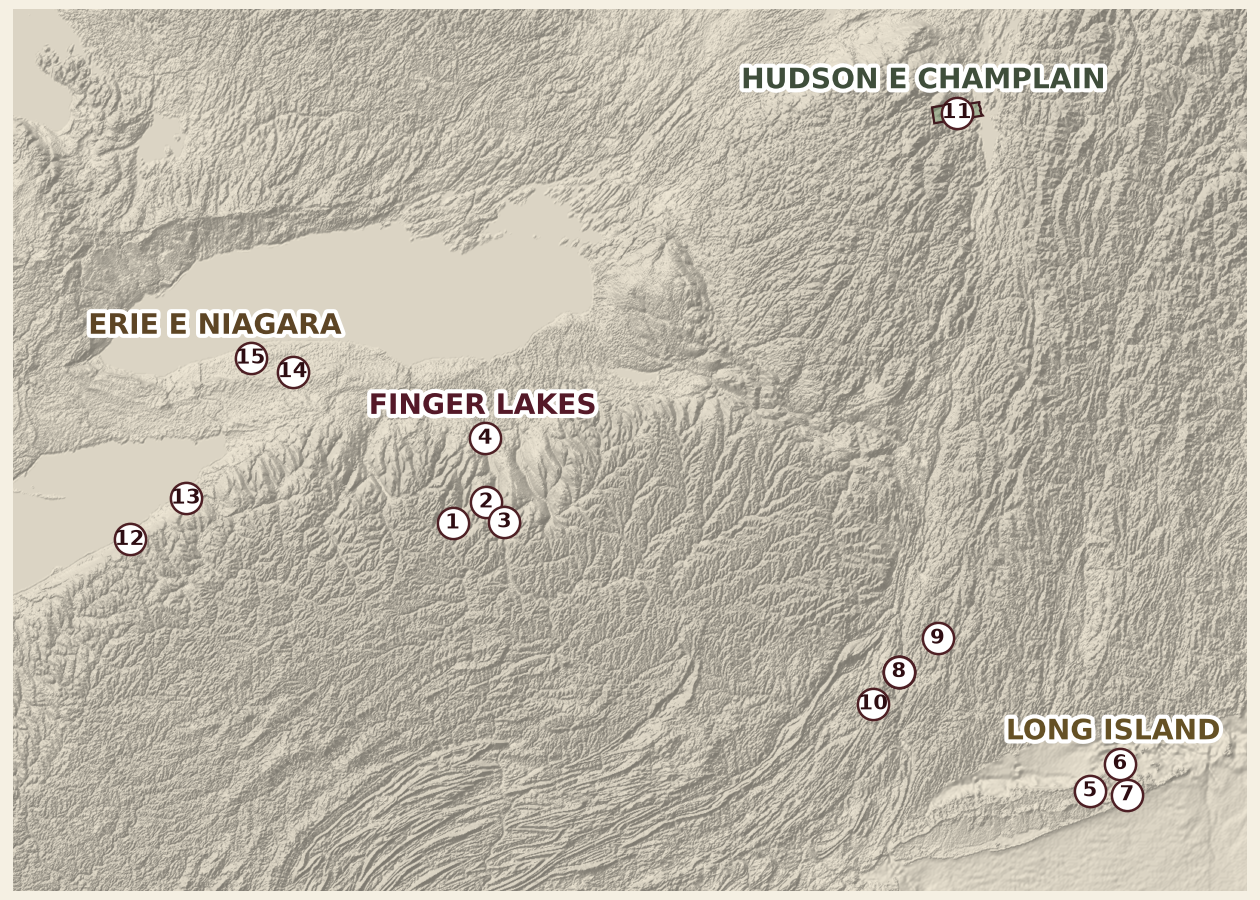
Quindici comuni per leggere i quattro distretti del vino newyorkese, da ovest a est: la fascia del lago Erie e l'Escarpment del Niagara, i Finger Lakes, il corridoio Hudson-Champlain e le due forche di Long Island.Fifteen towns to read New York's four wine districts, west to east: the Lake Erie belt and the Niagara Escarpment, the Finger Lakes, the Hudson-Champlain corridor and the two forks of Long Island.
- 1 Hammondsport
- 2 Dundee
- 3 Burdett
- 4 Geneva
- 5 Jamesport
- 6 Greenport
- 7 Bridgehampton
- 8 Marlboro
- 9 Millbrook
- 10 Washingtonville
- 11 Peru
- 12 Westfield
- 13 Silver Creek
- 14 Medina
- 15 Newfane
Zone e sottozoneZones and subzones
I vitigni del territorioThe grapes of the territory
Le denominazioniThe denominations
A tavolaAt the table
La cucina dello Stato di New York è di acqua fredda, di frutteto e di caseificio, e i suoi vini le vanno dietro senza sforzo.New York State cooking is cold-water, orchard and dairy cooking, and its wines follow it without effort.
Si comincia dalle ostriche della Peconic Bay, fra le due forche di Long Island: iodate, carnose, servite crude con una goccia di limone. Chiedono un bianco dell'isola — Sauvignon Blanc o Chardonnay non legnoso — teso, di buona sapidità, che non copra il mare. Sulla stessa tavola il rosato secco di Long Island, pallido e agrumato, regge bene anche i granchi azzurri e le vongole al vapore.Start with oysters from Peconic Bay, between the two forks of Long Island: briny, meaty, served raw with a drop of lemon. They ask for an island white — Sauvignon Blanc, or unoaked Chardonnay — taut, with good salinity, that does not cover the sea. On the same table Long Island's dry rosé, pale and citrussy, also handles blue crab and steamed clams well.
Nei Finger Lakes il piatto di casa è la trota di lago affumicata, con pane scuro e panna acida: il grasso affumicato del pesce trova il suo contrappeso nell'acidità nervosa di un Riesling secco della regione, che ha freschezza in abbondanza e una traccia minerale che allunga il finale. Il Riesling leggermente abboccato — quello che qui chiamano semi-dry — è invece il vino con cui gli abitanti di Buffalo bevono le alette di pollo piccanti, l'invenzione più famosa della città: la lieve morbidezza zuccherina spegne il peperoncino dove un rosso tannico lo accenderebbe.In the Finger Lakes the house dish is smoked lake trout, with dark bread and sour cream: the smoky richness of the fish finds its counterweight in the nervy acidity of a dry regional Riesling, which has freshness to spare and a mineral thread that lengthens the finish. Slightly off-dry Riesling — what they call semi-dry here — is instead the wine Buffalo drinks with its spicy chicken wings, the city's most famous invention: the touch of sugary softness puts out the chilli where a tannic red would fan it.
La valle dell'Hudson è terra di mele e di formaggi di fattoria — caprini freschi, erborinati, cheddar stagionati dello Stato. Sui caprini va un bianco aromatico e asciutto della valle; sul cheddar più vecchio e sulla mostarda di mele funziona meglio un Cabernet Franc locale, di tannino fine e profilo erbaceo. Sul lago Erie, infine, resiste un dolce di stagione che dice tutta la storia della regione: la torta di uva Concord, con quel profumo di succo che ogni americano riconosce. Accompagnala con un vino da uve surmature o un vino del ghiaccio locale, servito freddo e in piccola quantità.The Hudson Valley is apple and farmhouse cheese country — fresh goat's cheeses, blues, aged state cheddars. Fresh goat's cheese wants an aromatic dry white from the valley; older cheddar and apple mustard work better with a local Cabernet Franc, fine-grained in tannin and herbal in profile. And on Lake Erie a seasonal dessert survives that tells the region's whole story: Concord grape pie, with that grape-juice scent every American recognises. Serve it with a wine from over-ripe grapes or a local ice wine, cold and in small measure.
La storiaHistory
Per un secolo e mezzo, nello Stato di New York, si diede per assodato che le uve europee non ci potessero vivere. Il ragionamento sembrava solido: le vinifera venivano da climi marittimi, qui gli inverni scendono ben sotto lo zero, e i tentativi ottocenteschi erano finiti tutti allo stesso modo — viti morte alla prima gelata seria. Così si faceva vino con quello che sopravviveva: Concord, Catawba, Delaware, uve americane dal profumo inconfondibile e dalla polpa scivolosa, e poi gli ibridi franco-americani arrivati fra le due guerre. Il vino era dolce, spesso spumantizzato, e nessuno lo confrontava con l'Europa.For a century and a half it was taken as settled, in New York State, that European grapes could not live here. The reasoning looked sound: vinifera came from maritime climates, winters here go well below freezing, and the nineteenth-century attempts had all ended the same way — vines dead at the first serious frost. So wine was made from whatever survived: Concord, Catawba, Delaware, American grapes with an unmistakable scent and slippery pulp, and then the French-American hybrids that arrived between the wars. The wine was sweet, often sparkling, and nobody compared it with Europe.
A muovere le cose fu, prima di tutto, un francese. Charles Fournier era nato a Reims ed era stato enologo alla Veuve Clicquot quando, nel 1934, accettò di attraversare l'Atlantico per rimettere in piedi la Urbana Wine Company di Hammondsport, sul lago Keuka — quella che sarebbe diventata Gold Seal. Fournier sapeva fare le bollicine e le fece con gli ibridi, ottenendo risultati che sorpresero tutti. Ma restava la domanda a cui nessuno voleva più rispondere: e se si potesse fare con le uve vere?What moved things was, first of all, a Frenchman. Charles Fournier was born in Reims and had been a winemaker at Veuve Clicquot when, in 1934, he agreed to cross the Atlantic and rebuild the Urbana Wine Company of Hammondsport, on Keuka Lake — what would become Gold Seal. Fournier knew how to make sparkling wine and he made it from hybrids, with results that surprised everyone. But the question nobody wanted to answer any more was still there: what if it could be done with the real grapes?
La risposta arrivò per una strada imprevedibile. Nel 1951 sbarcò a New York, con la famiglia e senza inglese, un uomo di cinquantadue anni di nome Konstantin Frank. Era nato nel 1899 in Ucraina da una famiglia di lingua tedesca, aveva un dottorato in viticoltura conseguito nel 1939 con una tesi sulla resistenza al gelo e sulla protezione dei vigneti, e nel 1928 aveva inventato un aratro per rincalzare la terra sopra il punto d'innesto — la pratica che in inglese si chiama hilling up. In America nessuno di questi titoli valeva nulla: trovò lavoro alla Stazione Sperimentale di Cornell a Geneva, in ruoli umili, e da lì cominciò a ripetere a chiunque lo ascoltasse che il problema del New York non era il freddo. Il freddo lui l'aveva visto sul serio, in Ucraina, dove la vite europea cresceva lo stesso. Il problema era il portinnesto: quelli in uso spingevano la pianta a vegetare troppo a lungo, il legno non maturava in tempo e l'inverno la trovava impreparata. Bastava innestare su radici che chiudessero il ciclo prima.The answer came by an unlikely road. In 1951 a fifty-two-year-old man named Konstantin Frank landed in New York with his family and no English. He had been born in 1899 in Ukraine to a German-speaking family, held a doctorate in viticulture earned in 1939 with a thesis on frost resistance and vineyard protection, and in 1928 had invented a plough for banking earth over the graft union — the practice known as hilling up. In America none of these credentials counted for anything: he found work at Cornell's Geneva Experiment Station in humble roles, and from there began telling anyone who would listen that New York's problem was not the cold. He had seen real cold, in Ukraine, where the European vine grew all the same. The problem was the rootstock: those in use pushed the plant to keep growing too long, the wood did not ripen in time, and winter found it unprepared. It was enough to graft onto roots that closed the cycle earlier.
Fournier lo incontrò nel 1953 e capì. L'anno dopo lo assunse a Gold Seal con un mandato solo: fare un programma di vinifera. Andò come Frank aveva previsto. Nel 1958 comprò 188 acri sul lago Keuka e ci piantò il proprio vigneto europeo; nel 1962 fondò la sua cantina, Vinifera Wine Cellars, la prima negli Stati Uniti orientali costruita interamente su uve europee. Nel 1967 il suo vigneto sul Keuka ospitò la prima riunione dell'American Wine Society, duecento fra viticoltori e appassionati: la società dichiara oggi oltre seimila soci ed è una delle maggiori del Paese.Fournier met him in 1953 and understood. The following year he hired him at Gold Seal with a single brief: build a vinifera programme. It went as Frank had predicted. In 1958 he bought 188 acres on Keuka Lake and planted his own European vineyard; in 1962 he founded his winery, Vinifera Wine Cellars, the first in the eastern United States built entirely on European grapes. In 1967 his vineyard on Keuka hosted the first meeting of the American Wine Society, two hundred growers and wine lovers: the society today reports more than six thousand members and is one of the largest in the country.
Restava un ostacolo, e non era agronomico. Fino agli anni Settanta aprire una cantina nello Stato costava una licenza pensata per i grandi produttori, fuori portata per un contadino con dieci acri di vigna. Nel 1976 il Farm Winery Act abbassò quella soglia e permise a chi coltivava uva di vinificarla e venderla direttamente in azienda. È la legge che ha fatto il New York del vino contemporaneo: le cantine a conduzione familiare, le sale di degustazione lungo le sponde dei laghi, le strade del vino. Dal 2011 al 2024 le cantine con licenza sono passate da 285 a 513 — quasi il doppio in tredici anni.One obstacle remained, and it was not agronomic. Until the 1970s opening a winery in the state meant a licence designed for large producers, out of reach for a farmer with ten acres of vines. In 1976 the Farm Winery Act lowered that threshold and allowed grape growers to make wine and sell it directly at the farm. It is the law that made contemporary New York wine: the family wineries, the tasting rooms along the lake shores, the wine trails. Between 2011 and 2024 licensed wineries went from 285 to 513 — almost double in thirteen years.
Oggi il Riesling dei Finger Lakes si beve a Londra e a Tokyo, e il ragionamento che per un secolo e mezzo era sembrato solido si è rivelato semplicemente incompleto. Mancava una riga: non è il freddo, è la radice.Today Finger Lakes Riesling is drunk in London and Tokyo, and the reasoning that had looked sound for a century and a half turned out to be simply incomplete. One line was missing: it is not the cold, it is the root.
Numeri e denominazioni da fonti ufficiali verificate e archiviate: TTB (elenco delle AVA riconosciute) e 27 CFR Parti 4 e 9 su eCFR per il conteggio delle 11 AVA di New York, gli anni di riconoscimento e le regole d'etichettatura; New York Wine & Grape Foundation, 2024 Vineyard Report, per superfici, varietà e numero di cantine. Le notizie storiche vengono dalla cronologia pubblicata dalla Dr. Konstantin Frank Winery e dalle fonti istituzionali sul Farm Winery Act del 1976. Le descrizioni di suoli, clima e profili sensoriali sono nostre e non hanno valore normativo: negli Stati Uniti l'AVA certifica la provenienza, non il vitigno né la resa. Cantine e bottiglie sono verificate sui siti dei produttori alla data di pubblicazione; annate e disponibilità cambiano.Figures and appellations from verified, archived official sources: the TTB list of established AVAs and 27 CFR Parts 4 and 9 on eCFR for the count of New York's 11 AVAs, the years of recognition and the labelling rules; the New York Wine & Grape Foundation 2024 Vineyard Report for acreage, varieties and winery numbers. The historical detail comes from the timeline published by Dr. Konstantin Frank Winery and from institutional sources on the 1976 Farm Winery Act. Descriptions of soils, climate and sensory profiles are our own and carry no regulatory weight: in the United States an AVA certifies origin, not variety or yield. Wineries and bottles were verified on the producers' own sites at the date of publication; vintages and availability change.