Duecentosettemila ettari di vigna fra i contrafforti dei Pirenei e le sabbie della Camargue: la Linguadoca-Rossiglione è il bacino viticolo più esteso di Francia, e per quasi un secolo ne è stata anche la cantina del vino corrente. Poi è arrivato il ribaltamento — via le viti dalla pianura, ritorno sulle colline di scisto e di calcare, una generazione di vignaioli che ha smesso di ragionare in ettolitri. Oggi la regione conta trentaquattro AOP e ventidue IGP, dai vini dolci naturali del Rossiglione alle bollicine di Limoux, ed è anche il bacino francese con più vigna coltivata in biologico.Two hundred and seven thousand hectares of vines between the foothills of the Pyrenees and the sands of the Camargue: Languedoc-Roussillon is France's largest wine basin, and for almost a century it was also the country's cellar of everyday wine. Then came the reversal — vines pulled out of the plain, a return to the schist and limestone hills, a generation of growers who stopped thinking in hectolitres. Today the region counts thirty-four AOPs and twenty-two IGPs, from the fortified sweet wines of Roussillon to the sparkling wines of Limoux, and it is also the French basin with the most organically farmed vineyard.
Il territorioThe territory
La terraThe land
Non è un territorio, è un arco: duecento chilometri di costa mediterranea con le montagne sempre alle spalle. Scisti neri nella valle dell'Agly e a Faugères, calcari bianchi intorno al Pic Saint-Loup, arenarie rosse nelle Corbières, ciottoli del vecchio Rodano nelle Costières, sabbia pura — oltre l'80% della massa — nel delta della Camargue. Fra una vigna e l'altra c'è la garrigue: timo, rosmarino, cisto, roccia nuda. Il clima è mediterraneo e ventoso, e i due venti fanno mestieri opposti — la tramontana asciuga i grappoli, il marin porta umidità dal mare.It is not a territory, it is an arc: two hundred kilometres of Mediterranean coast with the mountains always behind. Black schist in the Agly valley and at Faugères, white limestone around Pic Saint-Loup, red sandstone in the Corbières, pebbles of the old Rhône in the Costières, pure sand — over 80% of the soil mass — in the Camargue delta. Between one vineyard and the next lies the garrigue: thyme, rosemary, cistus, bare rock. The climate is Mediterranean and windy, and the two winds do opposite jobs — the tramontane dries the bunches, the marin carries moisture in from the sea.
Il vitignoThe grape
Il repertorio è quello mediterraneo, e si legge nei disciplinari: grenache, syrah, mourvèdre, carignan e cinsault per i rossi e i rosati; grenache blanc, roussanne, marsanne, bourboulenc, clairette, piquepoul, macabeo e vermentino per i bianchi. Il moscato a piccoli acini è il vitigno dei vini dolci naturali, dal Rossiglione a Frontignan. Sull'alta valle dell'Aude cambia tutto: a Limoux comandano il mauzac — l'uva della Blanquette — insieme a chardonnay e chenin, che qui trovano un clima già mezzo atlantico.The repertoire is Mediterranean, and it is written into the specifications: Grenache, Syrah, Mourvèdre, Carignan and Cinsault for reds and rosés; Grenache Blanc, Roussanne, Marsanne, Bourboulenc, Clairette, Piquepoul, Macabeo and Vermentino for whites. Muscat à petits grains is the grape of the fortified sweet wines, from Roussillon to Frontignan. In the upper Aude valley everything changes: at Limoux the lead is taken by Mauzac — the Blanquette grape — together with Chardonnay and Chenin, which here find a climate already half-Atlantic.
L'uomoThe human hand
È la terra delle cantine cooperative: dopo la crisi di inizio Novecento i paesi si sono attrezzati in comune, e ancora oggi una parte importante del raccolto passa dalle caves coopératives. È anche la terra che ha inventato la protesta viticola moderna, nel 1907, e che dalle leggi nate da quella protesta ha ricevuto le regole su dichiarazione dei raccolti e zuccheraggio. L'ultima svolta è recente: espianti nella pianura, riconquista delle colline, e dal 2014 in poi tre nuove AOP — Terrasses du Larzac, La Clape, Pic Saint-Loup — nate staccandosi dall'appellazione regionale.This is cooperative country: after the crisis of the early twentieth century the villages organised themselves collectively, and a significant share of the harvest still goes through the caves coopératives. It is also the land that invented modern wine protest, in 1907, and that received from the laws born of that protest the rules on harvest declarations and chaptalisation. The latest turn is recent: vines pulled out of the plain, the hills reconquered, and from 2014 onwards three new AOPs — Terrasses du Larzac, La Clape, Pic Saint-Loup — born by splitting off from the regional appellation.
La mappaThe map
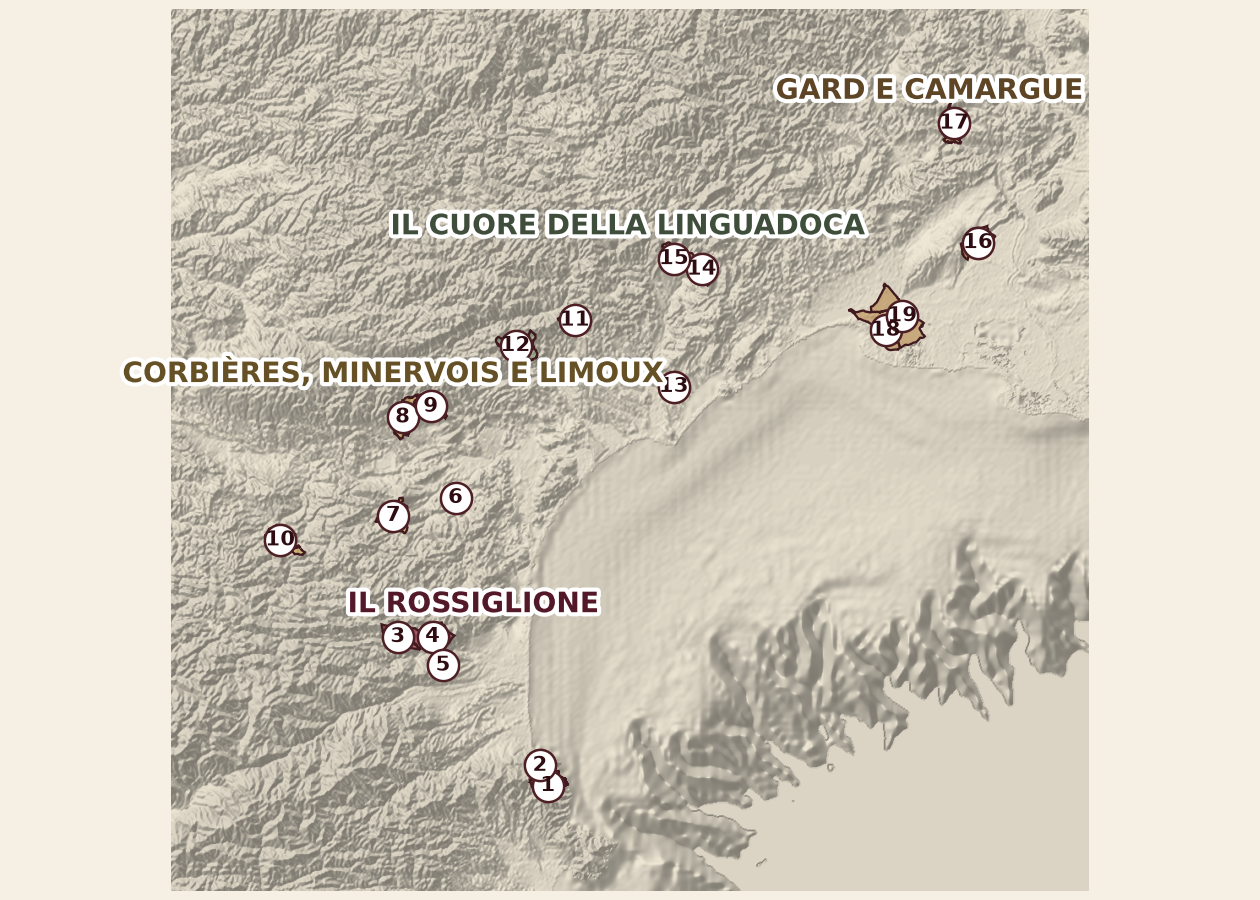
I quattro distretti del vino fra i Pirenei e la Camargue: 19 comuni reali, colorati per zona.The four wine districts between the Pyrenees and the Camargue: 19 real communes, coloured by zone.
- 1 Banyuls-sur-Mer
- 2 Collioure
- 3 Maury
- 4 Tautavel
- 5 Calce
- 6 Boutenac
- 7 Lagrasse
- 8 La Livinière
- 9 Minerve
- 10 Limoux
- 11 Faugères
- 12 Roquebrun
- 13 Pinet
- 14 Aniane
- 15 Montpeyroux
- 16 Bellegarde
- 17 Uzès
- 18 Aigues-Mortes
- 19 Saint-Laurent-d'Aigouze
Zone e sottozoneZones and subzones
I vitigni del territorioThe grapes of the territory
Le denominazioniThe denominations
A tavolaAt the table
La cucina di qui è di terra e di mare insieme, e cambia parlando catalano man mano che si scende verso sud. Il cassoulet di Castelnaudary — fagioli, cotenna, salsiccia, confit — chiede un rosso caldo e non troppo giovane: un Corbières o un Minervois di qualche anno, dove il calore del grenache e un tannino ormai levigato stanno bene con la carne grassa e sugosa del confit. Sul cinghiale in salmì o su un agnello alla brace vanno i rossi di scisto, Faugères e Saint-Chinian, con quel finale di garrigue che ritrova le erbe della marinata.The cooking here is of land and sea at once, and it starts speaking Catalan as you go south. The cassoulet of Castelnaudary — beans, pork rind, sausage, confit — calls for a warm red that is no longer young: a Corbières or a Minervois with a few years on it, where the warmth of grenache and a tannin now smoothed by age sit well with the rich, juicy meat of the confit. With jugged wild boar or grilled lamb, the schist reds work best, Faugères and Saint-Chinian, with that garrigue finish that echoes the herbs of the marinade.
Sulla costa si ribalta tutto. Con le ostriche di Bouzigues, allevate nello stagno di Thau, si beve il Picpoul de Pinet: acidità dritta contro il sale iodato delle ostriche, e finisce lì. Con le acciughe di Collioure — l'unico prodotto ittico della regione con una IGP europea — va un Collioure bianco o rosato, che ha abbastanza corpo da non farsi cancellare dal sale. La brandade nîmoise, baccalà mantecato con olio e latte, è un piatto grasso e delicato: un bianco di grenache blanc e roussanne del Languedoc, o un Clairette de Bellegarde, la sostiene senza coprirla.On the coast everything is reversed. Bouzigues oysters, farmed in the Thau lagoon, call for Picpoul de Pinet: straight acidity against the iodine salt of the oysters, and that is that. Collioure anchovies — the region's only seafood product with a European PGI — go with a white or rosé Collioure, which has enough body not to be wiped out by the salt. Brandade nîmoise, salt cod whipped with oil and milk, is rich and delicate at once: a Languedoc white from grenache blanc and roussanne, or a Clairette de Bellegarde, supports it without covering it.
Poi ci sono i formaggi e i dolci, che è dove i vini dolci naturali fanno il loro mestiere. Il pélardon, caprino AOP delle Cévennes, sta bene con un moscato — Frontignan, Lunel, Saint-Jean-de-Minervois: la dolcezza del vino risponde alla punta acidula del formaggio fresco. Su un dessert al cioccolato fondente si passa ai rossi dolci del Rossiglione: Banyuls o Maury, dove le note di cacao e frutta cotta del vino incontrano quelle del piatto. E il toro di Camargue AOP, grigliato e servito con il riso della stessa terra, torna al punto di partenza: un rosso della zona, o il «gris de gris» delle sabbie se il pranzo è d'estate.Then come the cheeses and the desserts, which is where the fortified sweet wines do their real work. Pélardon, the PDO goat's cheese of the Cévennes, goes with a muscat — Frontignan, Lunel, Saint-Jean-de-Minervois — matching the sweetness of the wine to the tangy edge of the fresh cheese. With a dark chocolate dessert you move to the sweet reds of Roussillon: Banyuls or Maury, where the cocoa and cooked-fruit notes of the wine meet those of the plate. And PDO Camargue bull, grilled and served with rice from the same land, brings you back to the beginning: a red from the area, or the «gris de gris» of the sands if lunch is in summer.
La storiaHistory
L'11 marzo 1907 ottantasette viticoltori del villaggio di Argeliers, nell'Aude, si incamminano verso Narbonne. Li guida Marcelin Albert, un vignaiolo che nessuno conosce fuori dal suo paese. A Narbonne siede una commissione parlamentare d'inchiesta, arrivata a studiare una crisi di mancate vendite che dura da sette anni: il vino del Midi non si vende più, o si vende sotto costo, schiacciato dalle frodi — vino fabbricato con acqua e zucchero, o allungato, che arriva sul mercato al posto del vino vero. Gli ottantasette chiedono una cosa sola: che la lotta contro la frode entri all'ordine del giorno.On 11 March 1907, eighty-seven winegrowers from the village of Argeliers, in the Aude, set off for Narbonne. They are led by Marcelin Albert, a grower nobody knows outside his own village. Sitting in Narbonne is a parliamentary commission of inquiry, sent to study a sales crisis that has dragged on for seven years: the wine of the Midi no longer sells, or sells below cost, crushed by fraud — wine manufactured from water and sugar, or stretched, reaching the market in place of the real thing. The eighty-seven ask for one thing only: that the fight against fraud be put on the agenda.
Quella marcia non resta un episodio. Diventa una domenica dopo l'altra: raduni pacifici che invadono le spianate delle città della Linguadoca e del Rossiglione, sempre più grandi, di paese in paese. Il 9 giugno 1907, a Montpellier, i partecipanti dichiarati sono cinquecentomila — una cifra che in Francia non è più stata eguagliata. Ad Albert si è unito Ernest Ferroul, sindaco socialista di Narbonne, e la mobilitazione ha smesso di avere colori politici: ci sono i proprietari e i braccianti, i sindaci e i preti, i commercianti che vivono di ciò che porta la vigna.That march does not remain an isolated episode. It becomes one Sunday after another: peaceful gatherings filling the esplanades of the towns of Languedoc and Roussillon, growing from village to village. On 9 June 1907, at Montpellier, the declared turnout is five hundred thousand — a figure never matched in France since. Albert has been joined by Ernest Ferroul, the socialist mayor of Narbonne, and the mobilisation has lost its political colours: there are landowners and labourers, mayors and priests, the shopkeepers who live on what the vineyard brings in.
Al governo di Georges Clemenceau arriva un ultimatum. Il 10 giugno, senza risposta, parte lo sciopero delle imposte e si dimettono in blocco le amministrazioni comunali: un intero pezzo di Francia si sfila dallo Stato. La reazione è l'occupazione militare del Midi e l'arresto dei capi del movimento; il 19 e il 20 giugno, a Narbonne, gli spari della truppa fanno sei morti. È allora che succede la cosa che rende il 1907 un caso di scuola: il 17° reggimento di fanteria, di stanza a Béziers, si ammutina e rifiuta di sparare sui propri paesi. Rientrerà nei ranghi solo dietro promessa di indulgenza, e sarà poi spedito a Gafsa, in Tunisia.An ultimatum reaches the government of Georges Clemenceau. On 10 June, with no reply, the tax strike begins and the municipal councils resign en masse: an entire slice of France steps out of the State. The response is the military occupation of the Midi and the arrest of the movement's leaders; on 19 and 20 June, at Narbonne, the troops open fire and six people are killed. That is when the thing happens that makes 1907 a textbook case: the 17th infantry regiment, stationed at Béziers, mutinies and refuses to fire on its own villages. It returns to the ranks only on a promise of leniency, and is later shipped off to Gafsa, in Tunisia.
Il 23 giugno Marcelin Albert è ricevuto a Parigi da Clemenceau. Ne esce distrutto politicamente per un dettaglio quasi comico: il presidente del Consiglio gli presta cento franchi per pagarsi il viaggio di ritorno, la notizia si diffonde, e il capo dei viticoltori diventa agli occhi dei suoi «l'uomo che si è fatto pagare da Parigi». Non si riprenderà più.On 23 June Marcelin Albert is received in Paris by Clemenceau. He comes out politically destroyed by an almost comic detail: the prime minister lends him a hundred francs to pay for his journey home, the news gets out, and in the eyes of his own people the leader of the winegrowers becomes «the man who took Paris's money». He never recovers.
Eppure la rivolta vince. Il 29 giugno e il 15 luglio 1907 il Parlamento vota le due leggi che per un secolo inquadreranno la produzione e il mercato del vino in Francia: dichiarazione obbligatoria dei raccolti, regolamentazione dello zuccheraggio, repressione della frode, controllo dei movimenti del vino. Il 22 settembre nasce a Narbonne la Confédération générale des vignerons, presieduta da Ferroul. Da quell'estate in poi lo Stato francese non smetterà più di regolare il vino — ed è da quel filone normativo che, trent'anni dopo, nasceranno le appellazioni d'origine controllata. La regione che oggi conta trentaquattro AOP è la stessa che nel 1907 chiedeva soltanto di poter distinguere il vino vero da quello fabbricato.And yet the revolt wins. On 29 June and 15 July 1907 Parliament votes the two laws that will frame wine production and the wine market in France for a century: compulsory harvest declarations, regulation of chaptalisation, suppression of fraud, control of wine movements. On 22 September the Confédération générale des vignerons is founded at Narbonne, chaired by Ferroul. From that summer on, the French State never stops regulating wine — and it is from that legislative line that, thirty years later, the appellations of controlled origin will be born. The region that today counts thirty-four AOPs is the same one that in 1907 asked only to be able to tell real wine from manufactured wine.
I numeri delle denominazioni vengono dalle fonti ufficiali: gli elenchi INAO e il registro europeo eAmbrosia. Le denominazioni geografiche complementari sono quelle scritte nei disciplinari e nei documenti unici pubblicati nella Gazzetta ufficiale dell'Unione europea; per l'AOP Languedoc sono dieci, e non comprendono Grés de Montpellier, la cui candidatura come denominazione autonoma risulta aperta. La superficie del vigneto è quella pubblicata da FranceAgriMer per il bacino Languedoc-Roussillon. La mappa mostra comuni reali scelti come esempio di ciascun distretto, non i confini delle denominazioni. Le note sui vini descrivono un profilo tipico e ricorrente, non la degustazione di una singola annata.The denomination figures come from the official sources: the INAO lists and the European eAmbrosia register. The complementary geographical denominations are those written into the specifications and single documents published in the Official Journal of the European Union; for AOP Languedoc there are ten, and they do not include Grés de Montpellier, whose application as an autonomous denomination is open. The vineyard area is the one published by FranceAgriMer for the Languedoc-Roussillon basin. The map shows real communes chosen as examples of each district, not the boundaries of the denominations. The tasting notes describe a typical, recurring profile, not the tasting of a single vintage.