L'Alsazia è la regione francese che scrive il vitigno sull'etichetta. Dove altrove si legge Chablis o Pauillac, qui si legge Riesling, Gewurztraminer, Pinot gris: una scelta che viene dalla storia tedesca della regione e che la rende, per un lettore italiano, sorprendentemente familiare. Il vigneto è una fascia stretta, larga fra quattro e venti chilometri, incollata al piede dei Vosgi fra il Bas-Rhin e il Haut-Rhin; le montagne le tengono lontane le piogge atlantiche e le lasciano una delle stagioni più asciutte e luminose di Francia. Il risultato sono bianchi che tengono insieme maturità e acidità, un metodo classico — il Crémant d'Alsace — che in Francia è il primo spumante a denominazione consumato in casa dopo lo Champagne, e cinquantun grand cru che dividono quella striscia in altrettanti terroir con un nome proprio.Alsace is the French region that puts the grape on the label. Where elsewhere you read Chablis or Pauillac, here you read Riesling, Gewurztraminer, Pinot gris: a habit that comes from the region's German century and that makes it, for an Italian reader, surprisingly familiar. The vineyard is a narrow band, four to twenty kilometres wide, pressed against the foot of the Vosges across the Bas-Rhin and the Haut-Rhin; the mountains keep the Atlantic rain away and leave one of the driest, brightest growing seasons in France. The result: whites that hold ripeness and acidity together, a traditional-method sparkling wine — Crémant d'Alsace — that in France is the leading AOC sparkling wine drunk at home after Champagne, and fifty-one grands crus that cut that ribbon into as many named terroirs.
Il territorioThe territory
La terraThe land
L'Alsazia nasce da una frattura: lo sprofondamento del fossato renano ha spezzato il terreno in una rete di faglie e ha lasciato, sul bordo, un mosaico di compartimenti piccolissimi e diversissimi. Il disciplinare li riassume in tre famiglie: suoli bruni su scisti, graniti o arenarie del substrato vosgiano, poco profondi e drenanti; suoli colluviali e alluvionali sabbio-ghiaiosi al margine della pianura; suoli bruni calcarei o rendzina delle colline sotto-vosgiane, con marne e conglomerati e un buon regime idrico. È per questo che due vigne distanti trecento metri possono dare vini che non si somigliano.Alsace was born from a fracture: the collapse of the Rhine graben broke the ground into a network of faults and left, along its edge, a mosaic of tiny, wildly different compartments. The rulebook sums them up in three families: brown soils over schist, granite or sandstone from the Vosges substrate, shallow and free-draining; colluvial and alluvial sandy-gravelly soils along the plain; brown limestone or rendzina soils on the sub-Vosges hills, with marls and conglomerates and a good water regime. Which is why two vineyards three hundred metres apart can give wines that bear no resemblance to each other.
Il vitignoThe grape
Undici varietà, e quasi sempre una sola nel bicchiere. Il disciplinare dell'AOC Alsace ammette chasselas, sylvaner, pinot blanc e auxerrois, riesling, i tre muscat, gewurztraminer, savagnin rose, pinot gris e pinot noir; l'etichetta può portare il nome della varietà come «denominazione in uso», ed è quasi sempre così. Fa eccezione l'Edelzwicker, l'assemblaggio di bianchi, erede diretto dello zwicker di quando i vitigni stavano mescolati nella stessa vigna. Il chardonnay c'è, ma solo per il Crémant: nei vini fermi non è ammesso.Eleven varieties, and almost always just one in the glass. The AOC Alsace rulebook allows Chasselas, Sylvaner, Pinot Blanc and Auxerrois, Riesling, the three Muscats, Gewurztraminer, Savagnin Rose, Pinot Gris and Pinot Noir; the label may carry the variety name as a «denomination in use», and nearly always does. The exception is Edelzwicker, the white blend, direct heir of the zwicker from the days when varieties grew mixed in the same plot. Chardonnay is here too, but only for Crémant: still wines may not use it.
L'uomoThe human hand
Qui l'organizzazione è arrivata prima del riconoscimento. L'Association des Viticulteurs d'Alsace esiste dal 1912, il comitato di esperti dei vini d'Alsazia nasce con l'ordinanza del 2 novembre 1945, ma l'AOC Alsace arriva solo nel 1962 — un quarto di secolo dopo Bordeaux e la Champagne. Da allora la regione ha costruito la sua gerarchia un pezzo alla volta: i primi grand cru nel 1975, le menzioni Vendanges Tardives e Sélection de Grains Nobles codificate il 1° marzo 1984, l'ultimo grand cru — il Kaefferkopf — nel 2007. Nel giugno 2025 il comitato nazionale dell'INAO ha avviato la fase operativa per riconoscere dei «cru» a livello di singolo lieu-dit: sette dossier sono già stati depositati.Here the organising came before the recognition. The Association des Viticulteurs d'Alsace has existed since 1912, the committee of experts for Alsace wines was created by the ordinance of 2 November 1945, but the AOC Alsace only arrived in 1962 — a quarter of a century after Bordeaux and Champagne. Since then the region has built its hierarchy one piece at a time: the first grands crus in 1975, the Vendanges Tardives and Sélection de Grains Nobles mentions codified on 1 March 1984, the last grand cru — Kaefferkopf — in 2007. In June 2025 INAO's national committee opened the operational phase for recognising «crus» at single lieu-dit level: seven applications have already been filed.
La mappaThe map
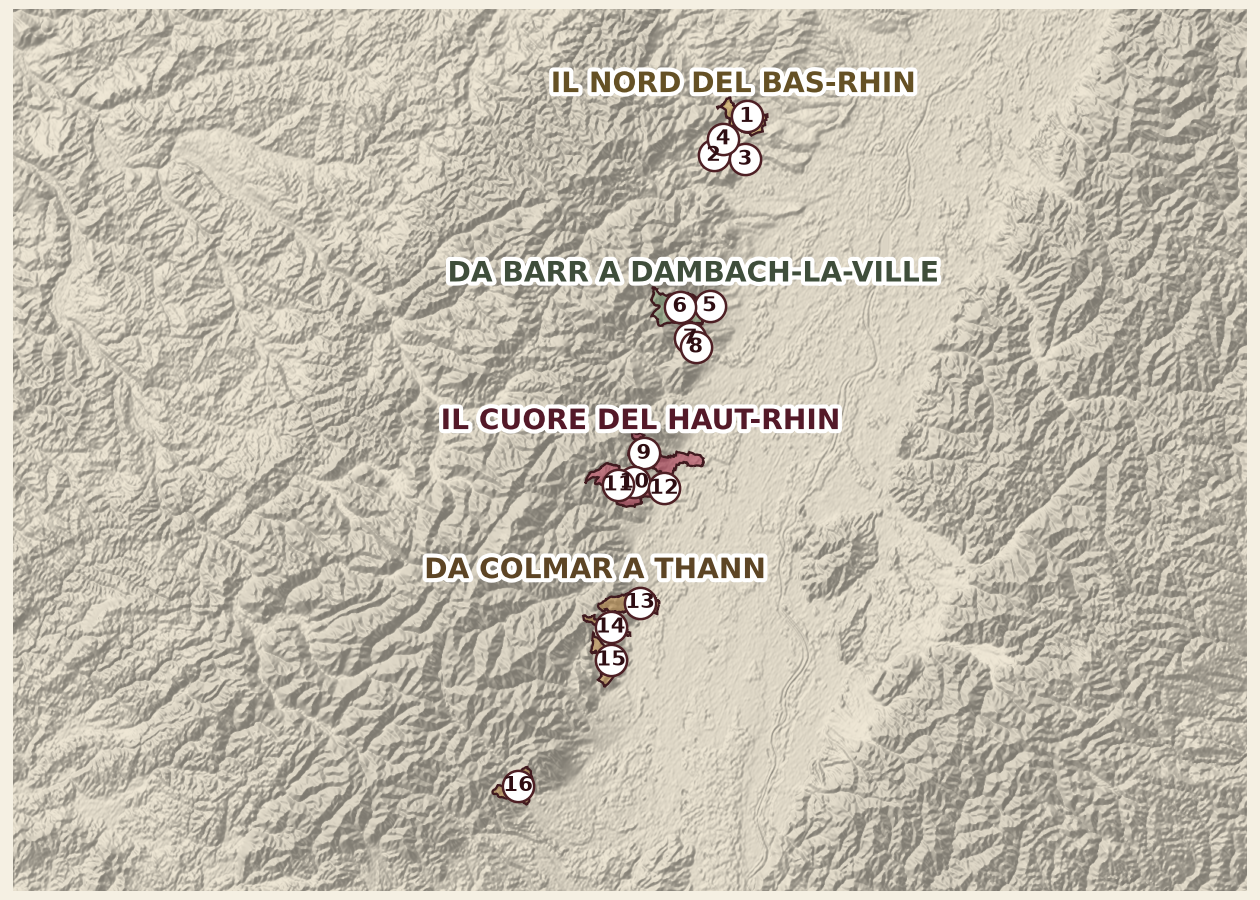
Il tratto continuo del vigneto alsaziano, da Marlenheim a Thann, e sedici comuni che lo rappresentano: la striscia stretta contro i Vosgi è il messaggio. A nord, verso Wissembourg, resta l'enclave staccata di Cleebourg, fuori inquadratura.The continuous stretch of the Alsace vineyard, from Marlenheim to Thann, and sixteen villages that stand for it: the narrow ribbon pressed against the Vosges is the point. Further north, towards Wissembourg, lies the detached Cleebourg enclave, outside the frame.
- 1 Marlenheim
- 2 Bergbieten
- 3 Wolxheim
- 4 Traenheim
- 5 Mittelbergheim
- 6 Andlau
- 7 Nothalten
- 8 Blienschwiller
- 9 Bergheim
- 10 Hunawihr
- 11 Riquewihr
- 12 Zellenberg
- 13 Eguisheim
- 14 Gueberschwihr
- 15 Westhalten
- 16 Thann
Zone e sottozoneZones and subzones
I vitigni del territorioThe grapes of the territory
Le denominazioniThe denominations
A tavolaAt the table
La cucina alsaziana è grassa, salata e affumicata, e i vini della regione hanno l'acidità e la spinta salina che questi piatti chiedono. La choucroute garnie, cavolo fermentato con carni di maiale salate e affumicate, chiede un Riesling secco: l'acidità taglia il grasso e l'agro del cavolo trova una spalla su cui appoggiarsi. Con la tarte flambée — pasta sottilissima, crema, cipolla e lardo — funziona meglio un vino leggero e sciolto, un Pinot bianco o un Sylvaner, o un calice di Crémant d'Alsace che pulisce a ogni morso.Alsatian cooking is fatty, salty and smoked, and the region's wines have the acidity and saline drive these dishes ask for. Choucroute garnie, fermented cabbage with salted and smoked pork, calls for a dry Riesling: the acidity cuts the fat and the cabbage's sourness finds a shoulder to lean on. With tarte flambée — paper-thin dough, cream, onion and bacon — a lighter, looser wine works better, a Pinot blanc or a Sylvaner, or a glass of Crémant d'Alsace that cleans up after every bite.
Il Munster, formaggio a pasta molle dalla crosta lavata e dal profumo che si sente prima di vederlo, è l'abbinamento naturale: un Gewurztraminer maturo lo regge perché ha la stessa intensità aromatica, e la sua morbidezza smorza il sale del formaggio. Il baeckeoffe, lo stufato di tre carni marinate nel vino bianco e cotto in una terrina di terracotta sigillata con la pasta, torna volentieri al vino con cui è stato marinato. Il foie gras — Strasburgo è una delle sue capitali — cerca invece un Pinot gris ricco, o una Vendange Tardive. Qui il vino dev'essere dolce almeno quanto il piatto: l'errore da non fare è servirlo meno dolce. Il kougelhopf di fine pasto, con l'uvetta e le mandorle, chiude bene con una Sélection de Grains Nobles.Munster, a washed-rind soft cheese you smell before you see, is the natural pairing: a mature Gewurztraminer holds it because it has the same aromatic intensity, and its softness tempers the salt of the cheese. Baeckeoffe, the stew of three meats marinated in white wine and cooked in an earthenware pot sealed with dough, goes happily back to the wine it was marinated in. Foie gras — Strasbourg is one of its capitals — instead wants a rich Pinot gris, or a Vendange Tardive. Here the wine must be at least as sweet as the dish: the mistake is serving it less sweet. The kougelhopf at the end of the meal, with raisins and almonds, closes well with a Sélection de Grains Nobles.
La storiaHistory
Il 20 aprile 1972 quattromila viticoltori scesero per le strade di Colmar. Non chiedevano sussidi: chiedevano una legge che li obbligasse a imbottigliare il proprio vino in casa. La richiesta suona strana finché non si guarda da dove veniva l'Alsazia. Per mezzo secolo, fra il 1871 e il 1918, era stata il vigneto meridionale dell'Impero tedesco, e il suo compito era produrre vino sfuso da spedire verso nord; tornata francese, si era ritrovata a essere il vigneto più settentrionale della Repubblica, con la stessa abitudine e un mercato diverso. Il vino partiva in cisterna, faceva centinaia di chilometri e arrivava altrove per essere imbottigliato — e quello che si perdeva per strada era esattamente ciò su cui l'Alsazia stava costruendo la propria identità: l'aroma.On 20 April 1972 four thousand growers took to the streets of Colmar. They were not asking for subsidies: they were asking for a law that would force them to bottle their own wine at home. The demand sounds odd until you look at where Alsace had come from. For half a century, between 1871 and 1918, it had been the southern vineyard of the German Empire, and its job was to produce bulk wine to be shipped north; back in France, it found itself the northernmost vineyard of the Republic, with the same habit and a different market. The wine left in tankers, travelled hundreds of kilometres and was bottled somewhere else — and what got lost on the way was exactly what Alsace was building its identity on: aroma.
Il disciplinare dell'AOC Alsace lo dice ancora oggi, con parole asciutte: il carattere aromatico dei vini era «malmenato dal trasporto sfuso su lunghe distanze». La legge del 5 luglio 1972 arrivò dopo la manifestazione e rese obbligatorio l'imbottigliamento nei dipartimenti del Bas-Rhin e del Haut-Rhin. Fu una scelta che costò: chi vendeva sfuso dovette attrezzarsi. Ma era il secondo tassello di una strategia lunga. Il primo era stato la bottiglia. La flûte «du type Vin du Rhin», il collo lungo e affusolato descritto in un decreto del 1955, era già entrata in un decreto del 13 maggio 1959 che ne riservava l'uso a un numero ristretto di denominazioni, l'Alsazia fra queste. Bottiglia riconoscibile, imbottigliamento in loco, nome del vitigno sull'etichetta: tre modi diversi per dire la stessa cosa, cioè che quel vino veniva da lì e da nessun altro posto.The AOC Alsace rulebook still says it, in dry words: the aromatic character of the wines was «knocked about by bulk transport over long distances». The law of 5 July 1972 came after the demonstration and made bottling compulsory within the Bas-Rhin and Haut-Rhin departments. It was a costly choice: anyone selling in bulk had to re-equip. But it was the second piece of a long strategy. The first had been the bottle. The flûte «du type Vin du Rhin», the long tapered neck described in a 1955 decree, had already entered a decree of 13 May 1959 that reserved its use to a small number of appellations, Alsace among them. A recognisable bottle, bottling on site, the grape name on the label: three different ways of saying the same thing — that this wine came from there and nowhere else.
Il resto è venuto dopo, e con calma. L'AOC Alsace era stata riconosciuta solo nel 1962 — un quarto di secolo dopo Bordeaux — e i primi grand cru arrivarono nel 1975, con lo Schlossberg di Kaysersberg. Nel 1984, il 1° marzo, furono codificate le menzioni Vendanges Tardives e Sélection de Grains Nobles: si usavano da oltre due secoli nella loro versione tedesca, e i produttori chiesero all'amministrazione di fissarne le regole prima che qualcun altro se ne appropriasse. L'ultimo grand cru, il Kaefferkopf di Ammerschwihr, è del 2007. E la storia non è chiusa: nel giugno 2025 il comitato nazionale dell'INAO ha validato la griglia per riconoscere dei «cru» a livello di singolo lieu-dit dentro l'AOC Alsace, con sette primi dossier già depositati. Cinquant'anni dopo la marcia su Colmar, l'Alsazia sta ancora dividendo la sua striscia di colline in pezzi sempre più piccoli e sempre più nominati.The rest came afterwards, and slowly. The AOC Alsace was recognised only in 1962 — a quarter of a century after Bordeaux — and the first grands crus arrived in 1975, with the Schlossberg of Kaysersberg. On 1 March 1984 the Vendanges Tardives and Sélection de Grains Nobles mentions were codified: they had been in use for more than two centuries in their German form, and the producers asked the administration to fix the rules before somebody else took them. The last grand cru, the Kaefferkopf of Ammerschwihr, dates from 2007. And the story is not closed: in June 2025 INAO's national committee validated the framework for recognising «crus» at single lieu-dit level within the AOC Alsace, with seven first applications already filed. Fifty years after the march on Colmar, Alsace is still cutting its ribbon of hills into ever smaller, ever more named pieces.
Numeri e denominazioni provengono dai cahiers des charges dell'INAO per le AOC «Alsace», «Alsace grand cru» e «Crémant d'Alsace», dal registro europeo delle indicazioni geografiche e dai dati della DRAAF Grand Est; le fonti sono archiviate. I 51 grand cru e le 13 denominazioni comunali sono quelli dell'elenco del disciplinare. Il riconoscimento dei «cru» a livello di lieu-dit, avviato dall'INAO nel giugno 2025, è un processo in corso: qui lo raccontiamo come tale, non come un livello già esistente.Figures and denominations come from INAO's cahiers des charges for the «Alsace», «Alsace grand cru» and «Crémant d'Alsace» AOCs, from the EU register of geographical indications and from DRAAF Grand Est data; the sources are archived. The 51 grands crus and the 13 communal denominations are those on the rulebook's own list. The recognition of «crus» at lieu-dit level, opened by INAO in June 2025, is an ongoing process: we describe it as such, not as a tier that already exists.