La Champagne comincia dove in Francia l'uva fa fatica a maturare: è fra i vigneti più settentrionali del Paese, e per secoli è stato questo il suo problema. Dal freddo, che dà vini magri e taglienti, è nato un vino che si costruisce in cantina — assemblando annate, villaggi e vitigni diversi — e che rifermenta in bottiglia. Sotto c'è il gesso, la roccia bianca che tiene l'acqua nelle estati secche e in cui sono scavate le cantine. Il nome vale per 319 comuni su cinque dipartimenti, dal versante della Montagne de Reims fino all'Aube, cento chilometri più a sud.Champagne begins where grapes in France struggle to ripen: it is one of the country's northernmost vineyards, and for centuries that was its problem. Out of the cold, which gives lean, sharp wines, came a wine that is built in the cellar — blending years, villages and grape varieties — and refermented in the bottle. Underneath lies chalk, the white rock that holds water through dry summers and into which the cellars are dug. The name covers 319 villages across five départements, from the slopes of the Montagne de Reims down to the Aube, a hundred kilometres further south.
Il territorioThe territory
La terraThe land
Il sottosuolo è gesso: sedimenti marini depositati quando qui c'era il mare. È una roccia porosa che si comporta come una riserva d'acqua — trattiene l'umidità e la restituisce alla vite quando l'estate si asciuga — ed è tenera abbastanza da scavarci dentro: le cantine sotto Reims ed Épernay sono chilometri di gallerie nel gesso, a temperatura costante. Le vigne stanno sui pendii di quelle che i geologi chiamano cuestas, i gradini del bacino parigino, fra i 90 e i 300 metri di quota (INAO). Nel 2015 l'UNESCO ha iscritto nella Lista del Patrimonio Mondiale l'insieme «Coteaux, Maisons et Caves de Champagne»: i versanti, le case e le cantine, cioè i tre pezzi dello stesso mestiere.The subsoil is chalk: marine sediment laid down when this was sea floor. It is a porous rock that works as a water reserve — holding moisture and giving it back to the vine when the summer dries out — and soft enough to dig into: the cellars beneath Reims and Épernay are kilometres of galleries cut in chalk, at constant temperature. The vines sit on the slopes of what geologists call cuestas, the steps of the Paris basin, between 90 and 300 metres above sea level (INAO). In 2015 UNESCO added the ensemble of the «Coteaux, Maisons et Caves de Champagne» to the World Heritage List: the hillsides, the houses and the cellars — the three parts of the same trade.
Il vitignoThe grape
Tre vitigni fanno quasi tutto il vigneto: il Pinot Noir con il 38% della superficie, poi Chardonnay e Meunier quasi alla pari (32% e 30%, dati Comité Champagne 2025). Il Pinot Noir dà corpo e struttura ed è il vitigno della Montagne de Reims e della Côte des Bar; lo Chardonnay comanda sulla Côte des Blancs, dove il gesso affiora, e porta freschezza e attitudine all'invecchiamento; il Meunier germoglia più tardi, teme meno le gelate primaverili e si trova sulle argille della Vallée de la Marne. Il disciplinare ammette anche quattro varietà storiche rare — Arbane, Petit Meslier, Pinot Blanc e Pinot Gris — che oggi valgono lo 0,3% della superficie e che qualche vigneron ha ripreso a piantare.Three grapes make up almost the whole vineyard: Pinot Noir with 38% of the area, then Chardonnay and Meunier almost level (32% and 30%, Comité Champagne 2025 figures). Pinot Noir gives body and structure and is the grape of the Montagne de Reims and the Côte des Bar; Chardonnay rules the Côte des Blancs, where the chalk comes to the surface, and brings freshness and ageing potential; Meunier buds later, is less exposed to spring frost and sits on the clays of the Vallée de la Marne. The rulebook also allows four rare historic varieties — Arbane, Petit Meslier, Pinot Blanc and Pinot Gris — which today account for 0.3% of the area and which a few growers have started planting again.
L'uomoThe human hand
Qui la mano dell'uomo è l'assemblaggio. Un Champagne senza annata nasce mettendo insieme vini di villaggi diversi e di anni diversi — i vini di riserva tenuti in cantina — per arrivare ogni volta allo stesso gusto: è un lavoro di memoria, non di vendemmia. Poi c'è il tempo obbligatorio in bottiglia: almeno dodici mesi sui lieviti prima della sboccatura e quindici mesi complessivi di affinamento prima della vendita, trentasei per i millesimati (disciplinare AOC). A farlo sono 16.460 vigneron, 120 cooperative e 410 maison (Comité Champagne, 2025): molti coltivano e vendono l'uva, altri imbottigliano il proprio, e questa divisione del lavoro è la ragione per cui la Champagne, prima ancora che un vino, è un'organizzazione.Here the human hand means blending. A non-vintage Champagne is made by putting together wines from different villages and different years — the reserve wines kept in the cellar — to arrive at the same taste every time: it is a job of memory, not of harvest. Then comes the compulsory time in bottle: at least twelve months on the lees before disgorgement and fifteen months of ageing in all before release, thirty-six for vintage wines (AOC rulebook). The people doing it are 16,460 growers, 120 cooperatives and 410 houses (Comité Champagne, 2025): many farm and sell their grapes, others bottle their own, and that division of labour is why Champagne is an organisation before it is a wine.
La mappaThe map
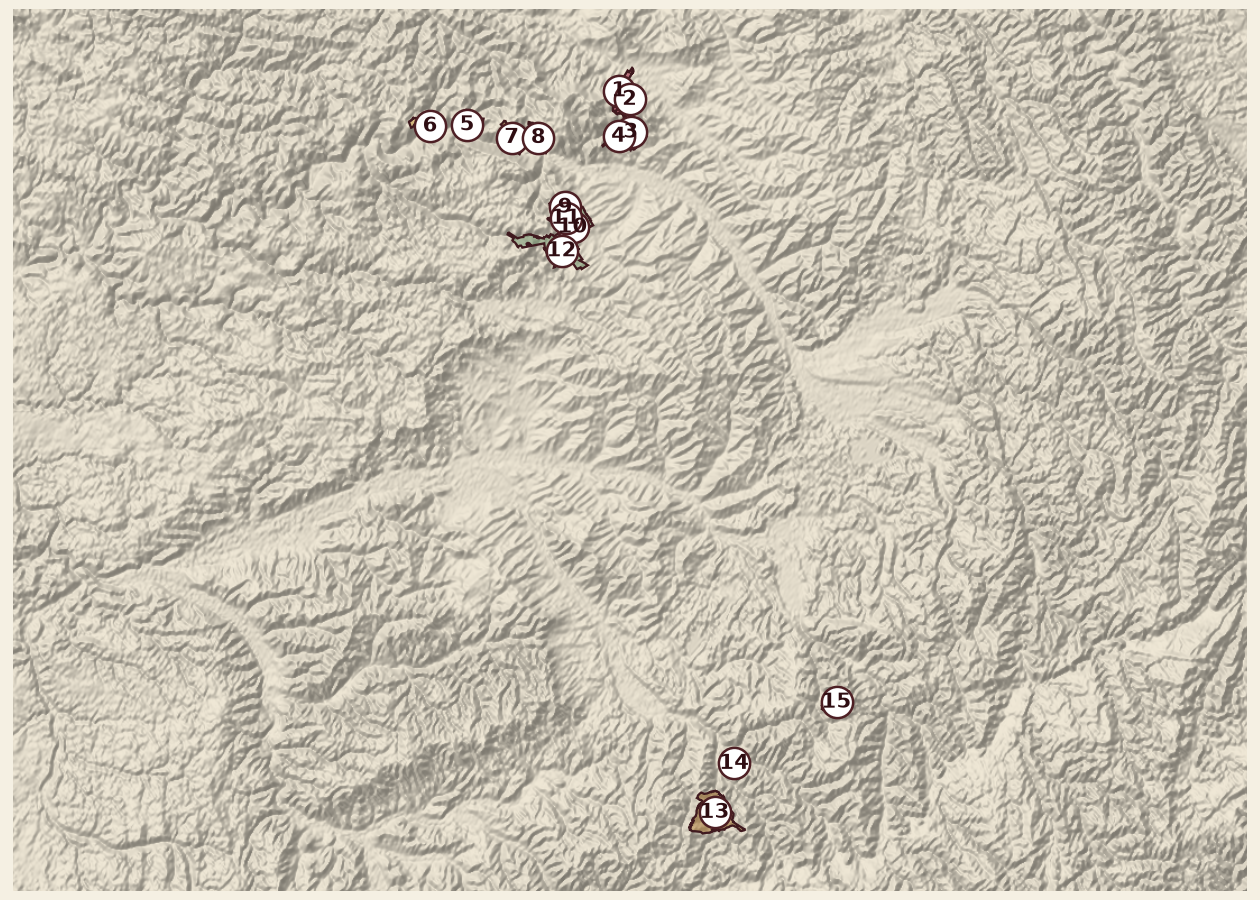
Quindici comuni per i quattro distretti del vigneto champenois. Fra i vigneti della Marna, in alto, e la Côte des Bar nell'Aube ci sono cento chilometri di campagna senza vigna: la stessa denominazione, due mondi. I numeri e i colori tornano nella legenda e nell'elenco delle denominazioni.Fifteen villages for the four districts of the Champagne vineyard. Between the Marne vineyards at the top and the Côte des Bar in the Aube lie a hundred kilometres of countryside with no vines: one appellation, two worlds. The numbers and colours return in the legend and in the list of appellations.
- 1 Verzenay
- 2 Verzy
- 3 Ambonnay
- 4 Bouzy
- 5 Châtillon-sur-Marne
- 6 Verneuil
- 7 Damery
- 8 Hautvillers
- 9 Avize
- 10 Le Mesnil-sur-Oger
- 11 Oger
- 12 Vertus
- 13 Les Riceys
- 14 Celles-sur-Ource
- 15 Urville
Zone e sottozoneZones and subzones
I vitigni del territorioThe grapes of the territory
Le denominazioniThe denominations
A tavolaAt the table
La tavola champenoise è di maiale e di formaggio, non di pesce: potée champenoise, il bollito di cavolo, carni di maiale e salsicce che si mangia d'inverno; jambon de Reims, prosciutto cotto e pressato in terrina; andouillette de Troyes, salsiccia di trippa che nell'Aube è un'istituzione. Su questi piatti, saporiti e grassi, funziona un Champagne di base Pinot Noir: la spuma e l'acidità puliscono il palato, la struttura regge il piatto. Sui rossi fermi della zona — i Coteaux Champenois di Bouzy o dell'Aube, Pinot Noir sottile e nervoso — la potée trova invece un abbinamento di casa, dove il vino asseconda la cucina senza sovrastarla.The Champagne table runs on pork and cheese, not fish: potée champenoise, the winter boiled dish of cabbage, pork and sausages; jambon de Reims, ham cooked and pressed in a terrine; andouillette de Troyes, the tripe sausage that in the Aube is an institution. With these rich, savoury dishes a Pinot Noir-based Champagne works: the mousse and the acidity clean the palate, the structure stands up to the plate. With the local still reds — the Coteaux Champenois of Bouzy or of the Aube, slender, nervy Pinot Noir — the potée finds a home-ground match instead, the wine following the cooking rather than overpowering it.
I formaggi sono il capitolo migliore. Il Chaource, riconosciuto in Appellation d'Origine dal 1970 (INAO), è una pasta molle a crosta fiorita di latte vaccino intero: cremoso e delicato, chiede un vino di buona acidità e sapidità, e un Blanc de Blancs della Côte des Blancs fa esattamente questo lavoro. Il Langres, della vicina Haute-Marne, ha un incavo in superficie in cui tradizionalmente si versa un goccio di Champagne o di marc. In chiusura, il biscuit rose de Reims: un biscotto asciutto che si inzuppa nel calice — abitudine locale, non da sommelier, e resta uno dei pochi casi in cui inzuppare è la regola.The cheeses are the better chapter. Chaource, an Appellation d'Origine since 1970 (INAO), is a soft, bloomy-rind cheese made from whole cow's milk: creamy and mild, it asks for a wine with good acidity and salinity, and a Blanc de Blancs from the Côte des Blancs does exactly that job. Langres, from neighbouring Haute-Marne, has a hollow on top into which a splash of Champagne or marc is traditionally poured. To finish, the biscuit rose de Reims: a dry biscuit dunked in the glass — a local habit rather than a sommelier's, and one of the few cases where dunking is the rule.
La storiaHistory
Nel 1908 il governo francese decise per la prima volta dove finiva la Champagne. Tracciò una linea attorno alla Marna e all'Aisne e lasciò fuori l'Aube: i vignaioli di Bar-sur-Aube e di Les Riceys, che coltivavano vite da secoli e vendevano l'uva alle case di Reims e di Épernay, si ritrovarono da un giorno all'altro fuori dal nome che dava valore al loro lavoro. Erano anni durissimi — peronospora, gelate, raccolti mancati, e un commercio che comprava vino da fuori regione per farne Champagne — e la decisione arrivò come una beffa.In 1908 the French government decided for the first time where Champagne ended. It drew a line around the Marne and the Aisne and left the Aube outside: the growers of Bar-sur-Aube and Les Riceys, who had farmed vines for centuries and sold their grapes to the houses of Reims and Épernay, found themselves overnight outside the name that gave their work its value. These were brutal years — mildew, frost, failed harvests, and a trade buying wine from outside the region to turn into Champagne — and the decision landed like an insult.
La protesta partì dall'Aube nell'inverno 1910-1911, guidata da Gaston Cheq: cortei, sciopero delle imposte, migliaia di persone in piazza a Bar-sur-Aube e a Troyes. Il governo cedette e fece marcia indietro sull'esclusione: a quel punto insorse la Marna, che si vide portare via l'esclusiva. Fra l'11 e il 12 aprile 1911 la rivolta arrivò ad Aÿ, il villaggio grand cru sulla valle: le case di commercio accusate di far venire uva da fuori furono assaltate, le cantine svuotate, alcuni edifici bruciati. Il governo mandò l'esercito nel vigneto.The protest started in the Aube over the winter of 1910-1911, led by Gaston Cheq: marches, a tax strike, thousands in the squares of Bar-sur-Aube and Troyes. The government gave way and reversed the exclusion — at which point the Marne rose up, seeing its exclusive right taken away. On 11 and 12 April 1911 the revolt reached Aÿ, the grand cru village on the valley: trading houses accused of bringing in grapes from elsewhere were stormed, cellars emptied, some buildings burned. The government sent the army into the vineyard.
Il compromesso arrivò nel giugno del 1911: all'Aube fu concessa una «Champagne di seconda zona», una denominazione di serie B che non accontentò nessuno. La questione restò aperta fino alla legge del 1927, che ridisegnò l'area dell'appellation e riportò dentro i comuni dell'Aube. Da quella delimitazione discende il perimetro di oggi — i 319 comuni su cinque dipartimenti — e la mappa qui sopra, con il suo vuoto di cento chilometri fra la Marna e la Côte des Bar, è il disegno di quella pace.The compromise came in June 1911: the Aube was granted a «second-zone Champagne», a second-class appellation that satisfied nobody. The matter stayed open until the law of 1927, which redrew the appellation area and brought the Aube villages back in. Today's perimeter descends from that delimitation — the 319 villages across five départements — and the map above, with its hundred-kilometre gap between the Marne and the Côte des Bar, is the drawing of that peace.
La storia ha un'ultima scena, ed è recente: le viti dell'Aube che nel 1908 non erano abbastanza Champagne oggi sono una delle quattro regioni vinicole riconosciute dal Comité Champagne e vendono l'uva alle stesse case che allora le rifiutavano. E a Les Riceys, il comune vitato più esteso della regione, sopravvive un rosato fermo con una denominazione tutta sua — l'unica di un solo villaggio in tutta la Champagne.The story has a last scene, and it is recent: the Aube vines that in 1908 were not Champagne enough are now one of the four wine regions recognised by the Comité Champagne and sell their grapes to the very houses that once refused them. And at Les Riceys, the largest vine-growing commune in the region, a still rosé survives with an appellation of its own — the only single-village one in all of Champagne.
Numeri e denominazioni da fonti ufficiali verificate: Comité Champagne (319 comuni, 34.200 ettari in produzione, ripartizione dei vitigni, numero di vigneron, cooperative e maison — cifre 2025) e INAO (cahier des charges dell'AOC Champagne, da cui abbiamo contato uno per uno i 17 comuni grand cru e i 42 premier cru; altitudini e durate minime di affinamento). Il riconoscimento UNESCO dei «Coteaux, Maisons et Caves de Champagne» è del 2015. Il Chaource è in Appellation d'Origine dal 1970 (INAO). Le indicazioni di stile e di abbinamento sono nostre e descrivono un profilo ricorrente, non una singola annata.Figures and appellations from verified official sources: Comité Champagne (319 villages, 34,200 hectares in production, grape breakdown, numbers of growers, cooperatives and houses — 2025 figures) and INAO (the cahier des charges of the Champagne AOC, from which we counted one by one the 17 grand cru villages and the 42 premiers crus; altitudes and minimum ageing periods). The UNESCO listing of the «Coteaux, Maisons et Caves de Champagne» dates from 2015. Chaource has been an Appellation d'Origine since 1970 (INAO). Style and food-pairing notes are ours and describe a recurring profile, not a single vintage.