All'incontro di due fiumi e di un grande estuario, attorno alla città di Bordeaux, si estende il più vasto vigneto a denominazione di Francia: quasi 87.000 ettari, una sessantina di denominazioni, due rive che parlano lingue diverse. Qui il vino ha imparato a viaggiare per mare e a invecchiare per decenni.Where two rivers meet a great estuary, around the city of Bordeaux, stretches France's largest appellation vineyard: almost 87,000 hectares, around sixty appellations, two riverbanks that speak different languages. Here wine learned to travel by sea and to age for decades.
Il territorioThe territory
La terraThe land
Due anime di suolo. Sulla riva sinistra della Garonna le ghiaie profonde e drenanti del Médoc e delle Graves scaldano e asciugano le radici, terreno d'elezione del Cabernet Sauvignon. Sulla riva destra, attorno a Saint-Émilion e Pomerol, argille e calcari trattengono l'acqua e fanno la fortuna del Merlot. Clima oceanico mitigato dall'Atlantico e dalla foresta delle Landes; l'estuario tiene lontane le gelate.Two souls of soil. On the left bank of the Garonne the deep, free-draining gravels of the Médoc and the Graves warm and dry the roots — the chosen ground of Cabernet Sauvignon. On the right bank, around Saint-Émilion and Pomerol, clay and limestone hold water and make the fortune of Merlot. An oceanic climate tempered by the Atlantic and the pine forest of the Landes; the estuary keeps frost at bay.
Il vitignoThe grape
L'idea di Bordeaux è l'assemblaggio: nessun vino vive di un solo vitigno. Tra i rossi il Merlot è il più piantato, seguito da Cabernet Sauvignon e Cabernet Franc, con i tocchi di Petit Verdot, Malbec e Carménère. Tra i bianchi, Sémillon e Sauvignon Blanc danno sia i secchi tesi sia i grandi dolci, con un soffio di Muscadelle.The idea of Bordeaux is the blend: no wine lives on a single grape. Among the reds Merlot is the most planted, followed by Cabernet Sauvignon and Cabernet Franc, with touches of Petit Verdot, Malbec and Carménère. Among the whites, Sémillon and Sauvignon Blanc give both the taut dry wines and the great sweet ones, with a breath of Muscadelle.
L'uomoThe human hand
Qui l'uomo ha inventato un modo di vendere il vino: lo château come marchio, il négoce e la Place de Bordeaux che da secoli smistano le bottiglie nel mondo attraverso i mediatori. La classifica del 1855, nata dai prezzi di mercato, e l'antico commercio con l'Inghilterra — che il rosso leggero lo chiamava «claret» — hanno fatto di Bordeaux un linguaggio prima ancora che un luogo.Here people invented a way of selling wine: the château as a brand, the négoce and the Place de Bordeaux that for centuries have channelled bottles across the world through their brokers. The 1855 classification, born from market prices, and the old trade with England — which called the light red 'claret' — turned Bordeaux into a language before it was even a place.
La mappaThe map
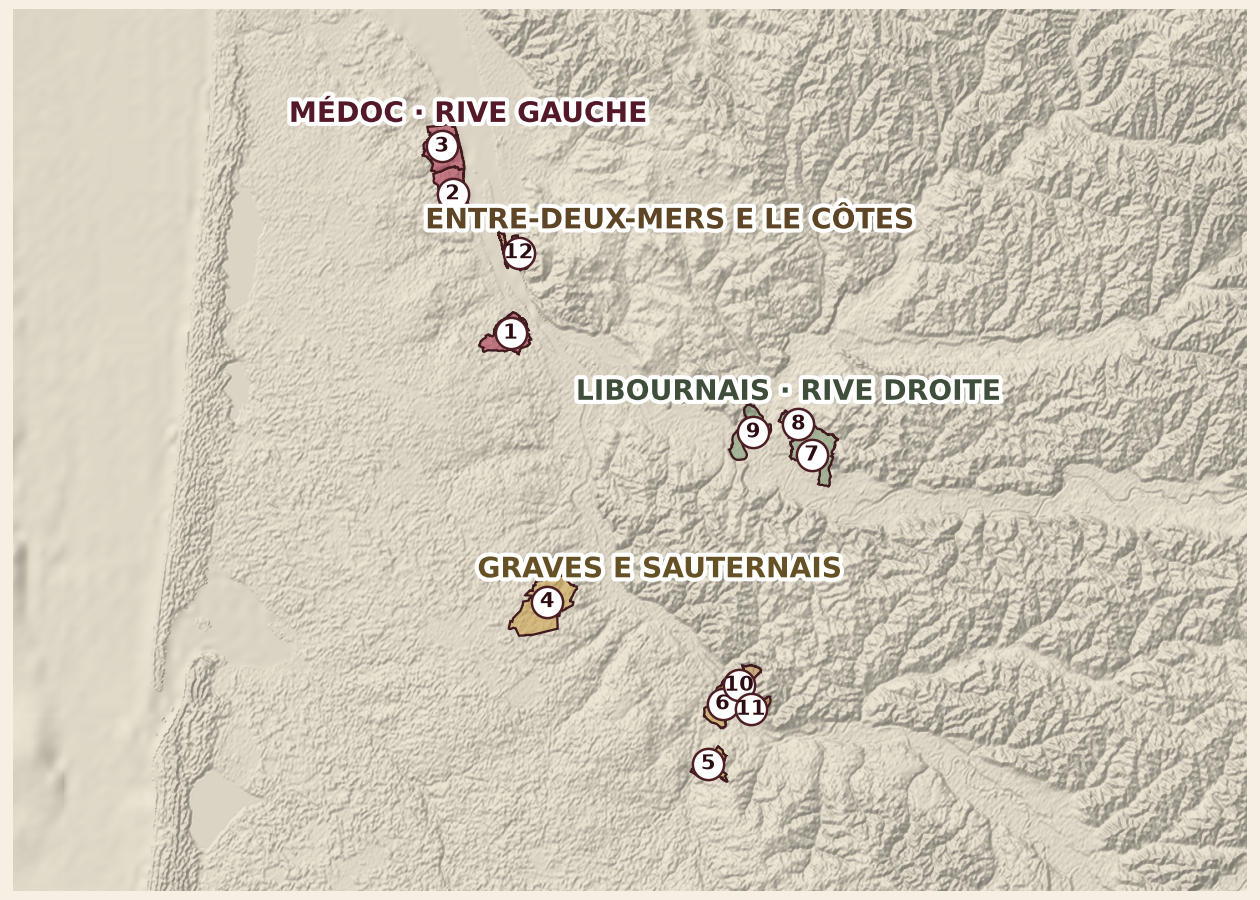
Le quattro grandi anime del vignoble bordolese: Médoc e Graves sulla riva sinistra, il Libournais sulla destra, l'Entre-Deux-Mers e le Côtes tra i fiumi. Comuni selezionati, dati aperti OpenStreetMap.The four great souls of the Bordeaux vineyard: Médoc and Graves on the left bank, the Libournais on the right, the Entre-Deux-Mers and the Côtes between the rivers. Selected communes, open OpenStreetMap data.
- 1 Margaux
- 2 Pauillac
- 3 Saint-Estèphe
- 4 Léognan
- 5 Sauternes
- 6 Barsac
- 7 Saint-Émilion
- 8 Pomerol
- 9 Fronsac
- 10 Loupiac
- 11 Sainte-Croix-du-Mont
- 12 Blaye
Zone e sottozoneZones and subzones
I vitigni del territorioThe grapes of the territory
Le denominazioniThe denominations
A tavolaAt the table
La tavola di Bordeaux e della Gironda chiede vini di casa. Sull'entrecôte alla bordolese — la costata nella salsa al vino rosso e midollo — si versa un rosso del Médoc, sodo e tannico, a base di Cabernet. L'agnello di Pauillac, tenero e saporito, ama gli stessi rossi strutturati. La lamproia alla bordolese, grassa e intensa, sta meglio con un rosso più morbido di Merlot, della riva destra o delle Côtes. Le ostriche del bacino di Arcachon vogliono un bianco secco e nervoso di Sauvignon, dall'Entre-Deux-Mers o dalle Graves. E sui canelé, caramellati e profumati di vaniglia, un dolce di Sauternes o di Loupiac chiude il cerchio.The table of Bordeaux and the Gironde calls for the wines of home. With entrecôte à la bordelaise — rib steak in a red-wine and marrow sauce — pour a firm, tannic Médoc red built on Cabernet. Pauillac lamb, tender and savoury, loves the same structured reds. Lamproie à la bordelaise, rich and intense, sits better with a softer Merlot red from the right bank or the Côtes. The oysters of the Arcachon bay want a dry, nervy Sauvignon white from the Entre-Deux-Mers or the Graves. And with canelés, caramelised and vanilla-scented, a sweet Sauternes or Loupiac closes the circle.
La storiaHistory
Nel 1855 Napoleone III volle che l'Esposizione Universale di Parigi mostrasse al mondo il meglio della Francia, vini compresi. La Camera di commercio di Bordeaux affidò il compito ai courtiers, i mediatori che ogni giorno trattavano le bottiglie sulla piazza: non assaggiarono nulla, si limitarono a mettere in fila i prezzi praticati da decenni. Il 18 aprile 1855 nacque così una classifica in cinque livelli per i rossi del Médoc — più l'unica eccezione di Château Haut-Brion, nelle Graves — e in tre livelli per i dolci di Sauternes e Barsac, con un solo nome al vertice assoluto: Château d'Yquem, Premier Cru Supérieur. In cima ai rossi, quattro castelli: Lafite, Latour, Margaux e Haut-Brion. Mancava Mouton Rothschild, fermo al secondo livello: il barone Philippe de Rothschild combatté per oltre un secolo, finché nel 1973 un decreto lo promosse — l'unico cambio di rango in oltre centosessant'anni. La riva destra, esclusa perché non dipendeva da quella Camera di commercio, si diede molto più tardi la propria classifica di Saint-Émilion, e la rivede ogni dieci anni: due modi opposti di leggere lo stesso vino.In 1855 Napoleon III wanted the Universal Exhibition of Paris to show the world the best of France, wines included. The Bordeaux Chamber of Commerce handed the task to the courtiers, the brokers who traded bottles on the marketplace every day: they tasted nothing, they simply lined up the prices of decades. So, on 18 April 1855, a five-tier ranking of the Médoc reds was born — plus the single exception of Château Haut-Brion, in the Graves — and a three-tier one for the sweet wines of Sauternes and Barsac, with a single name at the very summit: Château d'Yquem, Premier Cru Supérieur. Atop the reds stood four châteaux: Lafite, Latour, Margaux and Haut-Brion. Mouton Rothschild was missing, stuck at the second tier: Baron Philippe de Rothschild fought for over a century, until in 1973 a decree promoted it — the only change of rank in more than a hundred and sixty years. The right bank, left out because it did not answer to that Chamber of Commerce, gave itself the Saint-Émilion classification much later, and revises it every ten years: two opposite ways of reading the same wine.
I profili descritti sono caratteristici e ricorrenti, non la degustazione di una singola annata. Numeri e denominazioni provengono da fonti ufficiali verificate e archiviate — il registro UE delle indicazioni geografiche e la DRAAF Nouvelle-Aquitaine; il conteggio delle denominazioni varia secondo il criterio adottato (famiglie commerciali del CIVB o disciplinari INAO) e lo dichiariamo come tale.The profiles described are characteristic and recurring, not the tasting of a single vintage. Figures and appellations come from official sources, verified and archived — the EU register of geographical indications and DRAAF Nouvelle-Aquitaine; the count of appellations varies with the criterion used (CIVB commercial families or INAO specifications) and we flag it as such.