In Provenza il rosato non è una moda estiva: è la forma che il vino ha preso qui, e la sua fama fa ombra a tutto il resto — i rossi di lunga guardia di Bandol, i bianchi da tavola di pesce di Cassis, la minuscola enclave di Palette. Le denominazioni ufficiali sono otto. Una sola, Côtes de Provence, copre la gran parte del vigneto e al suo interno si articola in cinque terroir delimitati; le altre sette sono enclave incastrate fra il mare, la garriga e la roccia, ciascuna con una ragione geografica precisa e una manciata di produttori.In Provence rosé is not a summer fashion: it is the shape wine has taken here, and its fame overshadows everything else — the long-lived reds of Bandol, the seafood whites of Cassis, the tiny enclave of Palette. There are eight official denominations. Just one, Côtes de Provence, covers most of the vineyard and is itself divided into five delimited terroirs; the other seven are enclaves wedged between the sea, the garrigue and the rock, each with a precise geographical reason and a handful of growers.
Il territorioThe territory
La terraThe land
Due insiemi geologici si dividono la regione: il calcare a ovest e a nord, il cristallino a est, verso il mare. Alla prima corrisponde la garriga, al secondo la macchia. I suoli sono poveri, poco profondi e ben drenati — poca acqua trattenuta, radici che scendono. Sopra soffia il mistral, secco e violento: asciuga il vigneto, tiene lontani i parassiti e frena lo sviluppo delle malattie, e per questo qui si tratta meno. Dove la pendenza è forte si coltiva sulle restanques, i terrazzamenti a muretto a secco.Two geological blocks share the region: limestone to the west and north, crystalline rock to the east, towards the sea. The first carries garrigue, the second maquis. Soils are poor, shallow and well drained — little water retained, roots that go down. Above it all blows the mistral, dry and violent: it dries the vineyard, keeps pests away and slows disease, which is why less spraying is needed here. Where the slope is steep, vines grow on restanques, dry-stone terraces.
Il vitignoThe grape
Più di una dozzina di varietà, e l'assemblaggio come regola: è tradizione antica, e nasce da un fatto pratico — sotto gli eccessi del clima mediterraneo è raro che un vitigno solo dia un vino in equilibrio. Per rossi e rosati la base è grenache, cinsault, syrah, mourvèdre, con il tibouren che è quasi solo provenzale; per i bianchi clairette, ugni blanc, vermentino (qui chiamato rolle) e sémillon. Bandol fa eccezione e impone il suo vitigno: dal 50 al 95% di mourvèdre nell'impianto destinato ai rossi.More than a dozen varieties, and blending as the rule: an old tradition born of a practical fact — under the excesses of a Mediterranean climate a single variety rarely gives a balanced wine. For reds and rosés the base is Grenache, Cinsault, Syrah and Mourvèdre, plus Tibouren, which is almost exclusively Provençal; for whites, Clairette, Ugni Blanc, Vermentino (called rolle here) and Sémillon. Bandol is the exception and imposes its grape: 50 to 95% Mourvèdre in the plantings destined for red wine.
L'uomoThe human hand
All'inizio del Novecento ogni paese aveva la sua cantina sociale, e vendeva il vino sfuso; accanto crescevano le caves particulières, le aziende che vinificavano e imbottigliavano in proprio. Da quel doppio binario è nata la reputazione della regione. Oggi il vigneto è fra i più convertiti di Francia: circa il 20% delle superfici del Var e delle Bocche del Rodano è in biologico, e l'interprofessione ha fissato per il 2030 l'obiettivo del 100% di superfici certificate, biologico e/o HVE.In the early twentieth century every village had its cooperative, selling wine in bulk; alongside them grew the caves particulières, estates that vinified and bottled their own. The region's reputation came out of that double track. Today the vineyard is among the most converted in France: roughly 20% of the acreage in the Var and Bouches-du-Rhône is organic, and the trade body has set 2030 as the target for 100% certified acreage, organic and/or HVE.
La mappaThe map
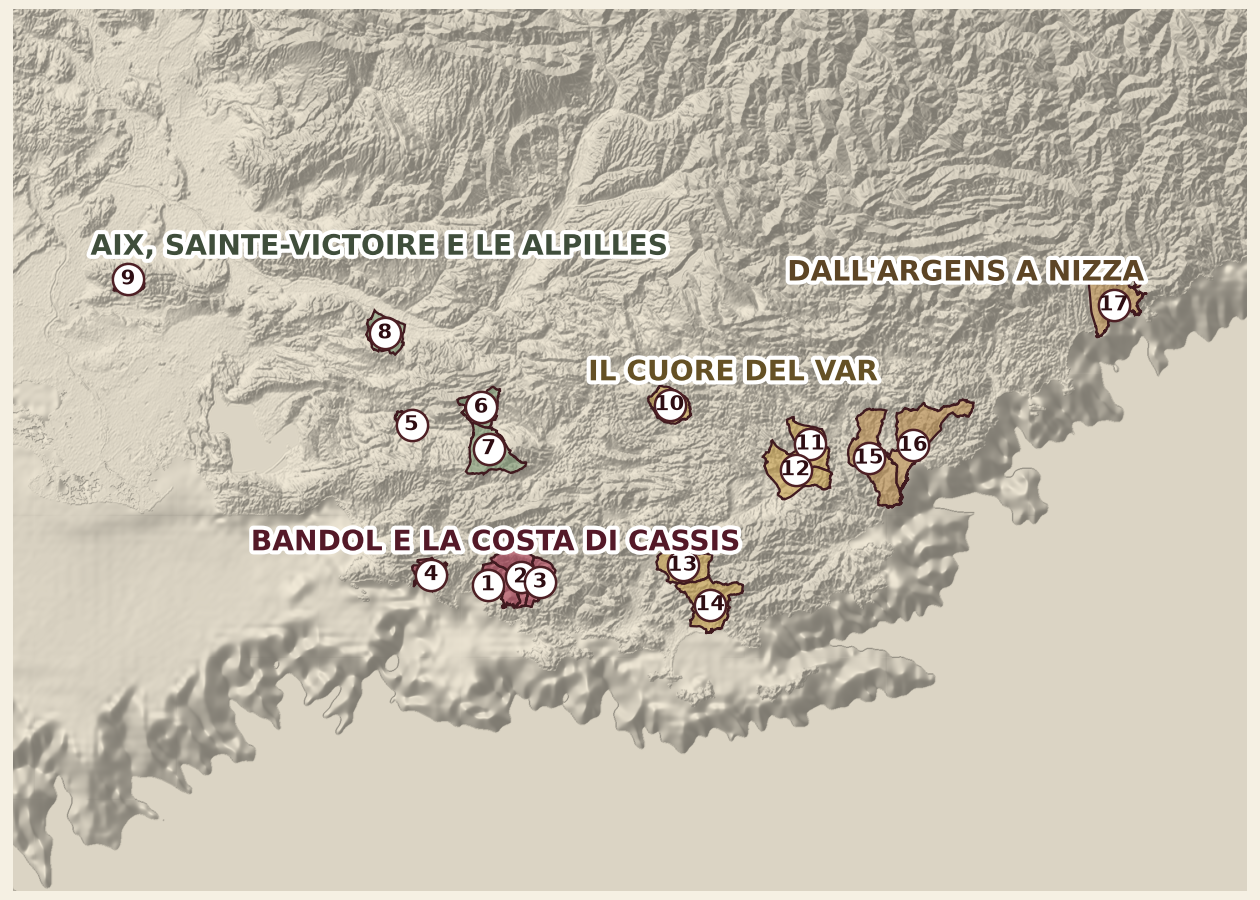
I quattro distretti del vigneto provenzale e diciassette comuni che li rappresentano. La dispersione è il messaggio: fra un'enclave e l'altra ci sono decine di chilometri di garriga, macchia e roccia.The four districts of the Provençal vineyard and seventeen communes that stand for them. The scattering is the point: between one enclave and the next lie dozens of kilometres of garrigue, maquis and rock.
- 1 La Cadière-d'Azur
- 2 Le Castellet
- 3 Le Beausset
- 4 Cassis
- 5 Meyreuil
- 6 Puyloubier
- 7 Trets
- 8 Le Puy-Sainte-Réparade
- 9 Les Baux-de-Provence
- 10 Cotignac
- 11 Les Arcs
- 12 Vidauban
- 13 Pierrefeu-du-Var
- 14 La Londe-les-Maures
- 15 Roquebrune-sur-Argens
- 16 Fréjus
- 17 Nizza (Bellet)
Zone e sottozoneZones and subzones
I vitigni del territorioThe grapes of the territory
Le denominazioniThe denominations
A tavolaAt the table
La cucina provenzale è fatta di aglio, olive, acciughe, erbe e pesce, e chiede vini che non si mettano in mezzo. La bouillabaisse marsigliese — la zuppa di pesce codificata dalla Charte de la Bouillabaisse Marseillaise — sta bene con i bianchi secchi e sapidi della costa: Cassis, che il disciplinare costruisce su clairette e marsanne, o un Bandol bianco. Stesso ragionamento per l'aïoli, il piatto conviviale di verdure lesse, baccalà e salsa all'aglio: la salsa è grassa e insistente, e serve un vino con acidità viva a rimetterla in riga — un Côtes de Provence rosato, o un bianco secco della zona.Provençal cooking is built on garlic, olives, anchovies, herbs and fish, and it asks for wines that stay out of the way. Marseille's bouillabaisse — the fish soup codified by the Charte de la Bouillabaisse Marseillaise — works with the dry, saline whites of the coast: Cassis, whose specification is built on clairette and marsanne, or a white Bandol. The same reasoning applies to aïoli, the communal dish of boiled vegetables, salt cod and garlic sauce: the sauce is rich and insistent, and it takes a wine with lively acidity to keep it in check — a Côtes de Provence rosé, or a dry local white.
Sulla daube provençale, il manzo brasato a lungo nel vino con erbe e scorza d'arancia, il vino cambia registro: qui serve struttura, e Bandol rosso la porta per costituzione, con il mourvèdre a dare tannino e una tenuta lunga. Vale anche per l'agnello arrosto con timo e rosmarino, dove il tannino tiene testa al grasso dell'agnello.With daube provençale, beef braised slowly in wine with herbs and orange peel, the register changes: this needs structure, and red Bandol has it by constitution, with mourvèdre supplying tannin and staying power. The same goes for roast lamb with thyme and rosemary, where tannin meets the fat of the meat.
Più a est la cucina si fa nizzarda: socca, pissaladière, petits farcis. Sono piatti salati e unti, da aperitivo lungo, e chiedono vini freschi e diretti — i rosati del Var, o i vini di Bellet, che di quella cucina sono i vicini di casa. E sulla tapenade spalmata sul pane, prima di tutto il resto, una bollicina secca fa un lavoro migliore di quanto ci si aspetti: le bolle e l'acidità puliscono il salato delle olive e delle acciughe.Further east the cooking turns Niçois: socca, pissaladière, petits farcis. These are salty, oily dishes for a long aperitivo, and they ask for fresh, direct wines — the rosés of the Var, or the wines of Bellet, which are that kitchen's next-door neighbours. And with tapenade spread on bread, before anything else, a dry sparkling wine does a better job than you would expect: bubbles and acidity clean up the salt of the olives and anchovies.
La storiaHistory
Quando i Focesi fondarono Marsiglia, circa 2.600 anni fa, portarono con sé le prime viti piantate in Francia: la Provenza è, cronologicamente, il vigneto francese più antico — lo scrive l'interprofessione dei Vins de Provence nella sua guida ufficiale. Quattro secoli dopo arrivarono i Romani, e da qui la vite si mosse verso il resto della Gallia. Duemila anni più tardi, però, quella primogenitura non contava quasi nulla: nel Novecento la Provenza era conosciuta per il vino sfuso, e il grosso della produzione usciva dalle cantine sociali di paese verso le città del nord.When the Phocaeans founded Marseille some 2,600 years ago, they brought with them the first vines planted in France: chronologically, Provence is France's oldest vineyard — as the Vins de Provence trade body states in its official guide. Four centuries later the Romans arrived, and from here the vine moved out into the rest of Gaul. Two thousand years on, however, that seniority counted for almost nothing: in the twentieth century Provence was known for bulk wine, and most of its production left the village cooperatives for the cities of the north.
La storia di come si sia rimessa in carreggiata è scritta, con date e numeri, nella parte storica del disciplinare delle Côtes de Provence. Il nome compare per la prima volta nel 1858, adottato dalla prima associazione di difesa del vigneto provenzale, e torna dal 1919 nel quadro della legge francese sulle «appellazioni semplici». Nel 1933 nasce la prima associazione di proprietari del Var, che nel 1936 tenta senza successo la strada dell'AOC. È lo stesso anno delle ferie pagate: i primi turisti scendono in Provenza d'estate e scoprono che i rosati dell'annata, bevuti giovani e freschi, sono esattamente il vino che vogliono. Quel gusto, nato per caso in una stagione di vacanze, non se ne andrà più.How it got back on track is written, with dates and figures, in the historical section of the Côtes de Provence specification. The name first appears in 1858, adopted by the earliest association defending the Provençal vineyard, and returns from 1919 under the French law on «simple appellations». In 1933 the first association of Var estate owners is formed, and in 1936 it makes an unsuccessful bid for AOC status. That is also the year paid holidays came in: the first tourists come down to Provence in summer and find that the year's rosés, drunk young and cold, are exactly the wine they want. That taste, born by accident in a holiday season, never went away.
Il riconoscimento arriva a tappe. Nel 1941 si costituisce il Syndicat de défense des Côtes de Provence; nel 1943 alcuni decreti riconoscono l'appellazione semplice e ne fissano l'area, spingendola fino alle Alpi Marittime e alle Bocche del Rodano; nel 1951 i vini diventano VDQS, vini delimitati di qualità superiore. Poi, con due decreti ministeriali — il 7 agosto 1953 e il 20 luglio 1955 — accade la cosa che rende la Provenza un caso a sé: lo Stato riconosce la notorietà di ventitré proprietà e le classifica come crus classés. È una classificazione di aziende, non di terreni, ed è per questo che non somiglia a nessun'altra: nessuna revisione, nessun declassamento, nessuna promozione. Chi c'era è rimasto, e chi ha chiuso ha portato via il titolo con sé.Recognition came in stages. In 1941 the Syndicat de défense des Côtes de Provence is founded; in 1943 a set of decrees recognises the simple appellation and fixes its area, pushing it as far as the Alpes-Maritimes and the Bouches-du-Rhône; in 1951 the wines become VDQS, delimited wines of superior quality. Then, with two ministerial decrees — 7 August 1953 and 20 July 1955 — comes the thing that makes Provence a case of its own: the State recognises the standing of twenty-three estates and classifies them as crus classés. It is a classification of estates, not of land, which is why it resembles no other: no revision, no demotion, no promotion. Those who were in stayed in, and those who closed took the title with them.
L'AOC vera e propria per l'insieme delle Côtes de Provence arriverà solo nel 1977 — ventidue anni dopo i crus classés, una sequenza al contrario rispetto a quasi ovunque in Francia. E l'ultimo capitolo è di questi mesi: nel febbraio 2025 il Comitato nazionale dell'INAO ha dato il via libera alla menzione «Cru» per Sainte-Victoire, la prima volta in Francia che una denominazione geografica complementare la ottiene. Settant'anni dopo i ventitré châteaux del 1955, la Provenza torna a classificare — ma questa volta classifica la terra.The full AOC for Côtes de Provence as a whole arrived only in 1977 — twenty-two years after the crus classés, a sequence reversed compared with almost anywhere else in France. And the latest chapter is recent: in February 2025 the INAO's National Committee approved the «Cru» mention for Sainte-Victoire, the first time in France that a complementary geographical denomination has obtained it. Seventy years after the twenty-three châteaux of 1955, Provence is classifying again — but this time it is classifying the land.
Numeri e denominazioni provengono da fonti ufficiali verificate e archiviate: la «Liste des AOC vins» dell'INAO per il conteggio delle appellation del bacino Provence-Corse, i disciplinari INAO di Côtes de Provence (comitato nazionale del 6 febbraio 2025), Bandol e Cassis per vitigni, sottozone e regole, il Syndicat des Vins Côtes de Provence per le denominazioni geografiche complementari e la guida ufficiale dei Vins de Provence per il quadro del vigneto. Dove le fonti divergono sul perimetro della regione — il caso di Pierrevert — lo diciamo in pagina invece di scegliere in silenzio. Nessun punteggio, nessun premio.Figures and denominations come from verified, archived official sources: the INAO's «Liste des AOC vins» for the count of appellations in the Provence-Corse basin, the INAO specifications for Côtes de Provence (national committee of 6 February 2025), Bandol and Cassis for grapes, subzones and rules, the Syndicat des Vins Côtes de Provence for the complementary geographical denominations, and the official Vins de Provence guide for the overall picture of the vineyard. Where sources diverge on the region's perimeter — the Pierrevert case — we say so on the page instead of choosing in silence. No scores, no awards.