Il Rodano scende da Vienne verso il mare e per quasi duecento chilometri porta con sé due vigneti che non si somigliano: al nord terrazze di granito dove la syrah cresce quasi da sola, al sud pianori di ciottoli dove il grenache si mescola a una dozzina di altre uve. In mezzo, l'alta valle della Drôme fa quasi soltanto bollicine. Ed è qui, a Châteauneuf-du-Pape, che nel 1923 i vignaioli hanno scritto le regole da cui è nata l'appellazione francese.The Rhône runs from Vienne down towards the sea, and for almost two hundred kilometres it carries two vineyards that have little in common: granite terraces in the north, where Syrah grows all but alone, and pebble plateaux in the south, where Grenache is blended with a dozen other grapes. In between, the upper Drôme valley makes almost nothing but sparkling wine. And it was here, at Châteauneuf-du-Pape, that in 1923 the growers wrote the rules from which the French appellation system was born.
Il territorioThe territory
La terraThe land
Il fiume scava un corridoio lungo quasi duecento chilometri e lo divide in due. A nord, fra Vienne e Valence, la roccia è granito e scisto: sui cru di pendio — Côte-Rôtie, Condrieu, Cornas, la collina dell'Hermitage — le vigne stanno su terrazze strette, sostenute da muri a secco, con pendenze che obbligano a lavorare a mano; più a valle, sulle terrazze pianeggianti di ciottoli del Crozes-Hermitage, il terreno si spiana. A sud il paesaggio si apre in distese di galets roulés, i ciottoli levigati dal fiume, posati su una matrice argillosa rossa e alternati a sabbie e arenarie. A Châteauneuf-du-Pape il disciplinare descrive il meccanismo: i ciottoli accumulano calore di giorno e lo restituiscono di notte. E su tutta la valle soffia il Mistral, vento freddo e secco da nord, che asciuga i grappoli e limita le malattie.The river carves a corridor almost two hundred kilometres long and splits it in two. In the north, between Vienne and Valence, the rock is granite and schist: on the slope crus — Côte-Rôtie, Condrieu, Cornas, the hill of Hermitage — the vines sit on narrow terraces held up by dry stone walls, on slopes steep enough to force hand work; further down, on the flat pebble terraces of Crozes-Hermitage, the ground levels out. In the south the landscape opens into stretches of galets roulés, pebbles rounded by the river, set in a red clay matrix and alternating with sands and sandstone. At Châteauneuf-du-Pape the specification spells out the mechanism: the pebbles store heat by day and give it back at night. And the Mistral, a cold dry wind from the north, blows the length of the valley, drying the bunches and limiting disease.
Il vitignoThe grape
Due vigneti, due grammatiche. Al nord il rosso è syrah e basta: Hermitage, Cornas, Crozes-Hermitage, Saint-Joseph. A Côte-Rôtie il disciplinare le affianca il viognier, piantato in mezzo ai filari di syrah e vinificato insieme a essa. Lo stesso viognier, da solo, fa Condrieu e Château-Grillet, mentre marsanne e roussanne firmano i bianchi degli altri cru: a Saint-Péray sono le uniche due uve ammesse. Al sud invece si assembla. Il grenache guida, la syrah porta colore e spezia, il mourvèdre tiene la struttura; e a Châteauneuf-du-Pape il disciplinare arriva a elencare diciotto voci — tredici varietà, contate anche nelle loro versioni bianche, grigie e rosate.Two vineyards, two grammars. In the north the red grape is Syrah and nothing else: Hermitage, Cornas, Crozes-Hermitage, Saint-Joseph. At Côte-Rôtie the specification allows Viognier alongside it, planted among the Syrah rows and vinified with it. That same Viognier, on its own, makes Condrieu and Château-Grillet, while Marsanne and Roussanne make the whites of the other crus: at Saint-Péray they are the only two grapes permitted. The south, by contrast, blends. Grenache leads, Syrah brings colour and spice, Mourvèdre holds the frame; and at Châteauneuf-du-Pape the specification lists eighteen entries — thirteen varieties, counted also in their white, grey and pink versions.
L'uomoThe human hand
È in questa valle che ha preso forma il modello dell'appellazione d'origine controllata francese. Nel 1923 i vignaioli di Châteauneuf-du-Pape si danno delle regole scritte, e da quelle regole arriva nel 1936 il primo decreto: la Francia intera adotterà lo stesso schema. Il sistema è rimasto una piramide — l'AOC regionale Côtes du Rhône alla base, i villages che possono aggiungere il proprio nome geografico in etichetta, i cru in cima — e continua a muoversi: nel 2024 Laudun è passato da villages a cru.It was in this valley that the model of the French appellation d'origine contrôlée took shape. In 1923 the growers of Châteauneuf-du-Pape gave themselves written rules, and from those rules came the first decree, in 1936: the whole of France would adopt the same design. The system has stayed a pyramid — the regional Côtes du Rhône AOC at the base, the villages allowed to add their own place name to the label, the crus at the top — and it still moves: in 2024 Laudun went from village to cru.
La mappaThe map
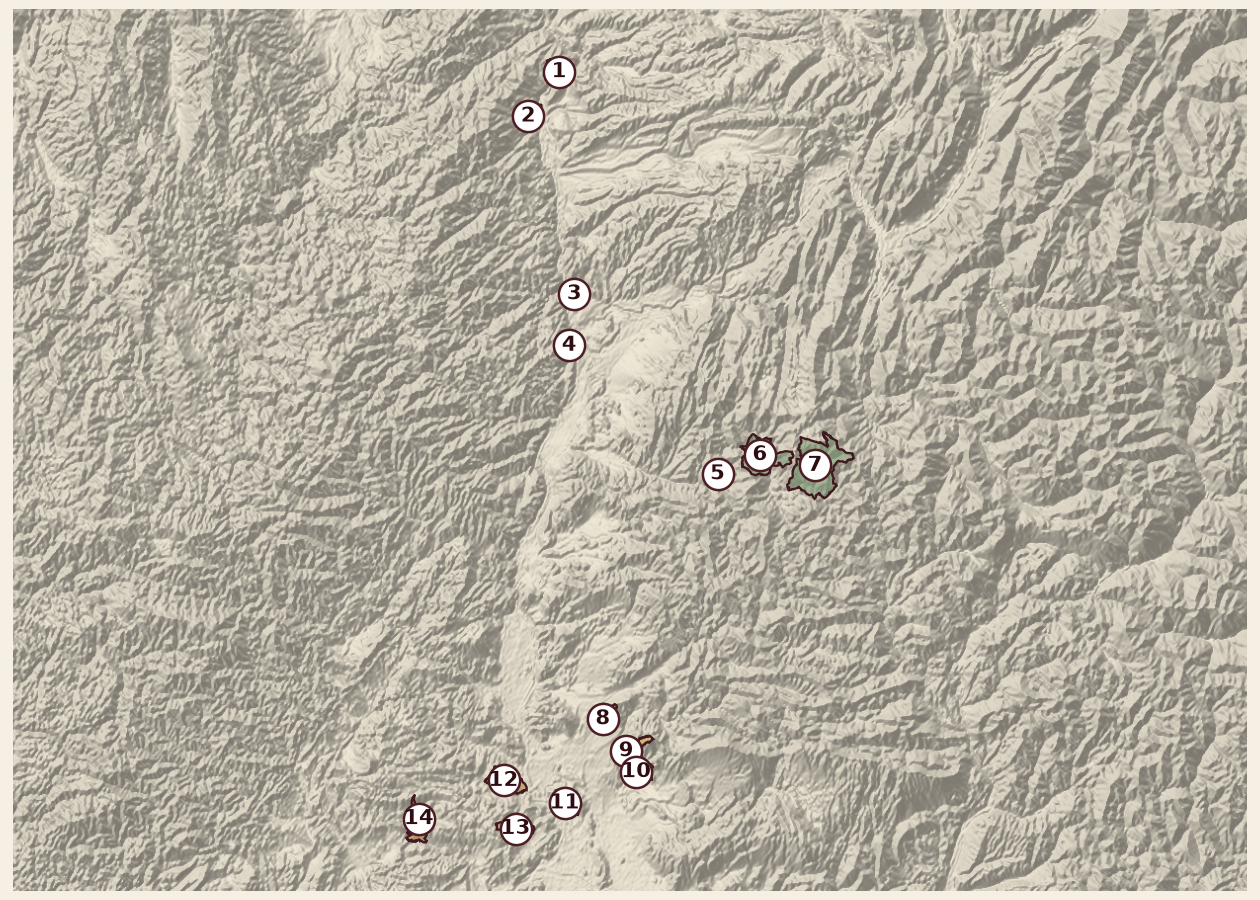
Quattordici comuni lungo il corridoio del Rodano: la prima cosa da leggere è la distanza — fra Ampuis e Tavel corrono quasi duecento chilometri di fiume.Fourteen communes along the Rhône corridor: the first thing to read is the distance — almost two hundred kilometres of river separate Ampuis from Tavel.
- 1 Ampuis
- 2 Chavanay
- 3 Tain-l'Hermitage
- 4 Cornas
- 5 Vercheny
- 6 Die
- 7 Châtillon-en-Diois
- 8 Cairanne
- 9 Gigondas
- 10 Beaumes-de-Venise
- 11 Châteauneuf-du-Pape
- 12 Laudun-l'Ardoise
- 13 Tavel
- 14 Uzès
Zone e sottozoneZones and subzones
I vitigni del territorioThe grapes of the territory
Le denominazioniThe denominations
A tavolaAt the table
La valle è lunga e la tavola cambia con lei. Al nord si mangia come a Lione e a Valence: la quenelle di luccio con la sua salsa cremosa chiede un bianco di marsanne e roussanne — un Saint-Péray, o un Crozes-Hermitage bianco — con acidità e sapidità sufficienti a stare accanto a un piatto ricco senza scomparire. La caillette dell'Ardèche, polpetta di maiale e verdure cotta al forno, e i salumi da taglio vanno con un Crozes-Hermitage rosso giovane: tannino fine, frutto scuro, poca legna.The valley is long, and the table changes with it. In the north people eat as they do in Lyon and Valence: pike quenelles in their creamy sauce call for a Marsanne-Roussanne white — a Saint-Péray, or a white Crozes-Hermitage — with enough acidity and savouriness to sit beside a rich dish without disappearing. The Ardèche caillette, a baked patty of pork and greens, and a plate of cured meats go with a young red Crozes-Hermitage: fine tannin, dark fruit, little oak.
Scendendo, la cucina diventa mediterranea. La gardianne, lo stufato di toro della Camargue cotto a lungo nel vino con le olive, trova la sua misura in un Costières de Nîmes o in un Lirac. L'agnello alle erbe e la daube provenzale chiedono più struttura: si aprono un Gigondas o un Châteauneuf-du-Pape, dove il grenache porta calore e il mourvèdre tiene la trama tannica. Il Tavel è un rosato di corpo: si porta a tavola come un rosso leggero, sull'aïoli, sui peperoni arrostiti, sul pesce all'aglio.Further south the cooking turns Mediterranean. Gardianne, the Camargue bull stew simmered at length in wine with olives, finds its measure in a Costières de Nîmes or a Lirac. Herb-roasted lamb and a Provençal daube ask for more structure: open a Gigondas or a Châteauneuf-du-Pape, where Grenache brings warmth and Mourvèdre holds the tannic weave. Tavel is a rosé with body: bring it to the table like a light red, with aïoli, roast peppers, garlicky fish.
Sui formaggi la scelta resta locale. Il picodon AOP della Drôme e dell'Ardèche, caprino asciutto, sta bene con un Condrieu: il viognier ha morbidezza e un profumo di albicocca che tiene testa al sale. Il pélardon AOP delle Cévennes preferisce un bianco più teso, dal Diois o dal Duché d'Uzès. E per chiudere, due dolci del posto — la pogne di Romans, brioche all'acqua di fiori d'arancio, e una crostata di frutta gialla — con un bicchiere di Clairette de Die, spumante dolce e leggero di grado, oppure con il Muscat de Beaumes-de-Venise, che ha zucchero e agrume in parti uguali.With cheese the choice stays local. Picodon AOP from the Drôme and the Ardèche, a dry goat's cheese, works with a Condrieu: Viognier has the softness and the apricot scent to stand up to the salt. Pélardon AOP from the Cévennes prefers a tauter white, from the Diois or the Duché d'Uzès. And to finish, two local sweets — the pogne of Romans, an orange-flower brioche, and a yellow-fruit tart — with a glass of Clairette de Die, a sweet, low-alcohol sparkling wine, or with Muscat de Beaumes-de-Venise, sugar and citrus in equal parts.
La storiaHistory
Nel 1309 il papato lascia Roma e si stabilisce ad Avignone. Sotto Giovanni XXII, papa dal 1316 al 1334, un borgo a una dozzina di chilometri dalla città diventa proprietà diretta della Santa Sede: il papa vi fa costruire il castello che gli darà il nome — la sua «residenza secondaria», scrive oggi il disciplinare — e la vigna, presente lì probabilmente già dall'XI secolo, prende slancio insieme alla fama dei suoi vini.In 1309 the papacy left Rome and settled at Avignon. Under John XXII, pope from 1316 to 1334, a village a dozen kilometres from the city became the direct property of the Holy See: the pope had the castle built there that would give the place its name — his "second residence", as the current specification puts it — and the vineyard, probably present there since the eleventh century, grew along with the reputation of its wines.
Nel Settecento il commercio si allarga. Le botti partono dai porti fluviali di Roquemaure e Les Armeniers per tutta la Francia, e da lì per l'Italia, la Germania, l'Inghilterra. Con la fama arriva però l'imitazione, e i produttori reagiscono presto: nel 1817, con l'accordo del Prefetto, il consiglio comunale vieta ai proprietari del posto di mescolare al proprio vino «frutti stranieri» — uve raccolte fuori dal territorio — perché non se ne deprezzi la qualità e non si inganni la buona fede dei mercanti. È già, in miniatura, il principio di un'origine controllata.In the eighteenth century trade widened. Barrels left the river ports of Roquemaure and Les Armeniers for the whole of France, and from there for Italy, Germany, England. With fame came imitation, and the growers reacted early: in 1817, with the Prefect's agreement, the town council forbade local owners to blend "foreign fruit" — grapes picked outside the territory — into their wine, so that its quality would not be cheapened nor the merchants' good faith abused. In miniature, that is already the principle of a controlled origin.
Un secolo dopo il problema è lo stesso, ma su scala nazionale. Il 4 ottobre 1923 i produttori di Châteauneuf-du-Pape fondano, con il barone Pierre Le Roy de Boiseaumarié, il primo sindacato per la difesa dell'appellazione. Chiedono e ottengono — con la sentenza del tribunale di Avignone del 28 giugno 1929 — una regolamentazione che fissa quattro cose insieme: la delimitazione dell'area, l'elenco delle uve autorizzate, un grado alcolico minimo e l'obbligo di scartare le uve non all'altezza. Il 15 maggio 1936 arriva il primo decreto di riconoscimento.A century later the problem was the same, but national in scale. On 4 October 1923 the growers of Châteauneuf-du-Pape founded, with Baron Pierre Le Roy de Boiseaumarié, the first syndicate for the defence of the appellation. They asked for and obtained — through the judgment of the Avignon court of 28 June 1929 — a set of rules that fixed four things at once: the boundary of the area, the list of authorised grapes, a minimum alcohol level, and the duty to reject fruit that was not good enough. On 15 May 1936 came the first decree of recognition.
Quelle quattro condizioni non restano un fatto locale: entrano quasi identiche nella legge nazionale che istituisce le appellations d'origine contrôlées. Il disciplinare in vigore lo dice ancora oggi con una frase asciutta — fu «il primo esempio di una disciplina e di una politica adottate in seguito dalle altre regioni francesi». Ogni denominazione francese, dallo Champagne al Bordeaux, discende da quel modo di ragionare.Those four conditions did not stay local: they passed almost unchanged into the national law that created the appellations d'origine contrôlées. The specification in force still says so in one dry sentence — it was "the first example of a discipline and a policy later adopted by the other French regions". Every French appellation, from Champagne to Bordeaux, descends from that way of thinking.
E la piramide continua a muoversi. Nel 2024 Laudun, che era un Côtes du Rhône Villages autorizzato ad aggiungere il proprio nome in etichetta, è diventato il diciottesimo cru della valle: cent'anni dopo il sindacato di Le Roy, il sistema che quei vignaioli hanno inventato è ancora in funzione.And the pyramid keeps moving. In 2024 Laudun, until then a Côtes du Rhône Villages entitled to add its name to the label, became the valley's eighteenth cru: a century after Le Roy's syndicate, the system those growers invented is still running.
Numeri e denominazioni vengono dalle fonti ufficiali citate: Inter Rhône (Chiffres clés, vendemmia 2024), i cahiers des charges INAO e il sito dei Côtes du Rhône. Le denominazioni cambiano nel tempo — l'elenco riflette la situazione verificata alla data di pubblicazione, compresa la promozione di Laudun a cru nel 2024.Figures and appellation names come from the official sources cited: Inter Rhône (Chiffres clés, 2024 harvest), the INAO product specifications and the Côtes du Rhône website. Appellations change over time — this list reflects the situation verified at the date of publication, including Laudun's promotion to cru in 2024.