È la comunità autonoma più grande della Spagna, e quasi tutto il suo vino nasce lungo un fiume solo. Il Duero attraversa la Castiglia e León da est a ovest e raccoglie ai suoi lati un altopiano che sta fra i seicento e i mille metri, con inverni durissimi, gelate tardive e notti fredde anche ad agosto. Su questa terra ci sono 85.210 ettari di vigna (Ministero dell'Agricoltura spagnolo, 31 luglio 2025): il 9,4% di tutto il vigneto spagnolo, seconda solo alla Castiglia-La Mancia. E c'è un dato che si legge di rado: dal 2011 a oggi la Castiglia e León è una delle sole tre comunità spagnole in cui il potenziale viticolo è cresciuto, mentre nel resto del Paese si estirpava. Qui convivono il rosso più famoso di Spagna e i bianchi di verdejo che riempiono i bar di Madrid, gli alberelli su ciottoli bianchi della Ribera del Duero e i pendii di ardesia del Bierzo — che con la Castiglia c'entra poco e guarda già alla Galizia.It is Spain's largest autonomous community, and almost all of its wine is born along a single river. The Duero crosses Castilla y León from east to west and gathers around it a plateau lying between six hundred and a thousand metres, with brutal winters, late frosts and cold nights even in August. On this land there are 85,210 hectares of vineyard (Spanish Ministry of Agriculture, 31 July 2025): 9.4% of the whole Spanish vineyard, second only to Castilla-La Mancha. And there is a figure rarely quoted: since 2011 Castilla y León has been one of only three Spanish communities whose vineyard potential has grown, while the rest of the country was pulling vines out. Here Spain's most famous red lives alongside the verdejo whites that fill the bars of Madrid, the bush vines on white pebbles of Ribera del Duero alongside the slate slopes of Bierzo — which has little to do with Castile and already looks towards Galicia.
Il territorioThe territory
La terraThe land
La Castiglia e León è un catino chiuso: la cingono il Sistema Central a sud, la cordigliera Cantabrica a nord e l'Iberica a est, e in mezzo resta un altopiano che il Duero e i suoi affluenti — Pisuerga, Arlanza, Esla, Tormes — hanno inciso in terrazze e páramos, i tavolati calcarei che si vedono da lontano come mesa. La quota è l'ingrediente principale: si vendemmia fra i 700 e i 900 metri, e a Valtiendas o a Cebreros si superano i 900. Il clima è continentale estremo, con meno di 500 mm di pioggia l'anno, e la vite ci sopravvive grazie all'escursione fra il giorno e la notte, che tiene l'acidità dentro uve maturate al sole forte. I suoli cambiano il vino più della latitudine: ciottoli e calcare bianco nella Ribera del Duero, ghiaie e sabbie su calcare a Rueda, sabbie profonde a Toro — che tennero lontana la fillossera e conservano vigne a piede franco — ardesia e argilla nel Bierzo, granito nella Sierra de Salamanca e sui pendii di Gredos, terrazze scavate nel canyon del Duero ad Arribes. Il Bierzo, in fondo a nord-ovest, è l'eccezione: una conca riparata dai monti dove arriva l'umidità atlantica e il calendario della vite anticipa di settimane.Castilla y León is a closed basin: ringed by the Sistema Central to the south, the Cantabrian range to the north and the Iberian range to the east, with a plateau in between that the Duero and its tributaries — Pisuerga, Arlanza, Esla, Tormes — have carved into terraces and páramos, the limestone tablelands that read from afar like mesas. Altitude is the main ingredient: harvest happens between 700 and 900 metres, and at Valtiendas or Cebreros it goes above 900. The climate is extreme continental, with under 500 mm of rain a year, and the vine survives thanks to the day-night swing that keeps acidity inside grapes ripened under a hard sun. Soils change the wine more than latitude does: pebbles and white limestone in Ribera del Duero, gravels and sands over limestone at Rueda, deep sands at Toro — which kept phylloxera out and still hold ungrafted vines — slate and clay in Bierzo, granite in the Sierra de Salamanca and on the Gredos slopes, terraces cut into the Duero canyon at Arribes. Bierzo, tucked away in the north-west, is the exception: a bowl sheltered by mountains where Atlantic moisture arrives and the vine's calendar runs weeks ahead.
Il vitignoThe grape
Un'uva sola, chiamata in tre modi, tiene insieme mezza regione: il Tempranillo, che nella Ribera del Duero si chiama Tinto Fino o Tinta del País e a Toro Tinta de Toro. Il disciplinare della Ribera chiede almeno il 75% di questa varietà nei rossi; a Toro dà vini scuri e alcolici, nella Ribera più tesi e minerali. Il grande bianco è il Verdejo, che a Rueda è documentato dal Medioevo e da solo ha fatto la fortuna moderna della regione; accanto gli stanno la Viura e, dal 2019, Sauvignon Blanc, Chardonnay e Viognier. Nel Bierzo comandano la Mencía, rossa profumata e di corpo medio, e il Godello fra i bianchi. Poi c'è la parte che quasi nessuno conosce fuori di qui: il Prieto Picudo della DO León, che fa rosati vibranti e rossi croccanti; il Juan García e il Bruñal nei canyon di Arribes; il Rufete sulle terrazze di granito della Sierra de Salamanca; la Garnacha di vecchia vigna a Cebreros e in Arlanza. E un bianco che stava per sparire e sta tornando: l'Albillo Mayor, che dal 2019 il disciplinare della Ribera del Duero ammette per i vini bianchi (almeno il 75%) e dal 2023 fino al 25% nei rossi.One grape, called by three names, holds half the region together: Tempranillo, known in Ribera del Duero as Tinto Fino or Tinta del País and at Toro as Tinta de Toro. Ribera's production rules require at least 75% of it in the reds; at Toro it gives dark, high-alcohol wines, in Ribera tenser and more mineral ones. The great white is Verdejo, documented at Rueda since the Middle Ages and single-handedly responsible for the region's modern fortune; beside it stand Viura and, since 2019, Sauvignon Blanc, Chardonnay and Viognier. In Bierzo the rulers are Mencía, a perfumed medium-bodied red, and Godello among the whites. Then comes the part almost nobody knows outside these borders: Prieto Picudo in DO León, which makes vibrant rosés and crunchy reds; Juan García and Bruñal in the Arribes canyons; Rufete on the granite terraces of the Sierra de Salamanca; old-vine Garnacha at Cebreros and in Arlanza. And a white that nearly disappeared and is coming back: Albillo Mayor, which since 2019 Ribera del Duero's rules allow for white wines (at least 75%) and since 2023 up to 25% in the reds.
L'uomoThe human hand
Sotto i paesi della Castiglia c'è un secondo paese. Le bodegas sotterranee — gallerie scavate a mano sotto i paesi, alcune medievali — servivano a tenere il vino a temperatura costante, e si riconoscono dalle zarceras, i camini di ventilazione che spuntano dai cortili e dai campi come piccole ciminiere di terra. Erano di tutti: ogni famiglia aveva la sua. Su questo impianto contadino si è costruita la viticoltura moderna, e non sempre in modo lineare. La DO Rueda, riconosciuta il 12 gennaio 1980, è la prima denominazione d'origine della Castiglia e León; la Ribera del Duero arriva nel 1982, quando nella valle le cantine si contavano su due mani. Da lì in avanti la regione ha fatto una cosa rara: invece di inseguire un solo modello, ha riconosciuto una dopo l'altra anche le zone piccole — Arlanza, Arribes, Tierra del Vino de Zamora, León, poi i vini di qualità di Sierra de Salamanca, Valtiendas, Valles de Benavente e Cebreros. Diciassette figure di qualità in tutto, e la sensazione che il lavoro non sia finito.Under the villages of Castile there is a second village. The underground bodegas — galleries dug by hand beneath the villages, some of them medieval — kept wine at a steady temperature, and you spot them by the zarceras, the ventilation shafts poking out of yards and fields like small earthen chimneys. They belonged to everybody: every family had one. Modern viticulture was built on that peasant framework, and not always in a straight line. DO Rueda, recognised on 12 January 1980, is the first denomination of origin in Castilla y León; Ribera del Duero followed in 1982, when the wineries in the valley could be counted on two hands. From then on the region did something rare: instead of chasing a single model, it recognised the small areas too, one after another — Arlanza, Arribes, Tierra del Vino de Zamora, León, then the quality wines of Sierra de Salamanca, Valtiendas, Valles de Benavente and Cebreros. Seventeen quality designations in all, and the feeling that the job is not finished.
La mappaThe map
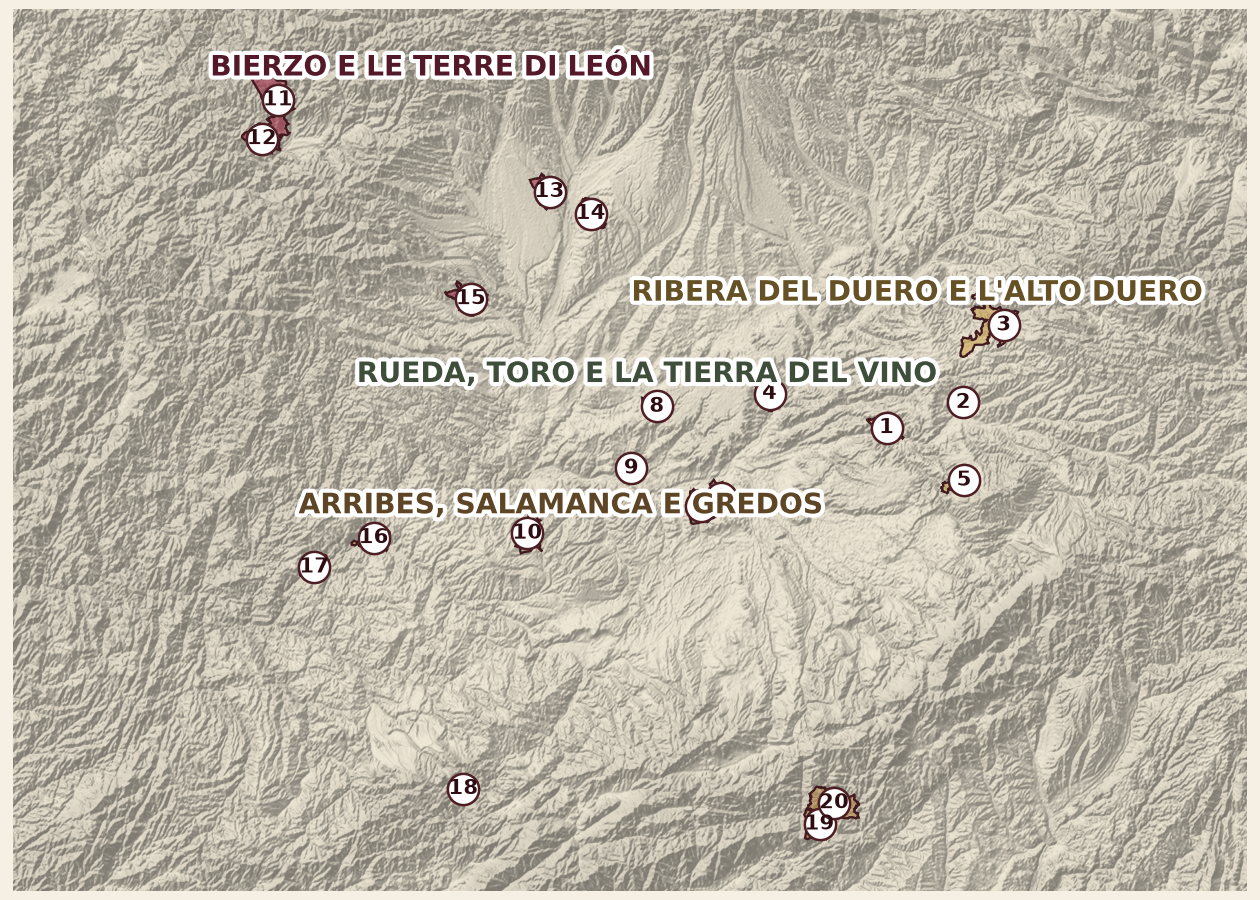
I quattro distretti del vino della Castiglia e León e venti comuni che li rappresentano. Le zone sono distanti fra loro: la mappa a scala regionale serve proprio a mostrarlo.The four wine districts of Castilla y León and twenty villages that stand for them. The zones lie far apart: the regional-scale map is meant to show exactly that.
- 1 Pesquera de Duero
- 2 La Horra
- 3 Lerma
- 4 Cigales
- 5 Valtiendas
- 6 La Seca
- 7 Rueda
- 8 Urueña
- 9 Morales de Toro
- 10 Corrales del Vino
- 11 Villafranca del Bierzo
- 12 Corullón
- 13 Valdevimbre
- 14 Pajares de los Oteros
- 15 Santibáñez de Vidriales
- 16 Fermoselle
- 17 Aldeadávila de la Ribera
- 18 Villanueva del Conde
- 19 El Tiemblo
- 20 Cebreros
Zone e sottozoneZones and subzones
I vitigni del territorioThe grapes of the territory
Le denominazioniThe denominations
A tavolaAt the table
La cucina castigliana è cucina di forno e di inverno, e il piatto che la riassume è il lechazo asado: agnello da latte di razza churra, cotto lentamente in forno a legna in una teglia di coccio con poca acqua e niente altro. È coperto da un'indicazione geografica protetta, il Lechazo de Castilla y León. La carne è grassa e di tendenza dolce, e chiede per contrapposizione un rosso con tannino e alcol: un tempranillo della Ribera del Duero con qualche anno di legno è l'abbinamento che si fa da sempre, un Arlanza più fresco quello che sorprende. Stessa logica per il cochinillo asado segoviano, maialino da latte dalla pelle vetrosa, dove la grassezza e la croccantezza vogliono un vino con acidità e tannino insieme.Castilian cooking is oven cooking and winter cooking, and the dish that sums it up is lechazo asado: churra-breed milk-fed lamb, roasted slowly in a wood-fired oven in an earthenware dish with a little water and nothing else. It is covered by a protected geographical indication, Lechazo de Castilla y León. The meat is fatty and sweet-tending, and by contrast it asks for a red with tannin and alcohol: a Ribera del Duero tempranillo with a few years of oak is the pairing everyone has always made, a fresher Arlanza the one that surprises. The same logic applies to Segovian cochinillo asado, suckling pig with glassy skin, where fat and crunch want a wine with acidity and tannin together.
Più a nord-ovest cambia tutto. Il botillo del Bierzo — insaccato affumicato di parti del maiale, bollito e servito con cachelos e cavolo — è potente, salino e affumicato: il vino giusto non è il più muscoloso ma il più bevibile, e la Mencía del Bierzo, con la sua acidità e i tannini fini, tiene testa senza sovrastare. La cecina de León, manzo salato, essiccato e affumicato, è tesa e sapida: qui un prieto picudo rosato della DO León, vivo e leggermente tannico, funziona meglio di un rosso importante. E la morcilla de Burgos, con il suo riso e la cipolla, sta bene con un clarete di Cigales, che è nato esattamente per queste tavole.Further north-west everything changes. Botillo del Bierzo — a smoked sausage of pork cuts, boiled and served with cachelos and cabbage — is powerful, salty and smoky: the right wine is not the most muscular but the most drinkable, and Bierzo Mencía, with its acidity and fine tannins, stands up to it without overwhelming. Cecina de León, salted, dried and smoked beef, is taut and savoury: here a prieto picudo rosé from DO León, lively and lightly tannic, works better than a serious red. And morcilla de Burgos, with its rice and onion, sits well with a Cigales clarete, which was born for exactly these tables.
Sul fronte dei bianchi, il verdejo di Rueda non è solo l'aperitivo: la sua acidità e la nota amaricante finale reggono le verdure amare, i formaggi freschi e le zuppe di legumi che qui sono un genere a sé — la lenteja de La Armuña, le judías de El Barco de Ávila. Con il queso Zamorano, pecorino stagionato e piccante, la scelta si sposta: o un verdejo maturato sui lieviti, o direttamente un Dorado di Rueda, il liquoroso ossidativo che quasi nessuno si aspetta di trovare in Castiglia.On the white side, Rueda verdejo is not just an aperitif: its acidity and faintly bitter finish hold up to bitter vegetables, fresh cheeses and the pulse soups that are a genre of their own here — lenteja de La Armuña, judías de El Barco de Ávila. With queso Zamorano, a sharp aged sheep's cheese, the choice shifts: either a verdejo aged on its lees, or straight to a Rueda Dorado, the oxidative fortified wine almost nobody expects to find in Castile.
La storiaHistory
Negli anni Sessanta, a La Seca e nei paesi intorno a Medina del Campo, il verdejo si strappava. Non perché fosse cattivo: perché non serviva più a niente. Per secoli quelle vigne avevano fatto il Dorado, un bianco maturato in ossidazione dentro le cantine scavate sotto i cortili — un vino che nel Siglo de Oro era arrivato alla corte dei Re Cattolici e che nel 1911 una Reale Ordinanza aveva dichiarato «vino speciale», simile a quelli di Jerez e di Malaga. Ma il gusto era cambiato: nessuno voleva più bianchi ossidati, e quel che restava del raccolto finiva sfuso, comprato a peso come base per il vermut. Una varietà autoctona, arrivata sul Duero nell'undicesimo secolo con i mozarabi che ripopolavano la valle, stava sparendo per obsolescenza commerciale. Al suo posto si piantava quel che rendeva di più.In the 1960s, at La Seca and in the villages around Medina del Campo, verdejo was being pulled out. Not because it was bad: because it was no longer good for anything. For centuries those vines had made Dorado, a white aged oxidatively in the cellars dug beneath the yards — a wine that in the Golden Age had reached the court of the Catholic Monarchs and that in 1911 a Royal Order had declared a «special wine», akin to those of Jerez and Malaga. But taste had changed: nobody wanted oxidative whites any more, and what was left of the crop went out in bulk, bought by weight as a base for vermouth. A native variety, brought to the Duero in the eleventh century by the Mozarabs repopulating the valley, was disappearing through commercial obsolescence. In its place people planted whatever paid better.
Rodríguez Vidal, viticoltore di La Seca da una famiglia che faceva vino lì dal Seicento, non strappò. Tenne le sue vigne, e in particolare il pago di Martínsancho, piantato a metà Ottocento e mai colpito dalla fillossera, che ancora oggi dà il nome alla sua cantina. Fu, per anni, una posizione solitaria e a suo modo poco ragionevole.Rodríguez Vidal, a grower at La Seca from a family that had been making wine there since the seventeenth century, did not pull his out. He kept his vines, and in particular the Martínsancho plot, planted in the mid-nineteenth century and never touched by phylloxera, which still gives his winery its name. For years it was a solitary and, in its way, hardly reasonable position.
Nel 1970 arrivò a Rueda una cantina di Rioja, Marqués de Riscal, che stava cercando in tutta la Spagna una zona in cui fare un bianco secco di qualità. Con loro c'era l'enologo francese Émile Peynaud, l'uomo che a Bordeaux aveva riscritto il modo di pensare la vinificazione. Cercavano un'uva bianca capace di acidità e di profumo in un Paese caldo; trovarono il verdejo, e trovarono Rodríguez Vidal, che mostrò loro che cosa quella vite sapeva ancora fare. Riscal comprò terra a Rueda e cominciò a imbottigliare bianchi secchi: fu la prova che la varietà aveva un futuro, e il resto della zona seguì.In 1970 a Rioja house, Marqués de Riscal, came to Rueda; it had been searching all over Spain for an area in which to make a serious dry white. With them was the French oenologist Émile Peynaud, the man who at Bordeaux had rewritten how winemaking was thought about. They were looking for a white grape capable of acidity and perfume in a hot country; they found verdejo, and they found Rodríguez Vidal, who showed them what that vine could still do. Riscal bought land at Rueda and began bottling dry whites: it was the proof that the variety had a future, and the rest of the area followed.
Il seguito è di quelli che si contano in date. Nel 1977 si riunisce per la prima volta un Consiglio Regolatore provvisorio, incaricato di scrivere il disciplinare. Il 12 gennaio 1980 il Ministero dell'Agricoltura approva il primo regolamento della DO Rueda: è la prima denominazione d'origine riconosciuta in Castiglia e León, due anni prima della Ribera del Duero. Nel 1982 il re Juan Carlos conferisce ad Rodríguez Vidal la Croce dell'Ordine Civile del Merito Agricolo proprio per aver salvato e mantenuto il verdejo mentre nella zona lo si estirpava; il primo imbottigliamento della sua cantina era uscito l'anno prima. Oggi Rueda è la prima denominazione spagnola per vino bianco di qualità, e nel 2023 l'Unione Europea ha esteso la categoria dei vini generosi anche ai suoi Dorado e Pálido: il vino da cui tutto era cominciato, e che quasi era stato lasciato morire, è tornato a essere una tipologia riconosciuta.What happened next can be counted in dates. In 1977 a provisional Regulatory Council met for the first time, charged with drafting the production rules. On 12 January 1980 the Ministry of Agriculture approved the first regulation of DO Rueda: the first denomination of origin recognised in Castilla y León, two years before Ribera del Duero. In 1982 King Juan Carlos awarded Rodríguez Vidal the Cross of the Civil Order of Agricultural Merit precisely for having saved and maintained verdejo while the area was tearing it up; his winery's first bottling had come out the year before. Today Rueda is Spain's leading denomination for quality white wine, and in 2023 the European Union extended the fortified-wine category to its Dorado and Pálido as well: the wine it had all begun with, and that had almost been left to die, is a recognised style once more.
Conteggio delle denominazioni e classificazioni dal registro ufficiale del Ministero dell'Agricoltura spagnolo (MAPA); superficie vitata dall'avanzo del potenziale viticolo MAPA al 31 luglio 2025; regole di uvaggio, menzioni e rese dai disciplinari ufficiali di Ribera del Duero, Rueda e Bierzo; cronologia della DO Rueda dal Consiglio Regolatore. Nessun punteggio, premio o volume di produzione è riportato.Denomination counts and classifications from the official register of the Spanish Ministry of Agriculture (MAPA); vineyard area from the MAPA vineyard-potential advance report as at 31 July 2025; blending rules, mentions and yields from the official production rules of Ribera del Duero, Rueda and Bierzo; the DO Rueda timeline from its Regulatory Council. No scores, awards or production volumes are reported.