La Basilicata ha sei denominazioni in tutto: una DOCG, quattro DOC e una IGT, secondo l'elenco del MASAF. Sono poche e stanno tutte scritte sulla carta geografica. A nord si alza il Monte Vulture, un vulcano spento che tocca i 1.327 metri: sulle sue pendici, fra i 200 e i 700 metri, l'Aglianico dà il vino che ha portato il nome della regione fuori dai suoi confini. A sud-est la collina materana guarda verso la Puglia e lavora soprattutto il Primitivo. Più a sud, nell'interno, stanno l'Alta Val d'Agri e Roccanova, e nella prima la vite arriva a ottocento metri. È una regione piccola, con un'uva che le dà il volto e una geografia che fa il resto.Basilicata has six appellations in all: one DOCG, four DOC and one IGT, according to the MASAF register. They are few, and they are all written into the map. To the north rises Monte Vulture, an extinct volcano reaching 1,327 metres: on its slopes, between 200 and 700 metres, Aglianico gives the wine that carried the region's name beyond its borders. To the south-east the Matera hills look towards Puglia and work mainly with Primitivo. Further south, inland, lie the upper Val d'Agri and Roccanova, and in the former the vine climbs to eight hundred metres. It is a small region, with one grape that gives it a face and a geography that does the rest.
Il territorioThe territory
La terraThe land
Il Monte Vulture è un vulcano spento, attivo fino al Pleistocene superiore, con la vetta maggiore a 1.327 metri; la sua attività eruttiva è cominciata circa 800.000 anni fa e ha lasciato un'alternanza di tufi vulcanici e tufi di deposito arenario, che nei mesi asciutti fanno da riserva d'acqua per la vite. I suoli vanno dal sabbioso e sabbioso-pozzolanico al limoso-argilloso; i vigneti stanno fra i 200 e i 700 metri, esposti a est e sud-est. Luglio e agosto sono aridi, con medie di 25 °C e punte di 35 per effetto dei venti africani, ma il massiccio richiama correnti e brezze che abbassano le temperature notturne. Le piogge annue medie sono di 650-750 millimetri e cadono soprattutto fra autunno e inverno. Nella collina materana la geologia cambia del tutto: pianura costiera, terrazzi marini con suoli rossi profondi e, per la gran parte, le superfici sabbioso-conglomeratiche della Fossa Bradanica.Monte Vulture is an extinct volcano, active until the late Pleistocene, its highest peak at 1,327 metres; its eruptive activity began around 800,000 years ago and left an alternation of volcanic tuffs and sandstone-deposit tuffs which, in the dry months, act as a water reserve for the vine. Soils range from sandy and sandy-pozzolanic to silty-clay; the vineyards sit between 200 and 700 metres, facing east and south-east. July and August are arid, averaging 25 °C with peaks of 35 under African winds, but the massif draws in air currents and breezes that lower night temperatures. Average annual rainfall is 650-750 millimetres, falling mostly between autumn and winter. In the Matera hills the geology changes entirely: a coastal plain, marine terraces with deep red soils and, for the most part, the sandy-conglomeratic surfaces of the Bradanic Trough.
Il vitignoThe grape
Sul Vulture comanda l'Aglianico, e comanda da solo: il disciplinare delle due denominazioni del vulcano ammette unicamente Aglianico del Vulture e Aglianico. È un'uva che germoglia tardi — per questo le gelate di primavera di norma non la intaccano — e matura ancora più tardi, di norma fra ottobre e novembre. Nel resto della regione le uve sono altre: Primitivo, Sangiovese e Malvasia bianca di Basilicata nella collina materana, Merlot e Cabernet Sauvignon nell'Alta Val d'Agri, Sangiovese con Cabernet Sauvignon, Malvasia nera di Basilicata e Montepulciano a Roccanova.On the Vulture Aglianico rules, and rules alone: the specification of the volcano's two appellations admits only Aglianico del Vulture and Aglianico. It is a grape that buds late — which is why spring frosts usually leave it untouched — and ripens later still, usually between October and November. Elsewhere in the region the grapes are different: Primitivo, Sangiovese and Malvasia bianca di Basilicata in the Matera hills, Merlot and Cabernet Sauvignon in the upper Val d'Agri, Sangiovese with Cabernet Sauvignon, Malvasia nera di Basilicata and Montepulciano at Roccanova.
L'uomoThe human hand
La proprietà qui è minuta: il disciplinare parla di una polverizzazione fondiaria che ancora oggi resta sotto l'ettaro, e le forme di allevamento ammesse sono quelle di sempre, alberello o spalliera semplice. La cantina, invece, è sottoterra. A Melfi, Rionero, Barile, Maschito e Ripacandida si vinificava e si conservava nelle grotte scavate nel tufo o negli ipogei naturali, e oggi molte case del Vulture lavorano in quelle stesse grotte, recuperate o ricostruite. Dove la proprietà è troppo piccola per fare da sé, il lavoro è cooperativo: la cantina sociale di Venosa nasce da lì.Holdings here are tiny: the specification speaks of a fragmentation of land that still today stays below one hectare, and the permitted training systems are the traditional ones, bush vine or simple trellis. The cellar, by contrast, is underground. At Melfi, Rionero, Barile, Maschito and Ripacandida wine was made and kept in caves cut into the tuff or in natural hypogea, and today many Vulture houses still work in those same caves, restored or rebuilt. Where a holding is too small to stand alone, the work is cooperative: the Venosa growers' cellar was born from that.
La mappaThe map
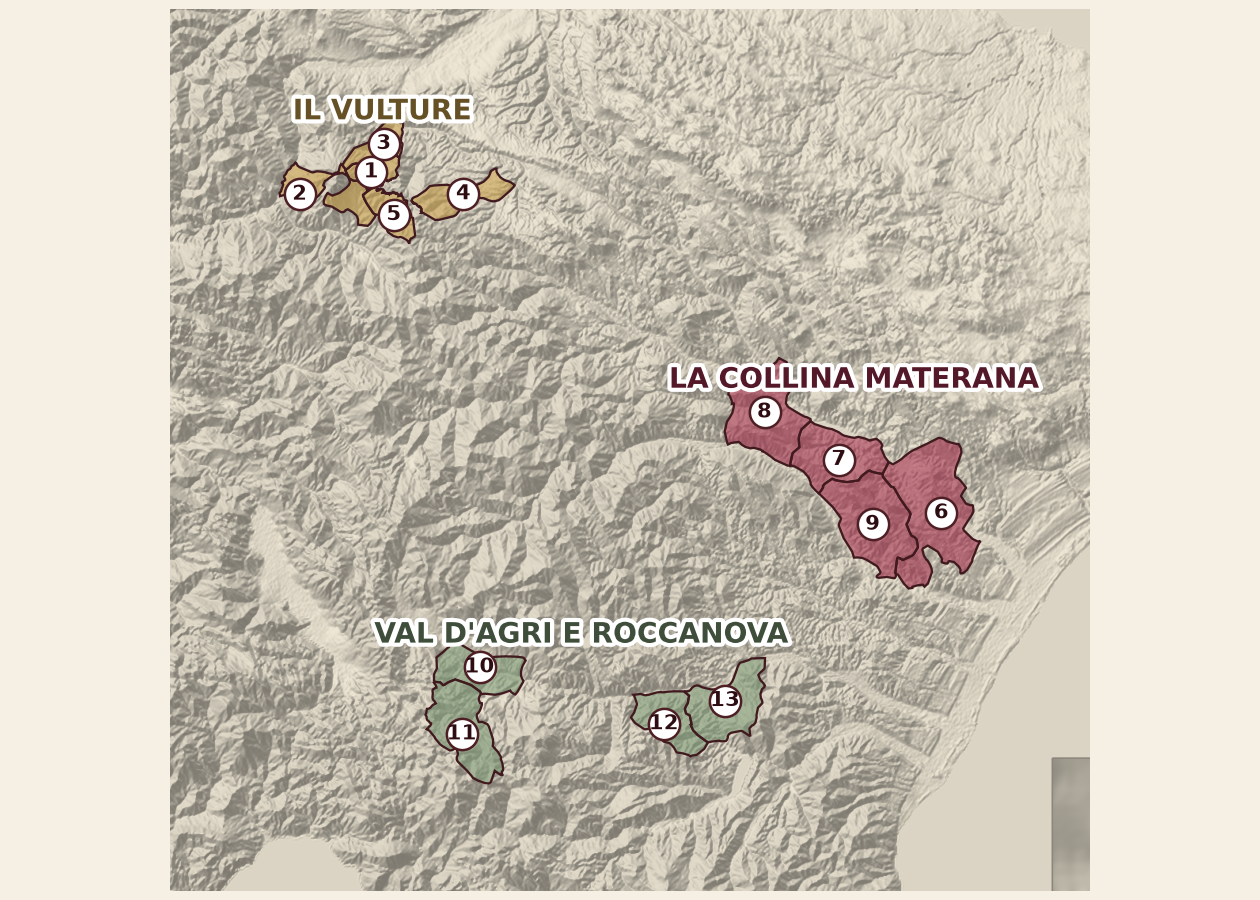
Tre distretti di lettura e tredici comuni: il Vulture a nord, la collina materana a est, l'Alta Val d'Agri e Roccanova a sud.Three reading districts and thirteen towns: the Vulture to the north, the Matera hills to the east, the upper Val d'Agri and Roccanova to the south.
- 1 Barile
- 2 Rionero in Vulture
- 3 Rapolla
- 4 Maschito
- 5 Ripacandida
- 6 Montescaglioso
- 7 Miglionico
- 8 Grottole
- 9 Pomarico
- 10 Grumento Nova
- 11 Moliterno
- 12 Roccanova
- 13 Sant'Arcangelo
Zone e sottozoneZones and subzones
I vitigni del territorioThe grapes of the territory
Le denominazioniThe denominations
A tavolaAt the table
Le lagane sono tagliatelle spesse tirate a mano, e con i ceci diventano il piatto che la guida dell'APT Basilicata chiama «piatto dei briganti»: nei racconti orali i briganti dei boschi di Gallipoli Cognato, nella seconda metà dell'Ottocento, erano soprannominati mangialagane. È un piatto di legumi e olio, con la polpa farinosa del cece. Chiede un Aglianico del Vulture DOC giovane, meno affinato del Superiore: la sua freschezza sgrassa l'olio di ogni boccone.Lagane are thick hand-rolled ribbons of pasta, and with chickpeas they become the dish the Basilicata tourist board's own recipe book calls the «brigands' dish»: in oral tradition the brigands of the Gallipoli Cognato woods, in the second half of the nineteenth century, were nicknamed mangialagane, lagane-eaters. It is a dish of pulses and olive oil, with the floury flesh of the chickpea. It asks for a young Aglianico del Vulture DOC, less aged than the Superiore: its freshness cuts through the oil in every mouthful.
Il pezzo forte della cucina di festa è la pecora a pasturale: carne tagliata grossa, bollita a lungo e schiumata, con verdure di campo, patate e cipolla, e a fine cottura salsiccia a dadi e pezzi di pecorino. La stessa logica vale per la coscia d'agnello «della sposa», incisa e riempita di alloro, aglio e sugna. Sono carni grasse e piene di sugo, e chiedono l'Aglianico del Vulture Superiore DOCG: il tannino e il calore dell'alcol asciugano il sugo di ogni boccone, mentre la freschezza lascia la bocca pulita.The centrepiece of feast-day cooking is pecora a pasturale: mutton cut into large pieces, long-boiled and skimmed, with field greens, potatoes and onion, and at the end diced sausage and chunks of pecorino. The same logic holds for the leg of lamb known as «coscia della sposa», scored and filled with bay, garlic and lard. These are fatty meats full of juices, and they call for Aglianico del Vulture Superiore DOCG: its tannin and the warmth of its alcohol dry the juices of each mouthful, while its freshness leaves the palate clean.
Sulla collina materana il pane è protagonista: il disciplinare del Pane di Matera IGP prescrive l'uso esclusivo di semola rimacinata e/o semolato di grano duro. Accanto stanno la ciambotta di patate, peperoni, melanzane e pomodori fritti e la minestra di fagioli e castagne insaporita con la polvere di peperone, che a Senise si ottiene dalle collane di peperoni essiccate al sole d'agosto e tutelate come Peperone di Senise IGP. Con le verdure fritte e il fritto in genere va bene un bianco da Malvasia bianca di Basilicata, fresco e sapido; con gli strascinati al ragù e il caciocavallo podolico stagionato, un Matera DOC Primitivo.In the Matera hills bread is the lead player: the Pane di Matera IGP specification requires the exclusive use of re-milled durum wheat semolina and/or durum semolato. Beside it stand ciambotta, of fried potatoes, peppers, aubergines and tomatoes, and a soup of beans and chestnuts seasoned with pepper powder, which at Senise comes from the strings of peppers dried in the August sun and protected as Peperone di Senise IGP. With fried vegetables and fried food in general a white from Malvasia bianca di Basilicata, fresh and savoury, does the job; with strascinati in meat sauce and aged caciocavallo podolico, a Matera DOC Primitivo.
La storiaHistory
A Barile, alle spalle del paese, c'è una collina di tufo chiamata Sheshë. È bucata da una miriade di grotte, e il Comune ne racconta l'origine senza giri di parole: furono le prime abitazioni degli esuli albanesi in fuga dal dominio ottomano. Barile fu colonizzata da profughi illirici nel Cinquecento e divenne una delle maggiori isole di cultura arbëreshë della Basilicata; le grotte scavate nella collina, da case, diventarono col tempo cantine.At Barile, behind the village, stands a hill of tuff called Sheshë. It is riddled with caves, and the town council tells their origin plainly: they were the first dwellings of the Albanian exiles fleeing Ottoman rule. Barile was settled by Illyrian refugees in the sixteenth century and became one of the largest islands of Arbëreshë culture in Basilicata; the caves cut into the hill turned, in time, from houses into cellars.
Non era pittoresco: era tecnica. I tufi del Vulture, dice il disciplinare, fanno da riserva idrica nei mesi siccitosi, e sottoterra la temperatura resta ferma mentre fuori i venti africani spingono a trentacinque gradi. Così si faceva dappertutto: a Melfi un inventario del 1589 registrava centodieci grotte, e a Melfi, Rionero, Barile, Maschito e Ripacandida le cantine erano tutte ricavate in grotte e ipogei, naturali o scavati con interventi modesti.This was not picturesque, it was technique. The Vulture's tuffs, says the specification, act as a water reserve in the dry months, and underground the temperature holds steady while outside African winds push it to thirty-five degrees. It was done everywhere: at Melfi an inventory of 1589 recorded a hundred and ten caves, and at Melfi, Rionero, Barile, Maschito and Ripacandida the cellars were all set in caves and hypogea, natural or cut with modest work.
Nel 1964 arrivò a Barile Pier Paolo Pasolini. Cercava un paesaggio per «Il Vangelo secondo Matteo» e trovò lì, nelle grotte del tufo, lo sfondo di alcune scene del film: le stesse cavità in cui il paese custodiva il vino. Il Vulture aveva già avuto la sua vetrina qualche decennio prima — all'Esposizione universale di Milano del 1906 dieci campioni di vini della zona furono apprezzati come «vini di corpo, fragranti, fini» — e negli anni Trenta, con la legge sui vini tipici, nacquero cantine e aziende, molte delle quali ancora oggi sono l'ossatura della vitivinicoltura lucana.In 1964 Pier Paolo Pasolini came to Barile. He was looking for a landscape for «The Gospel According to St Matthew» and found there, in the tuff caves, the setting for several scenes of the film: the same hollows in which the village kept its wine. The Vulture had already had its shop window a few decades earlier — at the 1906 Milan world's fair ten samples of the area's wines were praised as «wines of body, fragrant, fine» — and in the nineteen-thirties, under the law on typical wines, cellars and firms were founded, many of which still form the backbone of Lucanian winegrowing.
Il riconoscimento ufficiale arriva tardi e in due tempi: la DOC Aglianico del Vulture nel 1971, con decreto del Presidente della Repubblica del 18 febbraio; la DOCG Aglianico del Vulture Superiore quasi quarant'anni dopo, con decreto ministeriale del 2 agosto 2010. Molto prima, il poeta che Venosa rivendica da sempre: Orazio, nato lì, che in un'ode ricorda il Vulture della sua infanzia — ed è al suo nome che la cantina sociale del paese intitola ancora oggi una delle sue linee.Official recognition came late and in two stages: the Aglianico del Vulture DOC in 1971, by presidential decree of 18 February; the Aglianico del Vulture Superiore DOCG almost forty years later, by ministerial decree of 2 August 2010. Long before that came the poet Venosa has always claimed: Horace, born there, who in one of his Odes recalls the Vulture of his childhood — and it is his name that the town's growers' cellar still gives to one of its ranges.
Il conteggio delle denominazioni viene dall'elenco dei vini DOCG, DOC e IGT suddivisi per regione del MASAF; comuni, altitudini, uve, tempi di affinamento e descrizione del territorio dai disciplinari ufficiali delle singole denominazioni. Le settanta indicazioni geografiche aggiuntive sono quelle della lista positiva allegata al disciplinare dell'Aglianico del Vulture. Le notizie sulle grotte di Barile vengono dal Comune di Barile e dal portale del Ministero del Turismo; i piatti dalla guida «Basilicata a tavola» dell'APT Basilicata e dalla scheda sui prodotti tipici lucani dello stesso portale. Niente punteggi, premi o classifiche: le descrizioni sono profili di stile, non degustazioni di annata.The count of appellations comes from MASAF's register of DOCG, DOC and IGT wines by region; towns, altitudes, grapes, ageing periods and the description of the territory from the official specifications of each appellation. The seventy additional geographical indications are those of the positive list annexed to the Aglianico del Vulture specification. The account of the Barile caves comes from the town council of Barile and from the Italian tourism ministry's portal; the dishes from the «Basilicata a tavola» guide of the Basilicata tourist board and from the same portal's page on typical Lucanian products. No scores, awards or rankings: the descriptions are style profiles, not vintage tastings.