Il bacino della Loira mette in fila cinquantadue denominazioni, dalla foce atlantica alle colline dell'Alvernia: più di trecento chilometri in linea d'aria, e un vigneto che cambia carattere a mano a mano che si risale il fiume. Si comincia col Melon de Bourgogne del Muscadet, davanti all'oceano; si attraversano gli scisti dell'Anjou e il tufo della Turenna, dove comanda lo chenin; si arriva al sauvignon di Sancerre e Pouilly-Fumé, con gli inverni che si fanno più freddi e il mare ormai lontano. È la stessa valle, e non è mai lo stesso vino.The Loire basin lines up fifty-two appellations, from the Atlantic mouth to the hills of the Auvergne: more than three hundred kilometres as the crow flies, and a vineyard that changes character as you move upriver. It begins with Melon de Bourgogne in Muscadet, facing the ocean; it crosses the schists of Anjou and the tuffeau limestone of Touraine, where Chenin sets the tone; it reaches the Sauvignon of Sancerre and Pouilly-Fumé, where winters turn colder and the sea is well behind. The same valley, and never the same wine.
Il territorioThe territory
La terraThe land
Il fiume attraversa due mondi geologici. A ovest, nel Nantese, il sottosuolo è quello antico del massiccio armoricano: micascisti a nord e, verso est, un massiccio di gabbri che il disciplinare del Muscadet Sèvre et Maine indica come ossatura della sottozona «Gorges». Salendo in Anjou le vigne stanno su scisti scuri; poco più a est, verso Saumur, il disciplinare del Saumur-Champigny descrive l'incontro fra suoli «crayeux blanchâtres» e scisti d'ardesia — è il confine fra l'Angiò nero e l'Angiò bianco. In Turenna comincia il tufo, il tuffeau, pietra tenera in cui sono scavate le cantine e su cui poggiano i pianori di Vouvray e Montlouis. In cima al fiume, a Sancerre, il disciplinare elenca tre terreni: le marne del Kimmeridgiano dette «terres blanches», riconoscibili dalle migliaia di piccole conchiglie fossili d'ostrica, i calcari detti «caillottes» e i suoli argillo-silicei detti «silex».The river crosses two geological worlds. In the west, around Nantes, the bedrock is the ancient Armorican massif: mica schists to the north and, eastwards, a gabbro massif that the Muscadet Sèvre et Maine specification names as the backbone of the «Gorges» sub-zone. Upstream in Anjou the vines sit on dark schist; a little further east, towards Saumur, the Saumur-Champigny specification describes the meeting of whitish chalky soils and slate schists — the boundary between black Anjou and white Anjou. In Touraine the tuffeau begins, a soft limestone into which the cellars are dug and on which the plateaux of Vouvray and Montlouis rest. At the top of the river, in Sancerre, the specification lists three soils: Kimmeridgian marls known as «terres blanches», recognisable by thousands of small fossil oyster shells, limestone soils known as «caillottes», and clay-and-flint soils known as «silex».
Il vitignoThe grape
Quattro uve reggono la valle e si passano il testimone risalendo il fiume. Il Melon de Bourgogne fa il Muscadet e nient'altro. Lo chenin blanc — che a Vouvray i testi antichi chiamano «pineau de la Loire» — firma i secchi, i dolci e le bollicine dell'Angiò e della Turenna: Savennières, Coteaux du Layon, Quarts de Chaume, Vouvray, Montlouis. Il cabernet franc fa i rossi di Chinon, Bourgueil e Saumur-Champigny. Il sauvignon blanc arriva in cima, a Sancerre e Pouilly-Fumé, che ne fanno solo bianchi; a Sancerre il disciplinare gli affianca il pinot nero per i rossi e i rosati. Poi ci sono le uve che vivono in un posto solo: il romorantin, unico vitigno ammesso nel Cour-Cheverny; lo chasselas, che dal 1937 dà il Pouilly-sur-Loire mentre il sauvignon, nello stesso comune, dà il Pouilly-Fumé. Intorno circolano pineau d'Aunis, grolleau, côt e gamay, che entrano negli assemblaggi di Angiò, Saumur e Turenna.Four grapes carry the valley, handing over to one another as you move upstream. Melon de Bourgogne makes Muscadet and nothing else. Chenin Blanc — which old texts in Vouvray call «pineau de la Loire» — signs the dry wines, the sweet wines and the sparkling wines of Anjou and Touraine: Savennières, Coteaux du Layon, Quarts de Chaume, Vouvray, Montlouis. Cabernet Franc makes the reds of Chinon, Bourgueil and Saumur-Champigny. Sauvignon Blanc arrives at the top, in Sancerre and Pouilly-Fumé, which make only whites from it; in Sancerre the specification pairs it with Pinot Noir for reds and rosés. Then there are the grapes that live in one place only: Romorantin, the sole variety allowed in Cour-Cheverny; Chasselas, which since 1937 has made Pouilly-sur-Loire while Sauvignon, in the same commune, makes Pouilly-Fumé. Around them move Pineau d'Aunis, Grolleau, Côt and Gamay, which go into the blends of Anjou, Saumur and Touraine.
L'uomoThe human hand
Due mestieri sono nati qui e si riconoscono ancora in bottiglia. Il primo è la «méthode nantaise»: il vino resta sulle proprie fecce fini per almeno un inverno, senza travasi, e il disciplinare del Muscadet Sèvre et Maine scrive che l'abitudine viene dai produttori che mettevano da parte una botte del loro vino migliore in vista delle feste. È la menzione «sur lie» che si legge in etichetta. Il secondo è la bollicina: a Saumur, dal 1811, Jean-Baptiste Ackerman avvia la produzione di spumanti con il metodo tradizionale, dopo aver constatato che i vini di chenin ripartivano a fermentare da soli. Oggi il Crémant de Loire nasce per seconda fermentazione in bottiglia, con il tiraggio a partire dal 1° dicembre successivo alla vendemmia e almeno dodici mesi di affinamento prima della vendita.Two crafts were born here and can still be recognised in the bottle. The first is the «méthode nantaise»: the wine stays on its fine lees for at least one winter, with no racking, and the Muscadet Sèvre et Maine specification records that the habit came from growers who set aside a barrel of their best wine for the feasts ahead. It is the «sur lie» mention you read on the label. The second is the bubble: in Saumur, from 1811, Jean-Baptiste Ackerman began producing sparkling wines by the traditional method, having observed that Chenin wines started fermenting again on their own. Today Crémant de Loire is made by second fermentation in the bottle, with bottling from 1 December following the harvest and at least twelve months of ageing before release.
La mappaThe map
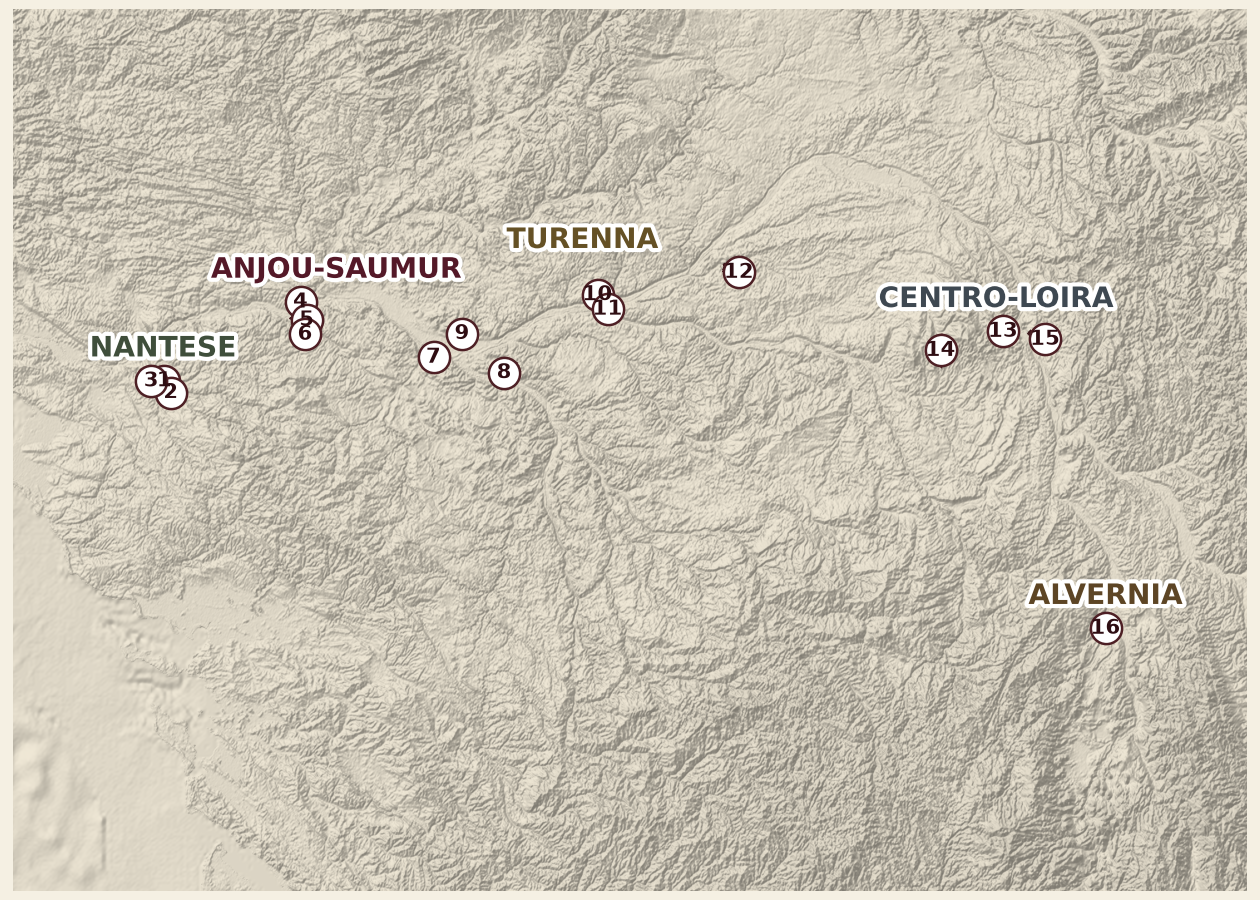
Sedici comuni lungo il fiume, scelti fra i più piccoli di ogni zona: fra Le Pallet, alle porte di Nantes, e Saint-Pourçain-sur-Sioule corrono più di trecento chilometri in linea d'aria. La prima cosa da leggere è proprio la distanza.Sixteen communes along the river, chosen among the smallest in each zone: more than three hundred kilometres as the crow flies separate Le Pallet, at the gates of Nantes, from Saint-Pourçain-sur-Sioule. The first thing to read is that distance.
- 1 Le Pallet
- 2 Gorges
- 3 Saint-Fiacre-sur-Maine
- 4 Savennières
- 5 Rochefort-sur-Loire
- 6 Saint-Lambert-du-Lattay
- 7 Souzay-Champigny
- 8 Cravant-les-Coteaux
- 9 Saint-Nicolas-de-Bourgueil
- 10 Vouvray
- 11 Montlouis-sur-Loire
- 12 Cour-Cheverny
- 13 Bué
- 14 Menetou-Salon
- 15 Pouilly-sur-Loire
- 16 Saint-Pourçain-sur-Sioule
Zone e sottozoneZones and subzones
I vitigni del territorioThe grapes of the territory
Le denominazioniThe denominations
A tavolaAt the table
Il Muscadet sur lie, teso e sapido, sta con le ostriche e con il pesce di fiume servito con la salsa al burro: la sua acidità taglia la salsa e ripulisce il palato fra un boccone e l'altro. Risalendo, la valle è anche un paese di formaggi di capra a denominazione protetta — Sainte-Maure de Touraine, Selles-sur-Cher, Pouligny-Saint-Pierre, Valençay — e sopra Sancerre, a Chavignol, si fa il Crottin: con un Sancerre bianco è l'abbinamento di casa, perché la freschezza del sauvignon regge la pasta cremosa del formaggio, e la sua vena sapida allunga il finale.Muscadet sur lie, taut and savoury, goes with oysters and with river fish served in butter sauce: its acidity cuts through the sauce and clears the palate between mouthfuls. Further upriver, the valley is also a land of protected-designation goat cheeses — Sainte-Maure de Touraine, Selles-sur-Cher, Pouligny-Saint-Pierre, Valençay — and above Sancerre, at Chavignol, they make Crottin: with a white Sancerre it is the local pairing, because the freshness of Sauvignon stands up to the creamy paste of the cheese, and its savoury streak lengthens the finish.
Le rillettes di Tours, che hanno la loro indicazione geografica protetta, e la carne di maiale della tradizione turenna chiedono un rosso di cabernet franc — un Chinon o un Bourgueil giovani, dal tannino sottile e dal frutto scuro — oppure, se si preferisce restare sul bianco, un Vouvray demi-sec, dove il residuo zuccherino e l'acidità stanno in equilibrio. In chiusura, una tarte Tatin o una crostata di mele con un Coteaux du Layon o un Bonnezeaux: sono dolci ricchi, e il vino deve essere altrettanto dolce e insieme fresco, o l'abbinamento non tiene.The rillettes of Tours, which have their own protected geographical indication, and the pork dishes of Touraine call for a Cabernet Franc red — a young Chinon or Bourgueil, fine-grained in tannin and dark-fruited — or, for those who would rather stay with white, a Vouvray demi-sec, where residual sugar and acidity hold each other in balance. To finish, a tarte Tatin or an apple tart with a Coteaux du Layon or a Bonnezeaux: these are rich desserts, and the wine must be just as sweet and fresh at the same time, or the pairing falls apart.
La storiaHistory
Il nome più curioso della valle è anche uno dei più antichi, e racconta come si pagava l'affitto di una vigna. Nel 1028 Folco Nerra, conte d'Angiò, lascia all'abbazia del Ronceray di Angers un bene situato sul territorio di Rochefort-sur-Loire. Le monache capiscono presto che cosa hanno per le mani e prendono le loro precauzioni: nel Quattrocento i signori della Guerche, che tengono in affitto il «tènement de Chaume», le pagano — sono parole del disciplinare, che cita l'atto — con «i migliori quarti della vendemmia pendente sul versante esposto a mezzogiorno». Non una parte qualsiasi del raccolto, quindi: i quarti migliori, e presi dal lato giusto della collina. Da lì viene il nome dell'appellazione, Quarts de Chaume.The valley's most curious name is also one of its oldest, and it tells how the rent on a vineyard was paid. In 1028 Fulk Nerra, count of Anjou, left the abbey of Ronceray in Angers an estate in the territory of Rochefort-sur-Loire. The nuns soon understood what they had and took their precautions: in the fifteenth century the lords of la Guerche, tenants of the «tènement de Chaume», paid them — the words are those of the specification, quoting the deed — with «the best quarters of the crop hanging on the slope facing south». Not just any part of the harvest, then: the best quarters, and taken from the right side of the hill. That is where the name of the appellation comes from, Quarts de Chaume.
L'abbazia amministra quelle terre per secoli e i suoi archivi conservano la memoria del vino: fra le carte c'è una convocazione datata 23 settembre 1674 per fissare il ban des vendanges, cioè il giorno in cui si poteva cominciare a vendemmiare — un dettaglio che dice quanto l'ora della raccolta contasse già allora, in un vino che si fa aspettando la surmaturazione. Nel Seicento e nel Settecento i sensali olandesi fanno delle rive del Layon il loro luogo di approvvigionamento privilegiato, e i vini dolci dell'Angiò prendono la strada del nord.The abbey administered those lands for centuries and its archives keep the memory of the wine: among the papers there is a summons dated 23 September 1674 to fix the ban des vendanges, the day on which picking could begin — a detail that shows how much the timing of the harvest already mattered in a wine made by waiting for overripeness. In the seventeenth and eighteenth centuries Dutch brokers made the banks of the Layon their preferred source, and the sweet wines of Anjou took the road north.
Il modo di raccogliere era codificato molto prima dei disciplinari. Nel 1816 Jullien, nella sua topografia dei vigneti conosciuti, annota che «nei buoni cru si vendemmia a più riprese» e che i primi due passaggi, con l'uva più matura, danno i vini che si spediscono all'estero; nel 1845 il conte Odart, nel «Traité des cépages», raccomanda per lo chenin di non raccogliere se non a una maturità «oltrepassata», quella che arriva verso Ognissanti. La Rivoluzione francese spezza la proprietà dell'abbazia e il vigneto si ridistribuisce fra poche tenute; all'inizio del Novecento chi conduceva il Château de Bellerive prende posizione contro la potatura lunga per lo chenin. L'appellazione viene riconosciuta con decreto nel 1954 e nel 2011 il disciplinare le riconosce il diritto di completare il proprio nome con la menzione «grand cru». Mille anni dopo quel lascito, si continua a raccogliere a più passate sullo stesso versante esposto a mezzogiorno.The way of picking was codified long before any specification. In 1816 Jullien, in his topography of the known vineyards, noted that «in the good crus the harvest is made in several passes» and that the first two, with the ripest fruit, gave the wines sent abroad; in 1845 count Odart, in his «Traité des cépages», recommended picking Chenin only at a maturity «gone beyond», the one reached around All Saints' Day. The French Revolution broke up the abbey's holdings and the vineyard was redistributed among a few estates; in the early twentieth century the man running Château de Bellerive spoke out against long pruning for Chenin. The appellation was recognised by decree in 1954, and in 2011 its specification granted it the right to complete its name with the mention «grand cru». A thousand years after that bequest, the fruit is still picked in successive passes on the same south-facing slope.
I numeri e i nomi di questa scheda vengono da fonti ufficiali, archiviate: l'elenco delle AOC del bacino Val de Loire pubblicato dall'INAO (aggiornamento del 26 gennaio 2012), riverificato nome per nome sul registro europeo eAmbrosia; i disciplinari e le schede tecniche europee delle singole denominazioni per vitigni, sottozone e regole di produzione. Dove una fonte ufficiale non c'era, il dato non è stato scritto. Le descrizioni dei vini sono profili caratteristici, non note di degustazione di una specifica annata; la mappa mostra sedici comuni scelti come esempio, non l'intero perimetro delle denominazioni.The figures and names on this page come from official, archived sources: the list of AOCs of the Val de Loire basin published by INAO (updated 26 January 2012), re-checked name by name against the European eAmbrosia register; the specifications and European technical sheets of the individual appellations for grape varieties, sub-zones and production rules. Where no official source existed, the figure was not written. Wine descriptions are characteristic profiles, not tasting notes of a specific vintage; the map shows sixteen communes chosen as examples, not the full perimeter of the appellations.