Un'isola che fa storia a sé: vigne tra le più antiche del Mediterraneo, molte uve autoctone che non si coltivano quasi da nessun'altra parte e un mare che entra in ogni calice. La Sardegna del vino si legge per zone — il Vermentino di granito della Gallura, il Cannonau dei paesi di montagna, il Carignano che cresce sulla sabbia del Sulcis, la Vernaccia di Oristano ossidativa — tenute insieme dal vento di maestrale e da una cultura contadina antichissima.An island in a league of its own: some of the Mediterranean's oldest vines, many native grapes grown almost nowhere else, and the sea in every glass. Sardinian wine reads by zones — the granite Vermentino of Gallura, the Cannonau of the mountain villages, the Carignano growing on the sands of the Sulcis, the oxidative Vernaccia di Oristano — all held together by the maestrale wind and a very ancient farming culture.
Il territorioThe territory
La terraThe land
Suoli che cambiano a ogni passo: il granito disfatto della Gallura, le sabbie del Sulcis dove la fillossera non è mai arrivata, scisti, basalti e calcari nell'interno. Sole forte, poca pioggia e il maestrale che asciuga i grappoli e tiene sana la vigna.Soils that change at every step: the decomposed granite of Gallura, the Sulcis sands the phylloxera never reached, schist, basalt and limestone inland. Strong sun, little rain, and the maestrale wind that dries the bunches and keeps the vines healthy.
Il vitignoThe grape
Un patrimonio di varietà autoctone. Il Cannonau è il rosso-simbolo; il Vermentino il bianco più amato; il Carignano regna nel Sulcis; e poi Nuragus, Monica, Nasco, Torbato, Bovale e la Vernaccia di Oristano, che dà un raro bianco ossidativo, affinato sotto un velo di lieviti come lo Sherry spagnolo e il Vin Jaune francese.A treasury of native varieties. Cannonau is the emblematic red; Vermentino the best-loved white; Carignano reigns in the Sulcis; then Nuragus, Monica, Nasco, Torbato, Bovale and Vernaccia di Oristano, which makes a rare oxidative white, aged under a veil of yeast like Spanish Sherry and French Vin Jaune.
L'uomoThe human hand
Si coltiva la vite qui da oltre tremila anni. La forma classica è l'alberello basso, piegato sul vento; nel Novecento sono state le grandi cooperative — su tutte Santadi — a riscattare la qualità dei vini sardi e a portarli nel mondo.Vines have been grown here for over three thousand years. The classic form is the low bush vine, bent to the wind; in the twentieth century it was the great cooperatives — Santadi above all — that redeemed the quality of Sardinian wines and carried them out into the world.
La mappaThe map
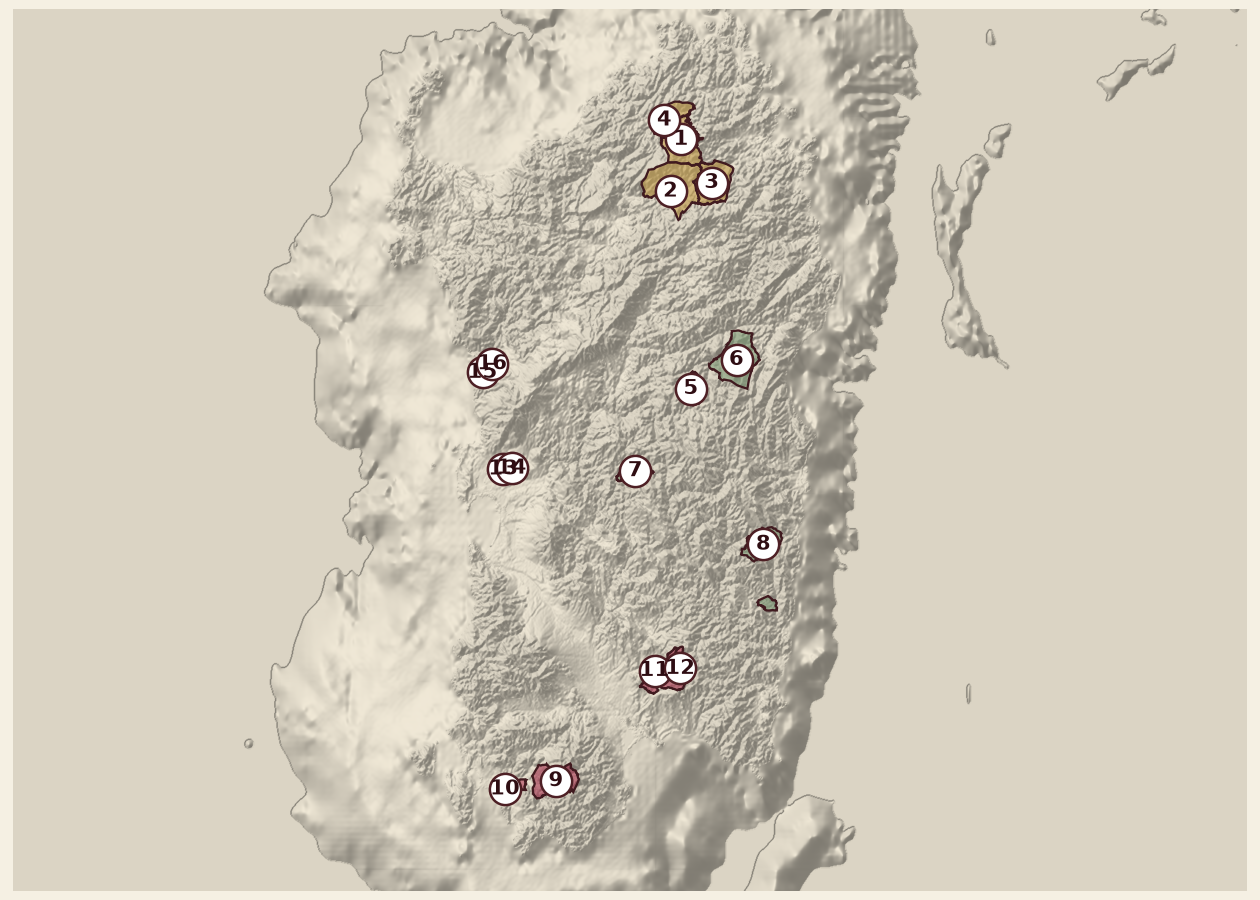
Le quattro grandi anime del vino sardo, dai paesi di granito della Gallura alle sabbie del Sulcis. I numeri sono comuni rappresentativi di ogni distretto.The four great souls of Sardinian wine, from Gallura's granite villages to the sands of the Sulcis. The numbers are representative towns of each district.
- 1 Calangianus
- 2 Berchidda
- 3 Monti
- 4 Luras
- 5 Mamoiada
- 6 Oliena
- 7 Atzara
- 8 Jerzu
- 9 Santadi
- 10 Giba
- 11 Serdiana
- 12 Dolianova
- 13 Baratili San Pietro
- 14 Zeddiani
- 15 Magomadas
- 16 Modolo
Zone e sottozoneZones and subzones
I vitigni del territorioThe grapes of the territory
Le denominazioniThe denominations
A tavolaAt the table
La cucina sarda è fatta di sapori netti e di cotture lente, e i vini dell'isola le rispondono uno per uno. Il porceddu, il maialetto arrosto dalla pelle croccante, chiede il Cannonau: caldo, di buon corpo, abbastanza tannico, tiene testa alla carne saporita. Sul pesce e sui crudi, e soprattutto sulla bottarga di Cabras, va il Vermentino di Gallura, fresco e sapido. I culurgiones, i ravioloni ripieni di patata, pecorino e menta, stanno bene su un Vermentino di Sardegna, mentre i malloreddus alla campidanese, con la salsiccia e il pomodoro, chiamano un rosso morbido come il Monica. Sul pecorino sardo ben stagionato torna il Cannonau, e sulle seadas — la sfoglia fritta con formaggio fresco e miele — si apre un vino dolce come il Moscato di Sardegna o il Nasco. La Vernaccia di Oristano, ossidativa e di lunga sosta, nello stile classico è secca e si beve volentieri con il pecorino più piccante; sui dolci di mandorla vanno invece le sue versioni dolci e liquorose.Sardinian cooking is built on clear flavours and slow cooking, and the island's wines answer each dish in turn. Porceddu, the spit-roasted suckling pig with its crisp skin, calls for Cannonau: warm, full-bodied, fairly tannic, it stands up to the rich meat. With fish and raw seafood, and above all with Cabras bottarga, comes Vermentino di Gallura, fresh and savoury. Culurgiones, the large ravioli filled with potato, pecorino and mint, sit well with a Vermentino di Sardegna, while malloreddus alla campidanese, with sausage and tomato, ask for a soft red like Monica. With well-aged Sardinian pecorino, Cannonau returns, and with seadas — fried pastry with fresh cheese and honey — a sweet wine like Moscato di Sardegna or Nasco opens up. Vernaccia di Oristano, oxidative and long-aged, is dry in its classic style and is gladly drunk with the sharper pecorino; almond sweets, by contrast, call for its sweet and fortified versions.
La storiaHistory
Per molto tempo si è raccontato che il Cannonau fosse arrivato in Sardegna dalla Spagna, portato dagli Aragonesi tra Tre e Quattrocento: la stessa famiglia della Garnacha, lo stesso vitigno con un altro nome. Poi, scavando, l'isola ha rovesciato la storia. Nel sito nuragico di Sa Osa, vicino a Cabras, e in altri come Duos Nuraghes a Borore, gli archeologi hanno trovato migliaia di vinaccioli — i piccoli semi dell'uva — carbonizzati e perfettamente conservati. Le analisi delle Università di Cagliari e Sassari li hanno datati intorno al 1200 a.C., in piena età del Bronzo, e li hanno riconosciuti non come uva selvatica ma come Vitis vinifera già domesticata, coltivata. È la prova che in Sardegna si faceva vino duemilacinquecento anni prima degli spagnoli, forse prima che in gran parte del Mediterraneo occidentale: i nuraghi non erano soltanto torri di pietra, ma anche cantine. Gli Aragonesi, semmai, hanno portato il nome — «Canonazo» — e qualche tecnica, innestandosi su una vite che gli isolani conoscevano da sempre. Oggi quei vinaccioli di tremila anni fa sono il filo che lega il bicchiere di Cannonau di un paese di Barbagia alla più antica civiltà dell'isola.For a long time the story went that Cannonau had arrived in Sardinia from Spain, brought by the Aragonese in the fourteenth and fifteenth centuries: the same family as Garnacha, the same grape under another name. Then, digging, the island overturned the story. At the Nuragic site of Sa Osa, near Cabras, and at others such as Duos Nuraghes at Borore, archaeologists found thousands of grape pips — the small seeds of the grape — charred and perfectly preserved. Analyses by the Universities of Cagliari and Sassari dated them to around 1200 BC, in the full Bronze Age, and identified them not as wild grapes but as already domesticated, cultivated Vitis vinifera. It is proof that wine was being made in Sardinia two and a half thousand years before the Spanish, perhaps earlier than in much of the western Mediterranean: the nuraghi were not only towers of stone but also cellars. The Aragonese, if anything, brought the name — 'Canonazo' — and a few techniques, grafting onto a vine the islanders had always known. Today those three-thousand-year-old pips are the thread that ties a glass of Cannonau from a Barbagia village to the island's most ancient civilisation.
Numeri e denominazioni verificati su fonti ufficiali — gli elenchi dei vini DOP e IGP del MASAF e i disciplinari di produzione — e archiviati in redazione. I profili dei vini descrivono il carattere tipico e ricorrente, non una singola annata.Figures and denominations verified against official sources — the MASAF lists of PDO and PGI wines and the production specifications — and archived by the editorial team. The wine profiles describe the typical, recurring character, not a single vintage.