Una regione al plurale, fatta di valli che scendono parallele verso il mare. Le Marche sono soprattutto la patria del Verdicchio — il bianco italiano che invecchia, con due anime, Jesi e Matelica — ma anche di rossi che meritano il viaggio: il Montepulciano del Conero, la profumata Lacrima, lo spumante rosso di Serrapetrona. Cinque DOCG e una sorprendente varietà in poco spazio.A region in the plural, made of valleys running parallel down to the sea. The Marche are above all the home of Verdicchio — the Italian white that ages, with two souls, Jesi and Matelica — but also of reds worth the trip: the Montepulciano of the Conero, the perfumed Lacrima, the sparkling red of Serrapetrona. Five DOCG and a surprising variety in a small space.
Il territorioThe territory
La terraThe land
Le Marche sono un plurale, e si vede dalla terra: una sequenza di valli parallele che scendono dall'Appennino — i Sibillini, i Monti Azzurri — verso l'Adriatico, scavate da fiumi che corrono fianco a fianco, il Metauro, l'Esino, il Potenza, il Chienti, il Tronto. In mezzo, un mare di colline argilloso-calcaree dove la vite trova esposizioni e brezze diverse a pochi chilometri di distanza. Sulla costa, un'eccezione: il promontorio del Conero, l'unica montagna a picco sul mare di tutto il medio Adriatico.The Marche are a plural, and you can see it in the land: a sequence of parallel valleys descending from the Apennines — the Sibillini, the Monti Azzurri — towards the Adriatic, carved by rivers that run side by side, the Metauro, the Esino, the Potenza, the Chienti, the Tronto. In between, a sea of clay-limestone hills where the vine finds different aspects and breezes within a few kilometres. On the coast, one exception: the Conero promontory, the only mountain plunging straight into the sea along the whole central Adriatic.
Il vitignoThe grape
Un protagonista assoluto, il Verdicchio, e due patrie che lo raccontano in modo diverso: più ampio e salino attorno a Jesi, più teso e minerale nell'entroterra di Matelica. Accanto a lui, i rossi: il Montepulciano del Conero e del Piceno, la rara Lacrima di Morro d'Alba dal profumo di rosa, la Vernaccia Nera che a Serrapetrona diventa uno spumante rosso. E due bianchi tornati di moda, Pecorino e Passerina, cuore della DOCG di Offida.One absolute protagonist, Verdicchio, and two homelands that tell it in different ways: broader and saltier around Jesi, tenser and more mineral in the Matelica hinterland. Alongside it, the reds: the Montepulciano of the Conero and the Piceno, the rare rose-scented Lacrima di Morro d'Alba, the Vernaccia Nera that at Serrapetrona becomes a sparkling red. And two whites back in fashion, Pecorino and Passerina, at the heart of the Offida DOCG.
L'uomoThe human hand
Terra di mezzadria e di piccoli vignaioli, le Marche hanno conosciuto la fama prima per una bottiglia che per un vino. La generazione venuta dopo ha rovesciato il discorso: meno effetto, più sostanza. Cantine storiche e cooperative serie hanno riportato il Verdicchio fra i grandi bianchi italiani, e i rossi del Piceno e del Conero hanno trovato una loro misura, di territorio più che di muscoli.A land of sharecropping and small growers, the Marche became famous for a bottle before they were famous for a wine. The generation that followed turned that around: less spectacle, more substance. Historic estates and serious cooperatives put Verdicchio back among Italy's great whites, and the reds of the Piceno and the Conero found their own measure — one of place rather than muscle.
La mappaThe map
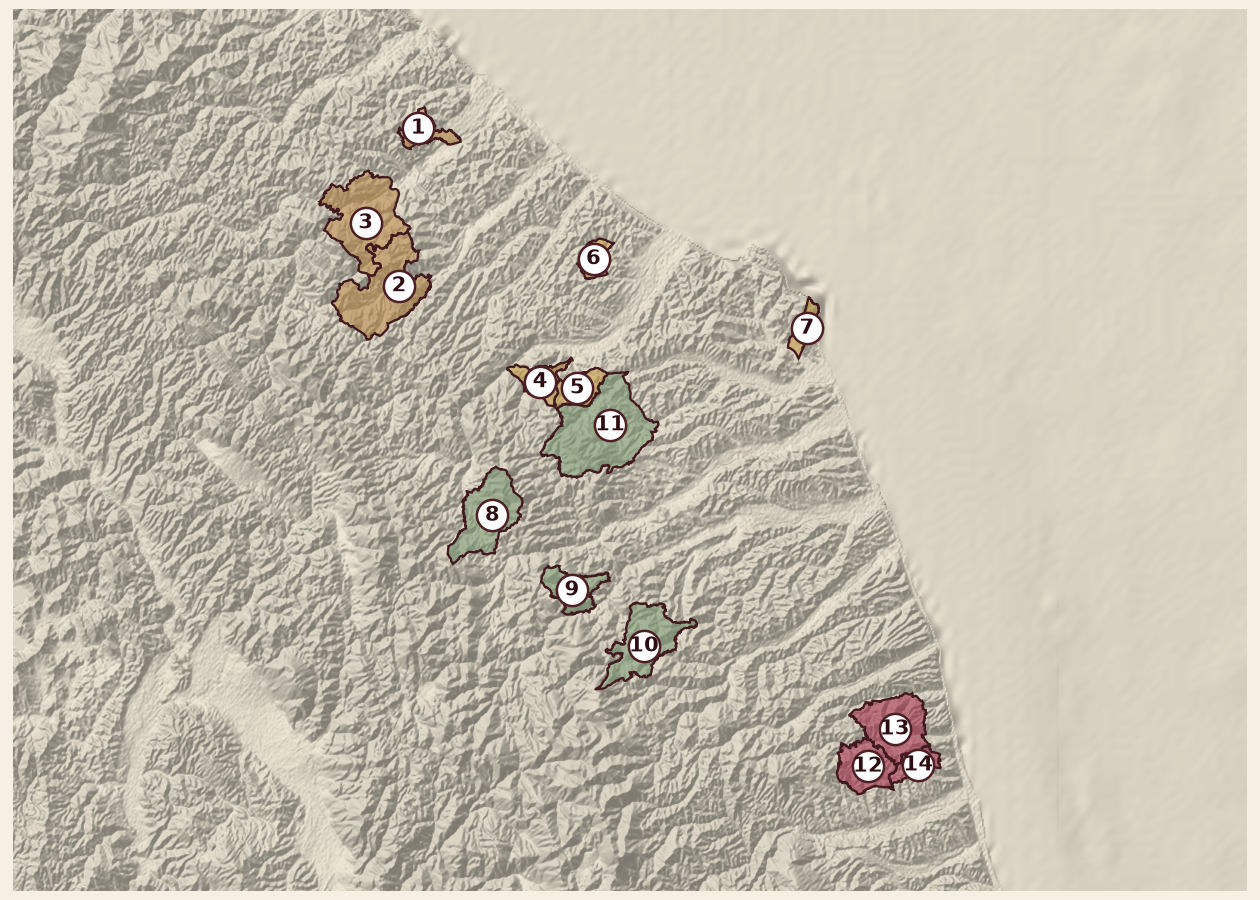
I quattro distretti del vino marchigiano, dall'Appennino all'Adriatico.The four districts of Marche wine, from the Apennines to the Adriatic.
- 1 Cartoceto
- 2 Pergola
- 3 Fossombrone
- 4 Cupramontana
- 5 Staffolo
- 6 Morro d'Alba
- 7 Sirolo
- 8 Matelica
- 9 Serrapetrona
- 10 San Ginesio
- 11 Cingoli
- 12 Offida
- 13 Ripatransone
- 14 Acquaviva Picena
Zone e sottozoneZones and subzones
I vitigni del territorioThe grapes of the territory
Le denominazioniThe denominations
A tavolaAt the table
Le olive ascolane fritte, ripiene di carne, chiedono un bianco fresco e sapido come il Verdicchio dei Castelli di Jesi: la sua acidità viva tiene testa al fritto senza appesantire. Il brodetto di pesce all'anconetana, ricco di tanti pesci dell'Adriatico, sta bene con un Verdicchio di buona spalla o con il più snello Bianchello del Metauro. I vincisgrassi — la lasagna marchigiana, ragù di carne e rigaglie — e il coniglio in porchetta vogliono un rosso di struttura, di buon corpo e tannino: Rosso Conero o Rosso Piceno. Il ciauscolo, salame morbido da spalmare, si gode con un rosso giovane e profumato come la Lacrima di Morro d'Alba. E per finire, la Vernaccia di Serrapetrona dolce sulla pasticceria secca delle feste.Fried olive all'ascolana, stuffed with meat, call for a fresh, savoury white like Verdicchio dei Castelli di Jesi: its lively acidity stands up to the frying without weighing things down. Brodetto all'anconetana, the local fish stew rich with many Adriatic fish, goes well with a Verdicchio with some shoulder, or with the leaner Bianchello del Metauro. Vincisgrassi — the Marche lasagne, with meat-and-giblet ragù — and rabbit in porchetta want a structured red with good body and tannin: Rosso Conero or Rosso Piceno. Ciauscolo, the soft spreadable salami, is best with a young, fragrant red like Lacrima di Morro d'Alba. And to finish, sweet Vernaccia di Serrapetrona with the dry festive pastries.
La storiaHistory
I marchigiani amano raccontare che nel 410 d.C., scendendo verso Roma da saccheggiare, Alarico e i suoi Visigoti si fermarono nelle valli di Jesi a fare scorta di Verdicchio — quaranta barili, dice la leggenda, per dare coraggio ai guerrieri. È una bella storia, e niente più: nessun documento la regge, e il vitigno come lo conosciamo oggi nel V secolo non esisteva ancora. Eppure dice qualcosa di vero sul legame antico tra questa terra e il suo bianco, rimasto però a lungo soltanto locale.The people of the Marche love to tell that in 410 AD, on their way down to sack Rome, Alaric and his Visigoths stopped in the valleys of Jesi to stock up on Verdicchio — forty barrels, the legend says, to give the warriors courage. It is a lovely story, and nothing more: no document supports it, and the grape as we know it today did not yet exist in the fifth century. Yet it says something true about the old bond between this land and its white wine — a bond that long remained purely local.
Per secoli il Verdicchio fu un vino di casa, sfuso, bevuto nelle osterie dell'entroterra anconetano. La svolta arrivò a metà Novecento, e fu un colpo di marketing prima ancora che di cantina. Nel 1953 la Fazi Battaglia di Jesi mise in commercio il suo Verdicchio in una bottiglia inconfondibile: un'anfora di vetro verde dalle linee sinuose, disegnata dall'architetto Antonio Maiocchi vincitore di un concorso, ispirata ai contenitori dell'antichità. Fu il primo bianco italiano con un contenitore così riconoscibile: l'anfora finì sulle tavole di mezzo mondo, soprattutto negli Stati Uniti, e per vent'anni «Verdicchio» volle dire quella forma più che quel vino.For centuries Verdicchio was a house wine, sold loose, drunk in the taverns of the Ancona hinterland. The turning point came in the mid-twentieth century, and it was a marketing coup before it was a cellar one. In 1953 Fazi Battaglia of Jesi launched its Verdicchio in an unmistakable bottle: a green glass amphora with sinuous lines, designed by the architect Antonio Maiocchi, winner of a competition, and inspired by the vessels of antiquity. It was the first Italian white with so recognisable a container: the amphora reached tables all over the world, above all in the United States, and for twenty years 'Verdicchio' meant that shape more than that wine.
Il rischio era restare un souvenir. A salvarlo dal cliché furono i produttori che, dagli anni Ottanta, scommisero sul contenuto: Bucci, Garofoli, Umani Ronchi e altri dimostrarono che il Verdicchio sa invecchiare, guadagnare in profondità, reggere il confronto con i grandi bianchi. Da lì la denominazione è cresciuta fino alla DOCG — le Riserve di Jesi e di Matelica, riconosciute nel 2010 — e l'anfora è diventata un ricordo affettuoso. Oggi conta più il bicchiere della bottiglia: la rivincita più bella per un vino che troppo a lungo si era fatto ricordare solo per la sua forma.The danger was ending up a souvenir. What saved it from cliché were the producers who, from the 1980s, bet on what was inside: Bucci, Garofoli, Umani Ronchi and others showed that Verdicchio can age, gain depth, and hold its own against the great whites. From there the denomination grew all the way to DOCG — the Riserve of Jesi and Matelica, recognised in 2010 — and the amphora became a fond memory. Today the glass matters more than the bottle: the finest revenge for a wine that for too long was remembered only for its shape.
Profilo del territorio, non degustazione di una singola annata o cantina. I conteggi delle denominazioni (5 DOCG, 15 DOC, 1 IGT) e i nomi vengono dall'elenco ufficiale MASAF dei vini DOP e IGP, verificato e archiviato. I vini citati indicano lo stile tipico della zona; annate ed etichette possono variare.A profile of the territory, not a tasting of a single vintage or winery. The denomination counts (5 DOCG, 15 DOC, 1 IGT) and names come from the official MASAF list of PDO and PGI wines, verified and archived. The wines mentioned indicate the typical style of each area; vintages and labels may vary.