Cinquantacinque chilometri di colline fra Mâcon e Lione, appoggiate a ovest ai contrafforti del Massiccio Centrale e a est alla piana della Saona: è il Beaujolais, che Inter Beaujolais racconta in dodici AOC e circa 13.500 ettari rivendicati, piantati per il 97% a gamay. Al nord i graniti e le «pierres bleues» dei dieci cru, al sud le argille e i calcari ocra delle Pierres Dorées. Dal 2018 tutto il territorio è Geoparco mondiale UNESCO, per una delle geologie più complesse di Francia.Fifty-five kilometres of hills between Mâcon and Lyon, leaning west on the foothills of the Massif Central and east on the Saône plain: this is Beaujolais, which Inter Beaujolais describes as twelve AOCs and some 13,500 claimed hectares, 97% of them planted to gamay. Granite and «pierres bleues» in the north, where the ten crus lie; clay, limestone and ochre stone in the south, in the Pierres Dorées. Since 2018 the whole territory has been a UNESCO Global Geopark, for one of the most complex geologies in France.
Il territorioThe territory
La terraThe land
Due paesaggi in uno. A nord il basamento cristallino del Massiccio Centrale — graniti, scisti, le dure «pierres bleues» — regge i dieci cru; a sud affiorano argille e calcari, e fra questi la pierre dorée, il calcare giurassico che gli ossidi di ferro tingono d'ocra e con cui sono costruiti i paesi. Dal 2018 il Beaujolais è Geoparco mondiale UNESCO: la cima del Mont Brouilly è un geosito con un belvedere che spiega la roccia sotto le vigne.Two landscapes in one. To the north the crystalline basement of the Massif Central — granite, schist, the hard «pierres bleues» — carries the ten crus; to the south clay and limestone surface, among them the pierre dorée, the Jurassic limestone that iron oxides turn ochre and out of which the villages are built. Since 2018 Beaujolais has been a UNESCO Global Geopark: the summit of Mont Brouilly is a geosite, with a viewpoint that explains the rock beneath the vines.
Il vitignoThe grape
Il gamay noir à jus blanc è il 97% dell'impianto, e in un vigneto di questa estensione è quasi una monocoltura. Il disciplinare lo indica come vitigno principale per rossi e rosati e riserva i bianchi al solo chardonnay, che occupa oltre trecento ettari fra l'estremo nord e il sud del vigneto. Un'uva sola, e dieci letture diverse: dal granito rosa di Fleurie agli scisti decomposti della Côte du Py, la stessa varietà cambia peso, profumo e tenuta nel tempo.Gamay noir à jus blanc accounts for 97% of the plantings, which in a vineyard this size is close to a monoculture. The specification names it as the principal variety for reds and rosés and reserves the whites for chardonnay alone, which covers more than three hundred hectares between the far north and the south of the region. One grape, ten different readings: from the pink granite of Fleurie to the decomposed schist of the Côte du Py, the same variety changes weight, scent and staying power.
L'uomoThe human hand
Qui il vino si fa in modo riconoscibile: vinificazione beaujolaise, macerazione semi-carbonica a grappolo intero, che è la stessa tecnica dietro il vino nuovo di novembre e dietro certi cru da invecchiamento. È una regione di piccole mani — solo il Beaujolais-Villages conta oltre mille vignaioli, metà dei quali imbottiglia in proprio — e di pendii che si lavorano a braccia: a Chiroubles le pendenze superano spesso il 30% e i vignaioli del posto vengono chiamati «eroici».Here wine is made in a recognisable way: vinification beaujolaise, whole-bunch semi-carbonic maceration, the same technique behind November's new wine and behind certain crus built to age. It is a region of small hands — Beaujolais-Villages alone counts more than a thousand growers, half of whom bottle their own wine — and of slopes worked by hand: at Chiroubles gradients often exceed 30%, and the local growers are called «heroic».
La mappaThe map
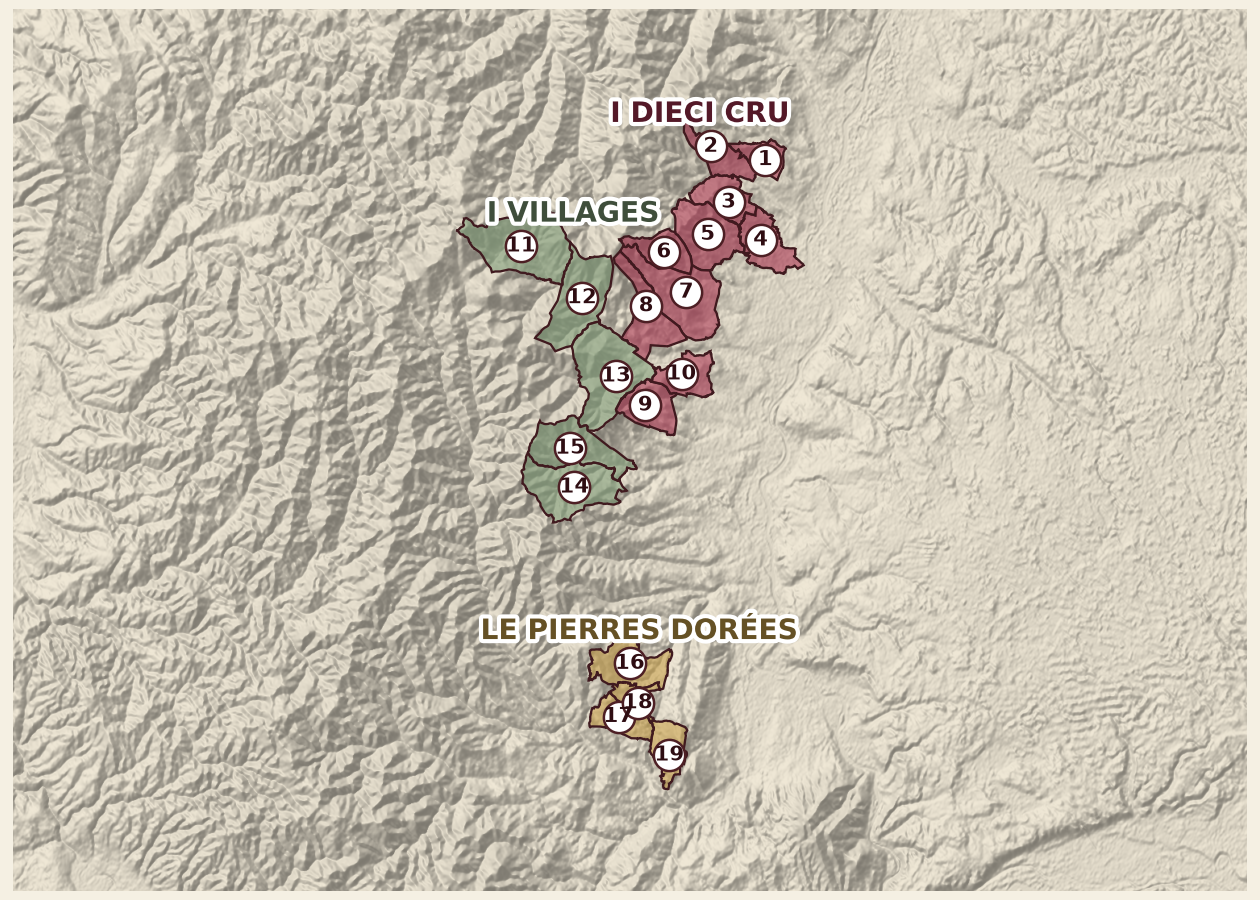
Diciannove comuni per leggere il vigneto da nord a sud: dieci sono i cru, uno per ciascuno, poi la fascia dei Villages e infine le Pierres Dorées. La prima cosa da guardare è la forma — una striscia sottile di cinquantacinque chilometri, non una macchia.Nineteen communes to read the vineyard from north to south: ten of them are the crus, one for each, then the Villages belt and finally the Pierres Dorées. The first thing to look at is the shape — a thin fifty-five-kilometre ribbon, not a blot.
- 1 Saint-Amour-Bellevue
- 2 Juliénas
- 3 Chénas
- 4 Romanèche-Thorins
- 5 Fleurie
- 6 Chiroubles
- 7 Villié-Morgon
- 8 Régnié-Durette
- 9 Odenas
- 10 Saint-Lager
- 11 Les Ardillats
- 12 Beaujeu
- 13 Quincié-en-Beaujolais
- 14 Vaux-en-Beaujolais
- 15 Le Perréon
- 16 Theizé
- 17 Bagnols
- 18 Frontenas
- 19 Charnay
Zone e sottozoneZones and subzones
I vitigni del territorioThe grapes of the territory
Le denominazioniThe denominations
A tavolaAt the table
Il Beaujolais finisce a mezz'ora di strada da Lione, e a tavola si vede: la cucina di riferimento è quella dei bouchon lionesi, generosa e senza cerimonie, che l'interprofessione ha ribattezzato con una parola sua, beaujonomie — Beaujolais più bistronomia, cioè piatti tradizionali e vino del posto in tavolate lunghe.Beaujolais ends half an hour's drive from Lyon, and it shows at table: the reference cuisine is that of the Lyonnais bouchons, generous and unceremonious, which the trade body has renamed with a word of its own, beaujonomie — Beaujolais plus bistronomy, meaning traditional dishes and local wine at long tables.
Si comincia dalla salumeria, che qui è quasi un'istituzione: saucisson brioché, sabodet servito caldo con le patate, terrine di campagna. Sono piatti saporiti e grassi, e chiedono un rosso fresco e di tannino leggero: il Beaujolais o il Beaujolais-Villages dell'annata, serviti quasi freschi, fanno esattamente questo mestiere. Un Crémant de Bourgogne brut, con la sua bolla fine e la spalla acida, regge bene lo stesso ruolo all'aperitivo. Le quenelle de brochet con la salsa cremosa, invece, sono il piatto dove il Beaujolais bianco da chardonnay — teso, sapido, di buona freschezza — dice qualcosa che il rosso non direbbe.It begins with charcuterie, close to an institution here: saucisson brioché, sabodet served warm with potatoes, country terrine. These are savoury, fatty dishes, and they call for a fresh red with light tannin: Beaujolais or Beaujolais-Villages of the current vintage, served cool, do exactly that job. A brut Crémant de Bourgogne, with its fine bead and acid backbone, holds the same role at the aperitif. Quenelles de brochet in their creamy sauce, on the other hand, are the dish where Beaujolais blanc from chardonnay — taut, saline, brightly fresh — says something the red would not.
Poi si sale di peso. Il tablier de sapeur, la trippa impanata e fritta, vuole freschezza e beva: Brouilly, Régnié o Chiroubles, che sono profumati e leggeri di tannino. Un arrosto di maiale con mele e castagne, un coq au vin fatto con un cru, un pezzo di selvaggina chiedono invece struttura e tannino fine, e allora si aprono Morgon e Moulin-à-Vent, i due che con qualche anno di bottiglia cambiano registro con più evidenza. La cervelle de canut, formaggio fresco montato con erbe e scalogno, si accompagna volentieri a un Fleurie giovane. Per chiudere, la tarte à la praline rosa: qui il vino si fa da parte, e il caffè fa meglio il suo lavoro.Then the weight rises. Tablier de sapeur, breaded and fried tripe, wants freshness and drinkability: Brouilly, Régnié or Chiroubles, scented and light in tannin. Roast pork with apples and chestnuts, a coq au vin made with a cru, a piece of game ask instead for structure and fine tannin, and that is when Morgon and Moulin-à-Vent are opened — the two that change register most clearly after a few years in bottle. Cervelle de canut, fresh cheese whipped with herbs and shallot, sits happily beside a young Fleurie. To close, the pink tarte à la praline: here wine steps aside, and coffee does the job better.
La storiaHistory
Il 31 luglio 1395, a Digione, Jehan de Varranges — chierico, licenziato in leggi e in decreti, balivo di Digione e commissario del duca — fa gridare pubblicamente un'ordinanza di Filippo l'Ardito, duca di Borgogna, conte di Fiandra, d'Artois e di Borgogna. Il testo è uno dei documenti più famosi della storia del vino, e il suo bersaglio è un'uva: «da poco tempo in qua parecchi dei nostri sudditi, bramosi di avere gran quantità di vino, hanno piantato subdolamente, tra le buone vigne dove cresceva il buon vino, viti di una pianta pessima e sleale, chiamata Gaamez, dalla quale pianta cattiva viene grandissima abbondanza di vino».On 31 July 1395, in Dijon, Jehan de Varranges — cleric, licensed in laws and decrees, bailiff of Dijon and commissioner of the duke — has an ordinance of Philip the Bold, Duke of Burgundy, Count of Flanders, Artois and Burgundy, publicly cried. The text is one of the most famous documents in the history of wine, and its target is a grape: «of late several of our subjects, covetous of great quantities of wine, have craftily planted, among the good vines where the good wine used to grow, vines of a very bad and very disloyal plant, named Gaamez, from which bad plant comes a very great abundance of wine».
L'atto d'accusa continua, e a leggerlo oggi fa quasi sorridere. Il vino di gamay, scrive il duca, è «assai nocivo alla creatura umana», tanto che molti di quelli che in passato ne hanno fatto uso ne sono usciti con gravi malattie; per natura è «pieno di grandissima e orribile amarezza»; e se da nuovo conserva una specie di dolcezza, è perché chi lo fa, quando vuole venderlo sulle fecce fresche, ha l'abitudine di versare nei tini acqua calda in gran quantità. Passata quella dolcezza, conclude, il vino torna alla sua prima natura, «e anche peggio: perché diventa tutto puzzolente». Segue l'ordine: tagliare le viti di gamay entro un mese, ovunque si trovino, sotto pena di sessanta soldi tornesi per ogni ouvrée di vigna non estirpata.The indictment goes on, and reading it today almost raises a smile. Gamay wine, the duke writes, is «most harmful to the human creature», so much so that many who used it in the past came away with grave illnesses; by nature it is «full of very great and horrible bitterness»; and if when new it holds a kind of sweetness, that is because those who make it, when they mean to sell it on its fresh lees, are in the habit of pouring hot water into the vats in great quantity. Once that sweetness has passed, he concludes, the wine returns to its first nature, «and worse still: for it turns altogether stinking». Then the order: cut the gamay vines within a month, wherever they stand, on pain of sixty sous tournois for every ouvrée of vineyard not grubbed up.
La Côte borgognona restò al pinot nero, e ci è rimasta. Il gamay uscì dai vigneti ducali: che sia sceso proprio qui è il racconto che il Beaujolais fa di sé più che un fatto documentato riga per riga, ma il risultato non è in discussione — è su questi graniti che l'uva bandita da Digione è diventata grande, ed è qui che oggi copre il 97% delle vigne.The Burgundian Côte stayed with pinot noir, and there it remains. Gamay left the ducal vineyards: that it came down precisely here is more the story Beaujolais tells about itself than a fact documented line by line, but the outcome is not in doubt — it is on this granite that the grape banished from Dijon became great, and here that it covers 97% of the vines today.
C'è un'ultima ironia, e vale la pena raccontarla. Filippo l'Ardito rimproverava al gamay la dolcezza ingannevole del vino nuovo. Cinque secoli e mezzo dopo, nel 1951, una decisione ministeriale francese vietò la vendita dei vini AOC prima del 15 dicembre dell'anno di vendemmia; i vignaioli del Beaujolais contestarono e ottennero ragione, a condizione che l'etichetta dicesse chiaramente che si trattava di un vino primeur. Da lì nasce il fenomeno del Beaujolais Nouveau, che dal 1985 esce il terzo giovedì di novembre in tutto il mondo. Il vino nuovo — proprio quello — è diventato la fortuna e insieme la condanna d'immagine della regione. La risposta è arrivata da dentro: Jules Chauvet (1907-1989), negoziante a La Chapelle-de-Guinchay in una casa di famiglia fondata nel 1850, che affiancava al commercio il laboratorio dell'Istituto di chimica biologica dell'Università di Lione, studiò i lieviti indigeni, la macerazione carbonica e l'effetto della solforosa sul gusto del vino. I vignaioli di Morgon che ne raccolsero il metodo hanno fatto del Beaujolais uno degli indirizzi di riferimento della vinificazione a bassissimo intervento. Stessa uva, due destini.There is one last irony worth telling. Philip the Bold reproached gamay for the deceptive sweetness of new wine. Five and a half centuries later, in 1951, a French ministerial decision forbade the sale of AOC wines before 15 December of the harvest year; the growers of Beaujolais contested it and won, on condition that the label state plainly that this was a vin primeur. From there comes the Beaujolais Nouveau phenomenon, released worldwide on the third Thursday of November since 1985. New wine — that very thing — became both the region's fortune and the burden on its image. The answer came from within: Jules Chauvet (1907-1989), a merchant at La Chapelle-de-Guinchay in a family house founded in 1850, who combined the trade with the laboratory of the Institute of Biological Chemistry at the University of Lyon, and who studied indigenous yeasts, carbonic maceration and the effect of sulphur dioxide on the taste of wine. The Morgon growers who took up his method made Beaujolais one of the reference addresses of very-low-intervention winemaking. The same grape, two destinies.
Numeri e denominazioni vengono da fonti ufficiali verificate e archiviate: il sito di Inter Beaujolais per il conteggio delle dodici AOC, la superficie rivendicata, la quota di gamay e le schede delle singole appellazioni; i disciplinari INAO del Beaujolais, del Morgon e del Crémant de Bourgogne per comuni, menzioni, vitigni e metodo; il Ministero dell'Agricoltura francese per la cronologia del Beaujolais Nouveau; il Geoparco mondiale UNESCO del Beaujolais per il riconoscimento del 2018; la trascrizione dell'ordinanza del 31 luglio 1395 per le citazioni del duca. Dove il numero delle appellazioni e quello dei disciplinari non coincidono lo diciamo in pagina invece di scegliere in silenzio. Le sottozone dei cru non sono menzioni ufficiali: il disciplinare del Morgon dichiara esplicitamente «nessuna disposizione particolare» sulle denominazioni geografiche complementari. I profili dei vini descrivono il carattere ricorrente delle denominazioni, non una specifica annata.Figures and denominations come from verified, archived official sources: the Inter Beaujolais site for the count of twelve AOCs, the claimed surface, the gamay share and the individual appellation sheets; the INAO specifications for Beaujolais, Morgon and Crémant de Bourgogne for communes, mentions, grape varieties and method; the French Ministry of Agriculture for the Beaujolais Nouveau timeline; the Beaujolais UNESCO Global Geopark for the 2018 designation; the transcription of the ordinance of 31 July 1395 for the duke's words. Where the number of appellations and the number of specifications do not match, we say so on the page rather than quietly picking one. The crus' lieux-dits are not official mentions: the Morgon specification explicitly states «no particular provision» on complementary geographical denominations. Wine profiles describe the recurring character of the denominations, not a specific vintage.