In Borgogna il vino si misura in parcelle. Su una stretta fascia di colline calcaree, lunga poco più di duecento chilometri, Pinot Noir e Chardonnay danno alcuni fra i rossi e i bianchi più ricercati al mondo — non per la quantità, ma per il modo in cui ogni «climat» racconta il suo pezzo di terra.In Burgundy, wine is measured in plots. Along a narrow band of limestone hills just over two hundred kilometres long, Pinot Noir and Chardonnay yield some of the world's most sought-after reds and whites — not for their volume, but for the way each «climat» tells the story of its own piece of ground.
Il territorioThe territory
La terraThe land
Il calcare, prima di tutto. Una lunga cuesta di marne e calcari del Giurassico, esposta in gran parte a est, dove ogni parcella ha suolo, pendenza e microclima propri: dal calcare fossilifero del nord di Chablis alle marne della Côte d'Or fino alle colline più dolci e calde del sud.Limestone, above all. A long Jurassic ridge of marl and limestone, mostly east-facing, where each plot has its own soil, slope and microclimate: from the fossil-rich limestone of Chablis in the north to the marls of the Côte d'Or, down to the gentler, warmer hills of the south.
Il vitignoThe grape
Due varietà su tutte. Il Pinot Noir per i rossi e lo Chardonnay per i bianchi qui hanno trovato la loro espressione di riferimento; li affiancano l'Aligoté, bianco storico della regione, e il Gamay, più presente nel sud.Two grapes above the rest. Pinot Noir for the reds and Chardonnay for the whites have found their benchmark expression here; alongside them stand Aligoté, the region's historic white, and Gamay, more common in the south.
L'uomoThe human hand
Il «climat» e l'eredità dei monaci. Secoli di osservazione hanno disegnato un mosaico di parcelle minuscole, ciascuna con il suo nome: oggi la frammentazione della proprietà e il culto del singolo appezzamento definiscono il modo borgognone di fare vino.The «climat» and the legacy of the monks. Centuries of observation drew a mosaic of tiny plots, each with its own name: today the fragmentation of ownership and the cult of the single plot define the Burgundian way of making wine.
La mappaThe map
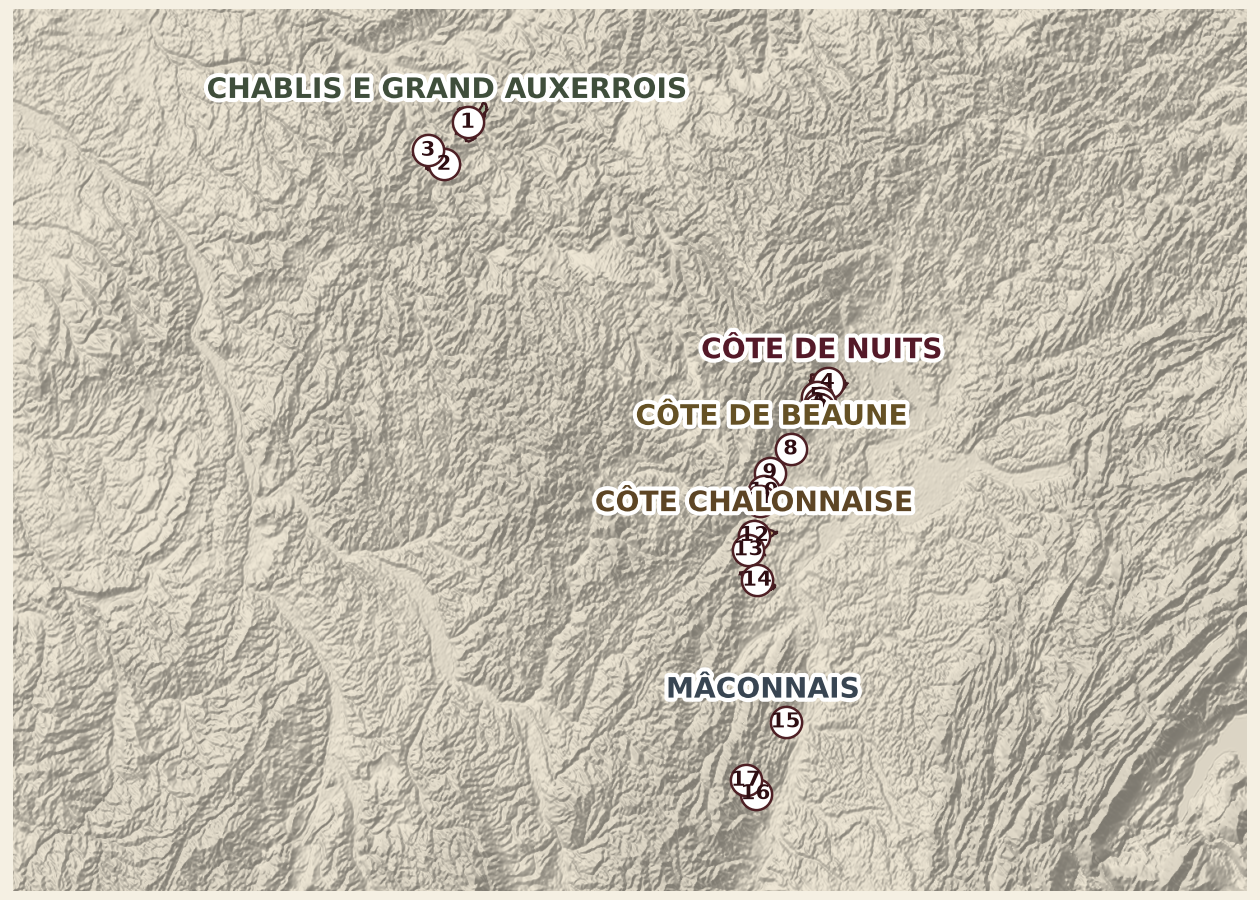
I cinque vignobles della Borgogna, da Chablis a nord fino al Mâconnais a sud, lungo la cuesta calcarea. Comuni indicativi per zona.Burgundy's five vineyard areas, from Chablis in the north down to the Mâconnais in the south, along the limestone ridge. Representative communes per zone.
- 1 Chablis
- 2 Irancy
- 3 Saint-Bris-le-Vineux
- 4 Gevrey-Chambertin
- 5 Chambolle-Musigny
- 6 Vougeot
- 7 Vosne-Romanée
- 8 Aloxe-Corton
- 9 Pommard
- 10 Meursault
- 11 Puligny-Montrachet
- 12 Rully
- 13 Mercurey
- 14 Givry
- 15 Viré
- 16 Fuissé
- 17 Vergisson
Zone e sottozoneZones and subzones
I vitigni del territorioThe grapes of the territory
Le denominazioniThe denominations
A tavolaAt the table
La cucina di Borgogna è fatta di piatti lunghi e generosi, nati attorno al vino di casa. Il boeuf bourguignon — manzo brasato a lungo nel vino rosso — e il coq au vin chiedono un rosso di Pinot Noir, dai tannini fini e dalla bella freschezza, che alleggerisce il fondo di cottura. Gli oeufs en meurette (uova in camicia in salsa di vino rosso) e il jambon persillé, prosciutto in gelatina al prezzemolo, restano sullo stesso registro. Sulle gougères, i bignè salati al formaggio, e sul formaggio forte a crosta lavata Époisses si apre invece un grande Chardonnay di Meursault, ampio e avvolgente. E i celebri escargots al burro e aglio chiamano un bianco fresco e teso, come uno Chablis.Burgundian cooking is built on long, generous dishes that grew up around the local wine. Boeuf bourguignon — beef slowly braised in red wine — and coq au vin call for a Pinot Noir red, with fine tannins and bright freshness that lightens the rich cooking juices. Oeufs en meurette (poached eggs in a red-wine sauce) and jambon persillé, parsleyed ham in jelly, stay in the same register. With gougères, the savoury cheese puffs, and the pungent washed-rind Époisses cheese, a great Chardonnay from Meursault opens up instead, broad and enveloping. And the famous escargots in garlic butter ask for a fresh, taut white, such as a Chablis.
La storiaHistory
Quando si parla di Borgogna si parla, prima di tutto, di monaci. Nel Medioevo furono i Benedettini di Cluny e, dal XII secolo, soprattutto i Cistercensi dell'abbazia di Cîteaux a prendere in mano le colline della Côte d'Or. Lavorando le vigne parcella per parcella, anno dopo anno, i monaci notarono ciò che ancora oggi è il cuore della regione: che due filari vicini, sullo stesso versante, potevano dare vini diversi. Cominciarono a delimitare gli appezzamenti con muretti a secco — i «clos» — e a tenerne memoria. Il Clos de Vougeot, cinto dai Cistercensi a partire dal XII secolo attorno a una cinquantina di ettari, è il monumento di quel lavoro paziente. Da quell'osservazione nasce l'idea borgognona di «climat»: non un'azienda né un marchio, ma un pezzo di terra preciso — con il suo suolo, la sua pendenza, la sua luce — capace di dare ogni anno un vino riconoscibile. È un modo di pensare il vino opposto a quello del castello di Bordeaux: qui conta il luogo, più di chi lo possiede. Nel 2015 l'UNESCO ha iscritto i «Climats du vignoble de Bourgogne» nella lista del Patrimonio Mondiale, riconoscendo a quel mosaico di parcelle — disegnato dai monaci e custodito per secoli — il valore di un paesaggio culturale unico.To speak of Burgundy is, first of all, to speak of monks. In the Middle Ages it was the Benedictines of Cluny and, from the 12th century, above all the Cistercians of the abbey of Cîteaux who took the hills of the Côte d'Or in hand. Working the vines plot by plot, year after year, the monks noticed what still lies at the heart of the region: that two neighbouring rows, on the same slope, could give different wines. They began to enclose the plots with dry-stone walls — the «clos» — and to keep a record of them. The Clos de Vougeot, walled by the Cistercians from the 12th century around some fifty hectares, is the monument to that patient work. From that observation comes the Burgundian idea of the «climat»: not an estate nor a brand, but a precise piece of ground — with its own soil, slope and light — able to give a recognisable wine year after year. It is a way of thinking about wine opposite to that of the Bordeaux château: here the place matters more than who owns it. In 2015 UNESCO inscribed the «Climats du vignoble de Bourgogne» on the World Heritage list, recognising in that mosaic of plots — drawn by the monks and tended for centuries — the value of a unique cultural landscape.
Profilo della regione a carattere divulgativo. I dati su denominazioni e livelli vengono dall'ente ufficiale della regione, il BIVB; la piramide delle AOC e i singoli climat possono evolvere nel tempo.An accessible profile of the region. The figures on appellations and tiers come from the region's official body, the BIVB; the AOC pyramid and the individual climats may change over time.