La Bassa Austria è dove sta il vino austriaco: 28.574 ettari di vigna, poco più del sessanta per cento della superficie nazionale, e quasi la metà piantata a una sola uva, il Grüner Veltliner. Il disegno si legge partendo dal Danubio, che entra nella regione fra le rocce della Wachau e ne esce a est verso la pianura: otto zone di produzione, tutte con la propria denominazione DAC, dai terrazzamenti di gneiss sopra il fiume alle colline di löss del Weinviertel, fino alle vigne di rosso alle porte di Vienna.Lower Austria is where Austrian wine lives: 28,574 hectares of vineyard, a little over sixty per cent of the national total, and almost half of it planted to a single grape, Grüner Veltliner. The pattern reads best from the Danube, which enters the region through the rock of the Wachau and leaves it eastwards towards the plain: eight growing zones, each with its own DAC appellation, from the gneiss terraces above the river to the loess hills of the Weinviertel and the red-wine vineyards at the gates of Vienna.
Il territorioThe territory
La terraThe land
Tre suoli si dividono la regione. Nella Wachau il Danubio ha scavato la valle in gneiss e anfiboliti: roccia dura, terra pochissima, terrazze tenute da muri a secco. Appena a valle, e poi per tutto il Weinviertel, il Wagram e buona parte del Kremstal, comanda il löss, la polvere di roccia portata dal vento nelle ere glaciali, profonda e capace di trattenere acqua. A sud del Danubio cambia ancora: conglomerati calcarei nel Traisental, il bordo delle Alpi Calcaree nella Thermenregion, ghiaie fluviali a Carnuntum. Il clima è un incontro fra due arie: il caldo pannonico che arriva da est e l'aria fresca che scende dal nord boscoso, ed è quello scarto fra il giorno e la notte a tenere in piedi l'acidità dei bianchi.Three soils share the region. In the Wachau the Danube carved its valley through gneiss and amphibolite: hard rock, very little soil, terraces held up by dry-stone walls. Just downstream, and then across the whole Weinviertel, the Wagram and much of the Kremstal, loess takes over — rock dust blown in during the ice ages, deep and good at holding water. South of the Danube it changes again: calcareous conglomerate in the Traisental, the edge of the Limestone Alps in the Thermenregion, river gravel at Carnuntum. The climate is where two airstreams meet: Pannonian warmth from the east and cool air coming down from the wooded north, and it is that gap between day and night that keeps the acidity in the white wines.
Il vitignoThe grape
Il Grüner Veltliner qui occupa 13.596 ettari, circa nove decimi di tutto quello austriaco: dà vini asciutti con una nota pepata che i viticoltori chiamano Pfefferl. Il Riesling è la seconda uva bianca, e sceglie le terrazze più sassose sopra il fiume. Fra i rossi domina lo Zweigelt, incrocio austriaco del Novecento; dietro vengono il Blauer Portugieser e il Blauburger, mentre Sankt Laurent e Pinot Noir si fermano poco sopra i trecento ettari ciascuno. Due uve poi non si trovano quasi in nessun altro posto: il Rotgipfler e lo Zierfandler della Thermenregion, che in Bassa Austria contano rispettivamente 127 e 73 ettari su un totale austriaco di 131 e 77.Grüner Veltliner covers 13,596 hectares here, roughly nine tenths of all the Grüner in Austria: it makes dry wines with a peppery note growers call Pfefferl. Riesling is the second white grape, and it takes the stoniest terraces above the river. Among the reds Zweigelt dominates — a twentieth-century Austrian crossing; behind it come Blauer Portugieser and Blauburger, while Sankt Laurent and Pinot Noir stop at just over three hundred hectares each. Two grapes are found almost nowhere else: Rotgipfler and Zierfandler in the Thermenregion, with 127 and 73 hectares in Lower Austria out of an Austrian total of 131 and 77.
L'uomoThe human hand
Dal 2002 la Bassa Austria ha ricostruito le proprie etichette attorno all'origine. Ogni DAC lavora su tre gradini: Gebietswein per la zona, Ortswein per il comune, Riedenwein per la singola vigna — la Ried, che è il nome storico di quel pezzo di collina. Sopra a questo, l'associazione privata Österreichische Traditionsweingüter classifica le vigne migliori come Erste Lage, la sigla 1ÖTW che si legge in etichetta. Nella Wachau la scelta è arrivata più a fondo: il disciplinare impone la raccolta a mano per tutti i vini DAC, e per i Riedenweine vieta ogni forma di arricchimento.Since 2002 Lower Austria has rebuilt its labels around origin. Every DAC works on three steps: Gebietswein for the zone, Ortswein for the village, Riedenwein for the single vineyard — the Ried, the historic name of that piece of hillside. Above this, the private Österreichische Traditionsweingüter association classifies the best sites as Erste Lage, the 1ÖTW mark you can read on the label. In the Wachau the choice went further: the regulation requires hand harvesting for all DAC wines, and forbids any form of enrichment for Riedenweine.
La mappaThe map
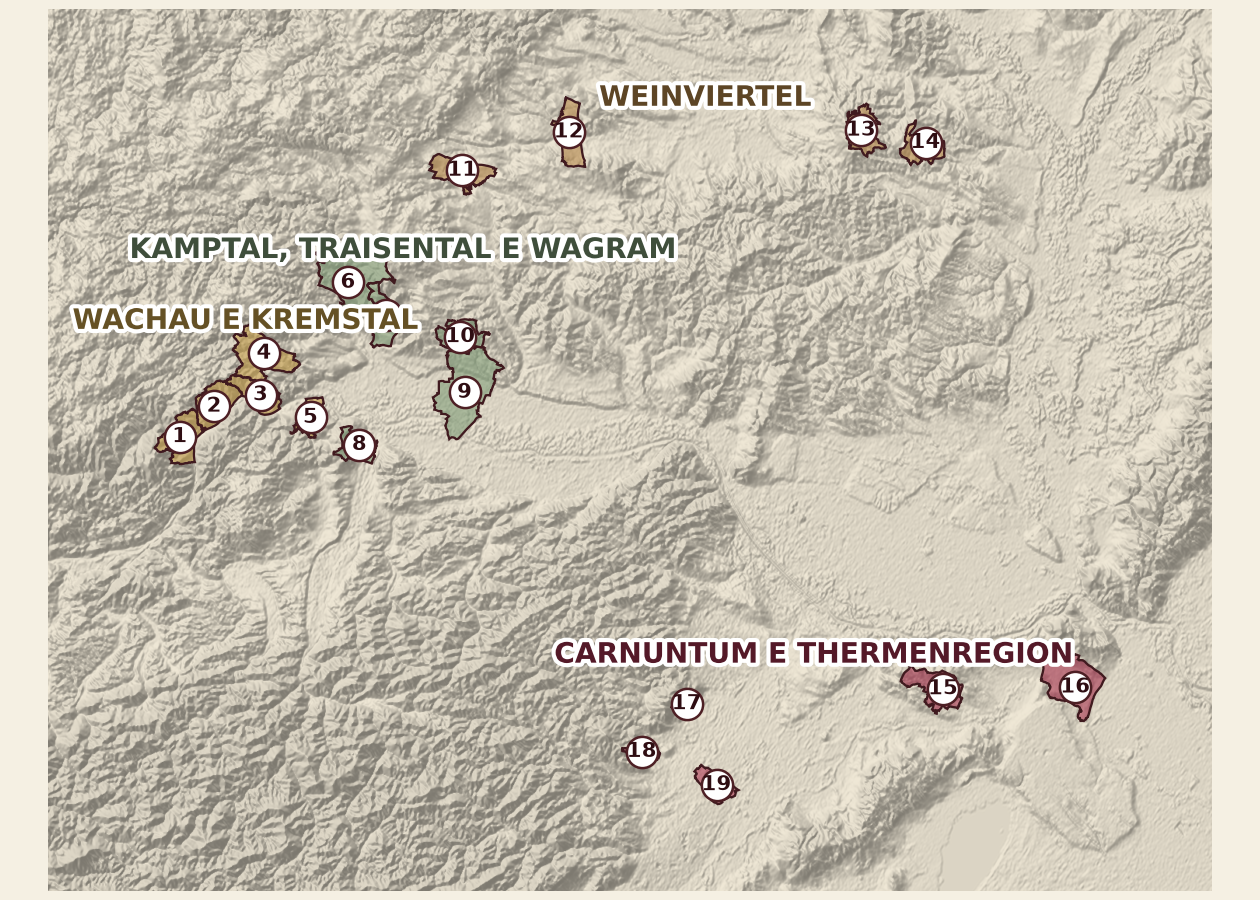
Diciannove comuni viticoli della Bassa Austria, raccolti nelle quattro macro-aree in cui abbiamo diviso le otto zone DAC. Il raggruppamento è editoriale e serve a leggere la mappa: le denominazioni qui sotto seguono gli stessi colori.Nineteen wine communes of Lower Austria, gathered into the four macro-areas we used to group the eight DAC zones. The grouping is editorial and exists to make the map readable: the appellations below follow the same colours.
- 1 Spitz
- 2 Weißenkirchen
- 3 Dürnstein
- 4 Senftenberg
- 5 Furth bei Göttweig
- 6 Schönberg am Kamp
- 7 Straß im Straßertale
- 8 Nußdorf ob der Traisen
- 9 Kirchberg am Wagram
- 10 Großriedenthal
- 11 Röschitz
- 12 Haugsdorf
- 13 Falkenstein
- 14 Herrnbaumgarten
- 15 Göttlesbrunn
- 16 Prellenkirchen
- 17 Gumpoldskirchen
- 18 Sooß
- 19 Tattendorf
Zone e sottozoneZones and subzones
I vitigni del territorioThe grapes of the territory
Le denominazioniThe denominations
A tavolaAt the table
La cucina di qui è di carne e di grassi cotti, e il Grüner Veltliner ci sta per il motivo più semplice: ha l'acidità che serve a ripulire. Con la cotoletta impanata alla viennese, o con il pollo fritto del Backhendl, un Federspiel o un Weinviertel DAC di annata fresca fa esattamente questo lavoro; e la nota pepata dell'uva regge bene anche il rafano che accompagna il bollito.The cooking here is built on meat and cooked fat, and Grüner Veltliner fits for the simplest of reasons: it has the acidity you need to clean the palate. With a breaded Wiener Schnitzel, or with the fried chicken of Backhendl, a Federspiel or a young Weinviertel DAC does exactly that job; and the grape's peppery note also stands up to the horseradish served with boiled beef.
Gli asparagi bianchi del Marchfeld, la pianura a est di Vienna, sono l'abbinamento di primavera più tipico della regione: qui serve un Grüner Veltliner più maturo, un Riedenwein o un Kremstal DAC Reserve, perché l'asparago con la salsa cerca un vino di corpo e non di sola acidità. Sui rossi si passa a est: lo Zweigelt di Carnuntum, morbido e di tannino gentile, sta bene sul gulasch e sullo Zwiebelrostbraten, la fetta di manzo con le cipolle fritte. E in chiusura ci sono i canederli di albicocca della Wachau, fatti con la Wachauer Marille, l'albicocca che dal 1996 ha il proprio nome protetto in Europa: lì il vino giusto è dolce, una vendemmia tardiva della regione.White asparagus from the Marchfeld, the plain east of Vienna, is the region's classic spring pairing: here you want a riper Grüner Veltliner, a Riedenwein or a Kremstal DAC Reserve, because asparagus with sauce calls for a wine with body and not acidity alone. For reds you move east: the Zweigelt of Carnuntum, soft and gently tannic, sits well with goulash and with Zwiebelrostbraten, beef with fried onions. And to finish there are the apricot dumplings of the Wachau, made with the Wachauer Marille, the apricot whose name has been protected across Europe since 1996: there the right wine is a sweet one, a late harvest from the region.
La storiaHistory
Il nome dell'associazione che ha cambiato la Wachau viene da un uomo del Duecento. Leuthold I di Kuenring, vissuto fra il 1243 e il 1313, era il coppiere maggiore d'Austria, e il cuore delle sue terre coincideva quasi esattamente con l'attuale zona vitivinicola della Wachau: quando nel 1983 un gruppo di viticoltori decise di darsi delle regole comuni, chiamò la propria associazione Vinea Wachau Nobilis Districtus, riprendendo la formula con cui quelle proprietà erano state descritte secoli prima.The name of the association that changed the Wachau comes from a man of the thirteenth century. Leuthold I of Kuenring, who lived between 1243 and 1313, was the chief cupbearer of Austria, and the core of his lands coincided almost exactly with today's Wachau winegrowing zone: when a group of growers decided in 1983 to give themselves a shared set of rules, they called their association Vinea Wachau Nobilis Districtus, taking up the phrase with which those holdings had been described centuries earlier.
Le regole erano poche e molto dure, e stavano tutte in un testo che si chiama Codex Wachau. I soci si impegnavano a vinificare esclusivamente uve del territorio delimitato, rinunciando volontariamente a comprare uva o vino da altre zone e a coltivare vigne altrove — un vincolo che ha tenuto piccole le aziende, ed è il motivo per cui la Wachau è ancora fatta di proprietà minuscole. Poi: nessun arricchimento, nessuna concentrazione, nessun aroma aggiunto, nessun legno percepibile. Nulla di tutto questo era richiesto dalla legge; era una restrizione che i produttori si imponevano da soli.The rules were few and very strict, and they all sat in a text called the Codex Wachau. Members undertook to vinify only grapes from the delimited area, voluntarily giving up buying grapes or wine from elsewhere and farming vineyards outside it — a constraint that kept the estates small, and the reason the Wachau is still made of tiny holdings. Then: no enrichment, no concentration, no added aromas, no perceptible oak. None of this was required by law; it was a restriction the growers imposed on themselves.
Mancava un modo per dire al cliente che cosa avrebbe trovato nella bottiglia, visto che la classificazione austriaca per grado zuccherino non descriveva vini secchi. Dal 1984 nascono così i tre marchi che ancora oggi sono la prima cosa che si legge su un'etichetta della valle: Steinfeder, dal nome di un'erba che cresce sulle terrazze, per i vini più leggeri; Federspiel, dal richiamo dei falconieri, per quelli di peso medio; Smaragd, dalla lucertola verde che sta al sole sui muri a secco, per i più pieni. Sono marchi registrati dell'associazione: li può usare solo chi ne fa parte.What was missing was a way of telling the customer what was in the bottle, since the Austrian classification by sugar level did not describe dry wines. So from 1984 came the three marks that are still the first thing you read on a label from the valley: Steinfeder, named after a grass that grows on the terraces, for the lightest wines; Federspiel, from the falconers' lure, for the medium-bodied ones; Smaragd, from the green lizard that suns itself on the dry-stone walls, for the fullest. They are registered trademarks of the association: only its members may use them.
La storia si chiude nel 2020, quando lo Stato ha riconosciuto alla Wachau la propria denominazione, Wachau DAC, e ha scritto nel disciplinare due cose che i soci della Vinea praticavano da quasi quarant'anni: la vendemmia esclusivamente a mano per tutti i vini della denominazione, e il divieto di qualsiasi arricchimento per i vini di singola vigna. Oggi le due cose convivono sulla stessa bottiglia — il DAC dello Stato e il nome della lucertola — e raccontano lo stesso patto, arrivato però da due strade diverse.The story closes in 2020, when the state granted the Wachau its own appellation, Wachau DAC, and wrote into the regulation two things Vinea members had been practising for almost forty years: hand harvesting only, for every wine in the appellation, and a ban on any enrichment for single-vineyard wines. Today the two sit on the same bottle — the state's DAC and the lizard's name — and they speak of the same commitment, reached by two different roads.
Superfici vitate e dati per vitigno: Statistik Austria, Weingartengrunderhebung 2020 (l'ultima rilevazione di base pubblicata). Zone, anni di istituzione dei DAC, uve ammesse e origini per gli Ortsweine: Österreich Wein Marketing. Il nome protetto della Wachauer Marille: registro europeo delle indicazioni geografiche. Le descrizioni dei vini sono profili caratteristici della zona e non note di degustazione di una specifica annata; annate e cuvée cambiano nel tempo.Vineyard areas and grape data: Statistik Austria, Weingartengrunderhebung 2020 (the most recent published basic survey). Zones, DAC starting years, permitted grapes and Ortswein origins: Österreich Wein Marketing. The protected name of the Wachauer Marille: the European register of geographical indications. The wine descriptions are characteristic profiles of the area and not tasting notes of a specific vintage; vintages and cuvées change over time.