Stretto fra le vette più alte dell'Appennino e una sottile striscia di Adriatico, l'Abruzzo è la regione del vino italiana che per decenni ha riempito le cisterne di mezza Europa — e che, negli stessi anni, ha fatto nascere alcune delle bottiglie di culto più ricercate del Paese. Il rosso Montepulciano, il rosato Cerasuolo e il bianco Trebbiano sono i suoi tre nomi-bandiera; accanto, una piccola rivoluzione di bianchi autoctoni (Pecorino, Passerina, Cococciola) ne sta riscrivendo l'identità.Squeezed between the highest peaks of the Apennines and a thin ribbon of Adriatic coast, Abruzzo is the Italian wine region that for decades filled the tanks of half of Europe — and that, in those same years, gave rise to some of the country's most sought-after cult bottles. The red Montepulciano, the rosé Cerasuolo and the white Trebbiano are its three flagship names; alongside them, a small revolution of native white grapes (Pecorino, Passerina, Cococciola) is rewriting its identity.
Il territorioThe territory
La terraThe land
È la regione più montuosa dell'Appennino: in poche decine di chilometri si passa dai 2.912 metri del Gran Sasso e dalla Maiella alle spiagge dell'Adriatico. La vite vive in mezzo, sulle colline, con forti escursioni di temperatura fra il giorno e la notte che danno freschezza e profumo. Un terzo del territorio è parco protetto: non a caso l'Abruzzo è detto «la regione verde d'Europa».It is the most mountainous region of the Apennines: within a few dozen kilometres you pass from the 2,912 metres of the Gran Sasso and the Maiella down to the Adriatic beaches. The vine lives in between, on the hills, with wide day-to-night temperature swings that bring freshness and fragrance. A third of the territory is protected parkland: fittingly, Abruzzo is called 'the green region of Europe'.
Il vitignoThe grape
Un re indiscusso, il Montepulciano: rosso scuro e profondo, da non confondere con la città toscana di Montepulciano (che fa Sangiovese). Da solo dà il Montepulciano d'Abruzzo; vinificato in rosa, l'inconfondibile Cerasuolo. Sul fronte bianco il longevo Trebbiano d'Abruzzo e il ritorno dei vitigni autoctoni Pecorino, Passerina, Cococciola e Montonico.One undisputed king, Montepulciano: a deep, dark red, not to be confused with the Tuscan town of Montepulciano (which makes Sangiovese). On its own it gives Montepulciano d'Abruzzo; vinified as a rosé, the unmistakable Cerasuolo. On the white side, the long-lived Trebbiano d'Abruzzo and the return of the native grapes Pecorino, Passerina, Cococciola and Montonico.
L'uomoThe human hand
Due anime convivono. Le grandi cooperative — fra le più importanti d'Italia — che hanno dato lavoro e vino quotidiano a migliaia di famiglie; e i piccoli vignaioli di culto, come Valentini ed Emidio Pepe, che hanno dimostrato al mondo quanto in alto possano salire un Trebbiano e un Montepulciano. Oggi la regione lavora a definire le sue zone più vocate.Two souls coexist. The large cooperatives — among the most important in Italy — that have given work and everyday wine to thousands of families; and the small cult growers, such as Valentini and Emidio Pepe, who showed the world just how high a Trebbiano and a Montepulciano can climb. Today the region is working to define its finest growing areas.
La mappaThe map
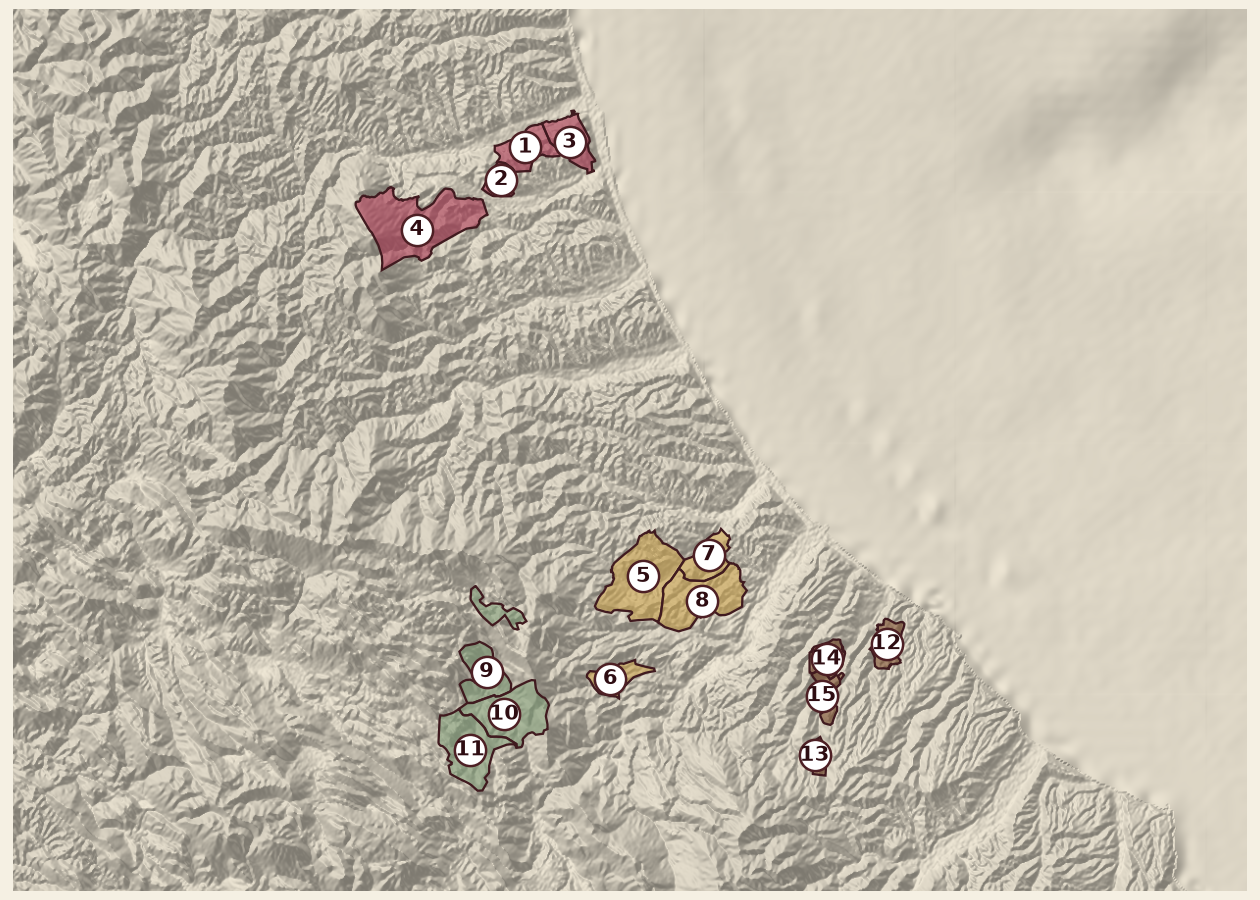
Le quattro province del vino abruzzese, dalle colline teramane del nord al versante chietino, il più vitato — con alcuni dei comuni più rappresentativi di ogni zona.The four provinces of Abruzzo wine, from the Teramo hills in the north to the Chieti side, the most planted — with some of the most representative villages of each area.
- 1 Controguerra
- 2 Torano Nuovo
- 3 Colonnella
- 4 Civitella del Tronto
- 5 Loreto Aprutino
- 6 Cugnoli
- 7 Moscufo
- 8 Pianella
- 9 Ofena
- 10 Capestrano
- 11 Navelli
- 12 Tollo
- 13 San Martino sulla Marrucina
- 14 Villamagna
- 15 Vacri
Zone e sottozoneZones and subzones
I vitigni del territorioThe grapes of the territory
Le denominazioniThe denominations
A tavolaAt the table
La tavola abruzzese è schietta e saporita, fatta per il rosso di casa. Gli arrosticini — piccoli spiedini di pecora cotti sulla brace — chiedono un Montepulciano d'Abruzzo giovane e succoso, o, d'estate, un Cerasuolo fresco che pulisce il palato dal grasso della carne. I maccheroni alla chitarra con il ragù d'agnello stanno bene su un Montepulciano più strutturato, capace di reggere il piatto. Sul pecorino di Farindola, intenso e stagionato, il rosso più maturo e morbido. E quando si va di pesce — il brodetto alla vastese, le alici — è il momento dei bianchi: un Pecorino sapido e teso, o un Trebbiano d'Abruzzo dal lungo respiro.The Abruzzo table is frank and full-flavoured, made for the house red. Arrosticini — small skewers of mutton grilled over embers — call for a young, juicy Montepulciano d'Abruzzo or, in summer, a fresh Cerasuolo that cleans the palate of the meat's fat. Maccheroni alla chitarra with lamb ragù sit well with a more structured Montepulciano, able to carry the dish. With Farindola pecorino, intense and aged, a riper, softer red. And when fish is on the table — the brodetto from Vasto, fresh anchovies — it is the moment for whites: a savoury, taut Pecorino, or a long-breathed Trebbiano d'Abruzzo.
La storiaHistory
Per gran parte del Novecento l'Abruzzo è stato il grande serbatoio del vino italiano: oceani di Montepulciano e Trebbiano partivano sfusi, in cisterna, per dare colore e grado ai vini di mezza Italia. In questo paesaggio di quantità, un avvocato di Loreto Aprutino prese la strada opposta. Edoardo Valentini — scomparso nel 2006, oggi una leggenda del vino italiano — possedeva vigne larghe ma metteva in bottiglia solo una piccola parte del raccolto, scegliendo a una a una le uve migliori e vendendo tutto il resto sfuso. Diceva che il vino si fa in vigna, rifuggiva enologi, giornalisti e mode, e da un'uva considerata «da taglio», il Trebbiano d'Abruzzo, tirò fuori un bianco capace di vivere e migliorare per decenni — uno dei più ricercati del Paese. La stessa testarda ricerca della qualità, sul Montepulciano, la mise Emidio Pepe a Torano Nuovo, con affinamenti lunghissimi e bottiglie senza filtrazione. Mentre le grandi cooperative — Tollo, Citra — davano dignità e mercato al lavoro di migliaia di contadini, questi pochi vignaioli dimostravano che l'Abruzzo, se voleva, poteva giocare in cima. È la lezione che la regione ha messo a frutto: oggi, accanto al vino di tutti i giorni, fioriscono cru, sottozone e una nuova generazione di bianchi.For most of the twentieth century Abruzzo was the great reservoir of Italian wine: oceans of Montepulciano and Trebbiano left in bulk, by tanker, to give colour and strength to the wines of half of Italy. In this landscape of quantity, a lawyer from Loreto Aprutino took the opposite road. Edoardo Valentini — who died in 2006 and is today a legend of Italian wine — owned broad vineyards but bottled only a small part of the harvest, choosing the best grapes one by one and selling all the rest in bulk. He used to say that wine is made in the vineyard; he shunned oenologists, journalists and fashions, and from a grape considered fit only for blending, Trebbiano d'Abruzzo, he drew a white able to live and improve for decades — one of the most sought-after in the country. The same stubborn pursuit of quality, on Montepulciano, was brought by Emidio Pepe at Torano Nuovo, with very long ageing and unfiltered bottles. While the great cooperatives — Tollo, Citra — gave dignity and a market to the work of thousands of farmers, these few growers proved that Abruzzo, when it chose to, could play at the very top. It is the lesson the region has taken to heart: today, alongside everyday wine, crus, subzones and a new generation of whites are flourishing.
Conteggi e nomi delle denominazioni dall'elenco ufficiale MASAF dei vini DOP e IGP, verificato e archiviato. Le note di territorio (suoli, altitudini, escursioni termiche) sono descrittive e non regole di produzione. I profili dei vini indicano un carattere tipico e ricorrente, non una specifica annata.Denomination counts and names are from the official MASAF list of PDO and PGI wines, verified and archived. Notes on the territory (soils, altitudes, temperature swings) are descriptive and not provisions of the production rules. Wine profiles indicate a typical, recurring character, not a specific vintage.