Il Tokaj è una regione piccola e compatta: ventisette comuni distesi sul margine meridionale dei monti Zemplén, nell'angolo nord-orientale dell'Ungheria, dove il Bodrog incontra il Tibisco. Da qui nasce l'Aszú, il vino dolce ottenuto scegliendo a mano, acino per acino, le uve attaccate dalla Botrytis cinerea; ma qui nascono anche i Furmint secchi che negli ultimi decenni hanno rimesso in discussione l'idea stessa di Tokaj. La delimitazione della zona risale al 1737, e il disciplinare in vigore la rivendica ancora come la prima regolamentazione al mondo sull'origine di un vino.Tokaj is a small, compact region: twenty-seven municipalities spread along the southern edge of the Zemplén hills, in the north-eastern corner of Hungary, where the Bodrog meets the Tisza. This is the home of Aszú, the sweet wine made by picking, one berry at a time, the grapes shrivelled by Botrytis cinerea; but it is also the home of the dry Furmints that have reopened the question of what Tokaj is. The boundaries of the district date back to 1737, and the specification in force still claims them as the first regulation on the origin of a wine anywhere in the world.
Il territorioThe territory
La terraThe land
Roccia vulcanica dei monti Zemplén e una varietà di tufi che cambia nel giro di cento metri; attorno a Tarcal e a Tokaj circa il cinque per cento della superficie è coperto da loess, che si scalda prima e anticipa la vegetazione. Le vigne stanno fra i 100 e i 300 metri, sui versanti sud e sud-est. I fiumi Bodrog e Tibisco e le zone umide che formano portano le nebbie autunnali: è quel microclima, dice il disciplinare, a rendere regolare l'arrivo della muffa nobile.Volcanic rock from the Zemplén hills and a patchwork of tuffs that can change within a hundred metres; around Tarcal and Tokaj some five per cent of the surface is covered by loess, which warms faster and starts the season earlier. The vineyards lie between 100 and 300 metres, on south and south-east slopes. The Bodrog and Tisza rivers and the wetlands they create bring the autumn mists: it is that microclimate, the specification says, that makes the arrival of noble rot regular.
Il vitignoThe grape
Il disciplinare ammette sei uve, tutte a bacca bianca. Il Furmint è la spina dorsale: acidità alta che resta anche a piena maturazione, buccia sottile che la botrite aggredisce volentieri. L'Hárslevelű — «foglia di tiglio» — è più profumato e più morbido, e spesso completa i vini del Furmint. Il Sárga Muskotály porta il tocco aromatico. Zéta, Kövérszőlő e Kabar sono presenti in misura molto minore, e lo scrive il disciplinare stesso.The specification allows six grapes, all white. Furmint is the backbone: high acidity that survives full ripeness, and a thin skin that botrytis readily attacks. Hárslevelű — «lime leaf» — is more perfumed and softer, and often rounds out the Furmint wines. Sárga Muskotály brings the aromatic touch. Zéta, Kövérszőlő and Kabar are present to a far smaller extent, as the specification itself states.
L'uomoThe human hand
L'Aszú si fa a mano, acino per acino, in più passaggi fra i filari: il disciplinare lo impone e non ammette la vendemmia meccanica per le specialità. Poi si scende: le cantine sono scavate nel tufo, restano fra gli 8 e i 12 gradi tutto l'anno e hanno le pareti coperte da una muffa, il Cladosporium cellare, che regola l'umidità dell'aria. Le botti piccole si costruiscono con il rovere dei boschi della Zemplén: qui il legno non arriva da lontano, lo produce lo stesso paesaggio che fa il vino.Aszú is made by hand, berry by berry, in several passes through the rows: the specification requires it and rules out machine harvesting for the specialities. Then you go down: the cellars are cut into tuff, stay between 8 and 12 degrees all year round, and their walls are lined with a mould, Cladosporium cellare, which regulates the humidity of the air. The small barrels are built from oak grown in the Zemplén woods: here the wood does not travel, it is produced by the very landscape that makes the wine.
La mappaThe map
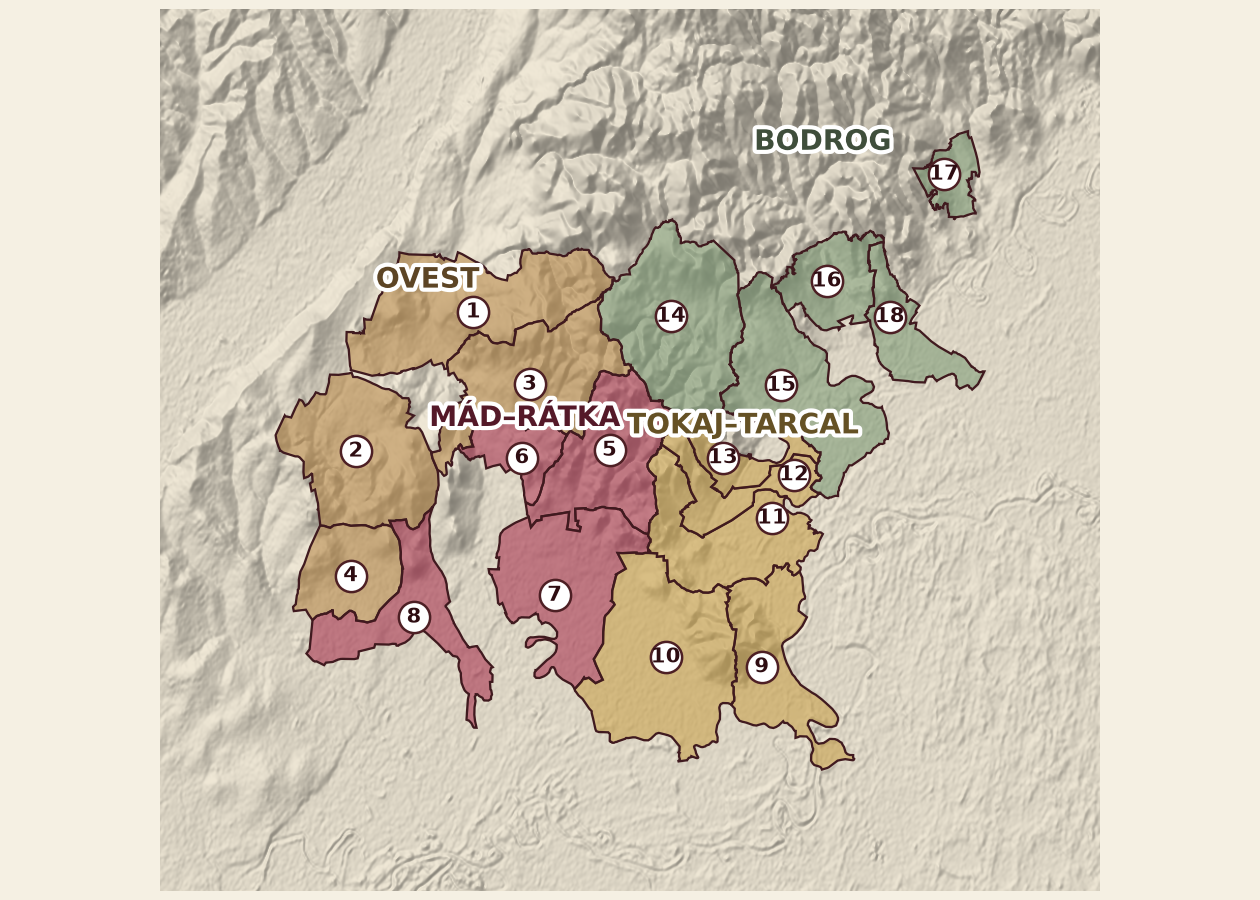
I comuni della denominazione Tokaj, raggruppati in quattro zone di lettura: l'ovest collinare, il cuore vulcanico attorno a Mád, la punta fra Tokaj e Tarcal, la valle del Bodrog e il nord-est. In mappa 18 comuni; la denominazione ne conta 27 in tutto.The municipalities of the Tokaj appellation, grouped into four reading zones: the western hills, the volcanic heart around Mád, the tip between Tokaj and Tarcal, the Bodrog valley and the north-east. 18 municipalities are shown; the appellation counts 27 in all.
- 1 Abaújszántó
- 2 Monok
- 3 Tállya
- 4 Legyesbénye
- 5 Mád
- 6 Rátka
- 7 Mezőzombor
- 8 Bekecs
- 9 Tokaj
- 10 Tarcal
- 11 Bodrogkeresztúr
- 12 Bodrogkisfalud
- 13 Szegi
- 14 Erdőbénye
- 15 Olaszliszka
- 16 Tolcsva
- 17 Hercegkút
- 18 Sárazsadány
Zone e sottozoneZones and subzones
I vitigni del territorioThe grapes of the territory
Le denominazioniThe denominations
A tavolaAt the table
L'abbinamento che ha fatto la fama dell'Aszú resta il fegato d'oca, che nella cucina ungherese si serve arrosto o in terrina: la dolcezza del vino e la sua acidità tagliente reggono un piatto ricco e grasso senza appesantirlo. Sullo stesso principio funzionano i formaggi erborinati, dove la nota salata trova nel vino un contrappeso morbido — un abbinamento che la nostra guida al vino dolce consiglia anche fuori dal dessert.The pairing that made Aszú famous is still goose liver, served roasted or as a terrine in Hungarian cooking: the sweetness of the wine and its cutting acidity carry a rich, fatty dish without weighing it down. Blue cheeses work on the same principle, their salt finding a soft counterweight in the wine — a match our guide to sweet wine recommends beyond dessert too.
Con i Furmint secchi si cambia registro: la loro sapidità e l'acidità alta trovano il piatto giusto nella halászlé, la zuppa di pesce del Tibisco insaporita di paprica, o in un pollo alla panna acida. Anche il maiale mangalica, grasso com'è, trova nel Furmint secco la freschezza che gli manca.With dry Furmints the register changes: their savouriness and high acidity find their match in halászlé, the paprika-spiced fish soup of the Tisza, or in chicken in sour cream. Mangalica pork, fatty as it is, also finds in dry Furmint the freshness it lacks.
Sui dolci si torna alle bottiglie dolci, ma con misura: lo Szamorodni dolce e i vini da vendemmia tardiva stanno bene con lo strudel di mele o con il somlói galuska, purché il dolce non sia più dolce del vino — è la regola che vale sempre. L'Eszencia, sciropposo e con pochissimo alcol, si beve invece da solo, a cucchiaiate: non è un vino da tavola.With desserts we return to the sweet bottles, but with restraint: sweet Szamorodni and late-harvest wines suit apple strudel or somlói galuska, as long as the dessert is not sweeter than the wine — the rule that always applies. Eszencia, syrupy and with very little alcohol, is drunk on its own, by the spoonful: it is not a table wine.
La storiaHistory
La cronologia allegata al disciplinare del Tokaj è un documento singolare: un elenco di date che un ente pubblico ha ritenuto necessario mettere per iscritto dentro una norma tecnica. Vale la pena seguirla, perché racconta come una regione abbia imparato a difendere il proprio nome secoli prima che esistesse la parola «denominazione».The chronology annexed to the Tokaj specification is an unusual document: a list of dates that a public body felt it necessary to write into a technical rule. It is worth following, because it tells how a region learnt to defend its own name centuries before the word «appellation» existed.
La prima menzione scritta di un vino aszú compare in un inventario della famiglia Garay datato 15 maggio 1571. Sessant'anni dopo, nel 1631, il pastore calvinista Szepsi Laczkó Máté prepara — sempre secondo la cronologia ufficiale — il suo primo vino aszú con l'uva del vigneto Oremus di Sátoraljaújhely, e lo destina alla principessa Lórántffy Zsuzsanna. Le due date convivono nello stesso documento: quella del 1571 dice che l'aszú esisteva già, quella del 1631 è il gesto che la tradizione ha scelto di ricordare. Nel Settecento arriva la frase che tutti citano: Luigi XIV, ricevuto in dono un aszú da Francesco II Rákóczi, lo chiama «il re dei vini e il vino dei re».The first written mention of an aszú wine appears in an inventory of the Garay family dated 15 May 1571. Sixty years later, in 1631, the Calvinist pastor Szepsi Laczkó Máté made — again according to the official chronology — his first aszú wine from grapes of the Oremus vineyard at Sátoraljaújhely, for Princess Lórántffy Zsuzsanna. The two dates sit in the same document: 1571 says that aszú already existed, 1631 is the gesture tradition chose to remember. In the eighteenth century comes the line everybody quotes: Louis XIV, given an aszú by Ferenc Rákóczi II, called it «the king of wines and the wine of kings».
Poi comincia la parte amministrativa, ed è quella decisiva. Nel 1707 lo Stato del principe Rákóczi ordina una classificazione nazionale dei territori vinicoli ungheresi: cinque gruppi, e la prima classe la ottiene soltanto la Tokaj-Hegyalja. È in quel momento, annota il disciplinare, che il ruolo del singolo vigneto — il dűlő — comincia a contare per la qualità e per il commercio. Nel 1720 una nuova classificazione riduce le classi a tre e conferma quasi tutta la regione in prima. Nel 1737 si arriva al punto: la delimitazione della zona viene fissata e con essa — è il disciplinare stesso a rivendicarlo — il fondamento giuridico della tutela dell'origine, per la prima volta al mondo.Then the administrative part begins, and that is the decisive one. In 1707 the state of Prince Rákóczi ordered a national classification of the Hungarian wine territories: five groups, and only Tokaj-Hegyalja was placed in the first class. It was at that moment, the specification notes, that the role of the single vineyard — the dűlő — began to count for quality and for trade. In 1720 a new classification reduced the classes to three and confirmed almost the whole region in the first. In 1737 came the decisive step: the boundaries of the district were fixed and with them — as the specification itself claims — the legal basis for protecting an origin, for the first time anywhere in the world.
Da lì in poi la storia è quella di un nome che va difeso. Nel 1886 arriva la fillossera e in dieci anni distrugge il novanta per cento dei vigneti; nello stesso periodo i produttori del Tokaj portano in tribunale la prima causa internazionale per la protezione del proprio nome, e la vincono. Nel 1893 la prima legge ungherese sul vino dedica un capitolo a sé alla denominazione Tokaj. Nel 1920 il trattato del Trianon taglia via dalla regione due paesi e una parte dei vigneti di Sátoraljaújhely, che finiscono oltre confine. Nel 1993 un accordo fra Comunità europea e Ungheria riconosce all'Ungheria l'uso esclusivo del nome «Tokaj», con una moratoria che lascia in vita fino al 31 marzo 2007 i vitigni chiamati Tocai e Tokay in Alsazia e in Friuli.From then on the story is that of a name to be defended. In 1886 phylloxera arrived and destroyed ninety per cent of the vineyards within ten years; in the same period the Tokaj growers brought the first international lawsuit for the protection of their name, and won it. In 1893 the first Hungarian wine law devoted a chapter of its own to the Tokaj appellation. In 1920 the Treaty of Trianon cut two villages and part of the Sátoraljaújhely vineyards away from the region, leaving them across the border. In 1993 an agreement between the European Community and Hungary recognised Hungary's exclusive use of the name «Tokaj», with a moratorium that kept the grape names Tocai and Tokay alive in Alsace and Friuli until 31 March 2007.
L'ultimo capitolo è del 2002, quando il Comitato del patrimonio mondiale dell'UNESCO iscrive il paesaggio culturale della regione nella Lista del patrimonio mondiale. Due anni dopo la legge ungherese riserva la parola «aszú» al solo Tokaj. E il disciplinare continua ad aggiornarsi: la revisione approvata dalla Commissione europea il 2 luglio 2026 ha ridotto i tempi minimi di affinamento in botte di alcune tipologie, separato lo Szamorodni secco da quello dolce e cancellato tre tipi di vino ormai marginali.The last chapter is from 2002, when the UNESCO World Heritage Committee inscribed the region's cultural landscape on the World Heritage List. Two years later Hungarian law reserved the word «aszú» for Tokaj alone. And the specification keeps being updated: the amendment approved by the European Commission on 2 July 2026 shortened the minimum barrel ageing of some types, separated dry from sweet Szamorodni and deleted three wine types that had become marginal.
I profili di vino descritti sono il carattere ricorrente delle tipologie, non la degustazione di una singola annata. Il numero dei comuni, le uve ammesse, le tipologie e le regole di produzione vengono dal disciplinare ufficiale della DOP Tokaj e dal registro europeo eAmbrosia; i nomi dei vigneti sono una selezione dall'allegato del disciplinare, che ne elenca molti di più, comune per comune. Esiste anche una zona vitivinicola del Tokaj in Slovacchia, con denominazione propria registrata nell'Unione europea: questa scheda riguarda la regione ungherese.The wine profiles described are the recurring character of each type, not a tasting of a single vintage. The number of municipalities, the permitted grapes, the wine types and the production rules come from the official Tokaj PDO specification and from the European eAmbrosia register; the vineyard names are a selection from the annex to the specification, which lists many more, village by village. There is also a Tokaj wine area in Slovakia, with its own appellation registered in the European Union: this page is about the Hungarian region.