Lungo le anse strette della Mosella, tra Treviri e il Reno, la vite si arrampica su pendii di pura ardesia tra i più ripidi del mondo. È una delle tredici regioni vinicole ufficiali della Germania, e qui il Riesling trova una delle sue case d'elezione: vini di poca alcolicità e grande tensione, dove il secco e l'abboccato convivono sulla stessa parete di ardesia.Along the tight bends of the Mosel, between Trier and the Rhine, the vine climbs slopes of pure slate among the steepest in the world. It is one of Germany's thirteen official wine regions, and here Riesling finds one of its true homes: wines of modest alcohol and great tension, where dry and off-dry live side by side on the same slate wall.
Il territorioThe territory
La terraThe land
Ardesia devoniana — grigia, blu, rossa — che si sgretola al sole e di notte restituisce il calore alla vite. Pendii a strapiombo esposti a sud e un fiume che curva di continuo: ogni ansa moltiplica le pareti che prendono il sole, in un clima settentrionale che senza l'ardesia non maturerebbe l'uva.Devonian slate — grey, blue, red — that crumbles in the sun and gives its stored heat back to the vine at night. Sheer south-facing slopes and a river that bends without rest: every meander multiplies the walls that catch the sun, in a northern climate that without the slate would never ripen the grapes.
Il vitignoThe grape
Il Riesling regna su poco più del sessanta per cento dei vigneti, 5.156 ettari sugli 8.287 della regione: matura tardi, conserva un'acidità affilata e traduce l'ardesia in un timbro affumicato e agrumato. Accanto, l'Elbling antico dell'Obermosel, il Müller-Thurgau e, sui versanti più caldi, lo Spätburgunder, il Pinot Nero.Riesling reigns over just over sixty per cent of the vineyards, 5,156 hectares of the region's 8,287: it ripens late, keeps a keen acidity and turns the slate into a smoky, citrus-tinged signature. Alongside it, the old Elbling of the Obermosel, Müller-Thurgau and, on the warmer slopes, Spätburgunder — Pinot Noir.
L'uomoThe human hand
Qui si lavora a mano: su pendenze che superano i trenta gradi — metà del vigneto della regione — i trattori non salgono, e la vite si alleva spesso a palo singolo, pianta per pianta. Una fatica che i vignaioli tramandano da generazioni, su radici piantate dai Romani duemila anni fa.Here the work is done by hand: on slopes steeper than thirty degrees — half the region's vineyard — no tractor can climb, and the vine is often trained on a single stake, plant by plant. A labour the growers have handed down for generations, on roots the Romans planted two thousand years ago.
La mappaThe map
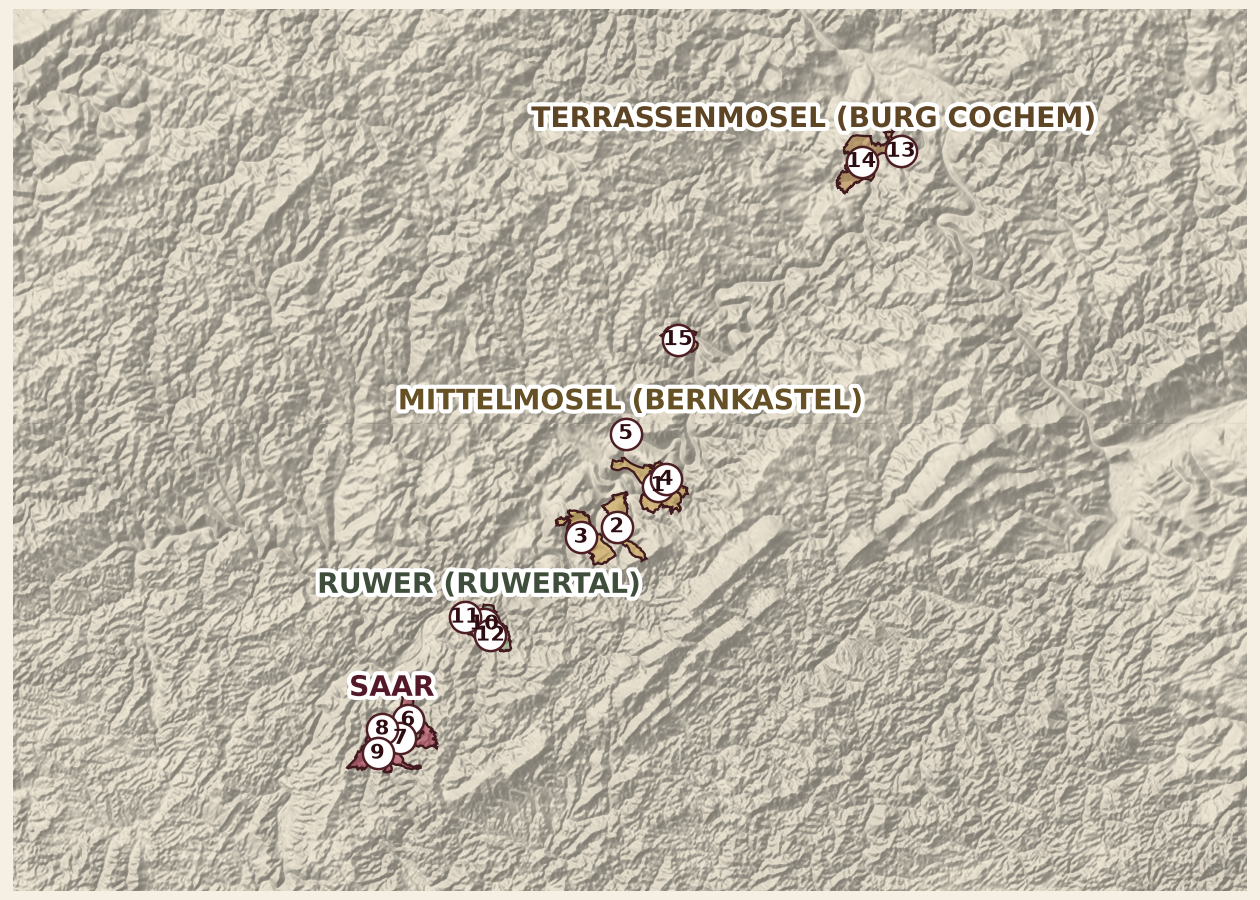
I distretti storici della Mosella e alcuni dei loro comuni del vino. Mappa Incalice su dati aperti (OpenStreetMap + rilievo).The historic districts of the Mosel and some of their wine villages. Incalice map on open data (OpenStreetMap + elevation).
- 1 Bernkastel-Kues
- 2 Brauneberg
- 3 Piesport
- 4 Graach
- 5 Ürzig
- 6 Wiltingen
- 7 Ockfen
- 8 Ayl
- 9 Saarburg
- 10 Kasel
- 11 Mertesdorf
- 12 Waldrach
- 13 Winningen
- 14 Kobern-Gondorf
- 15 Bremm
Zone e sottozoneZones and subzones
I vitigni del territorioThe grapes of the territory
Le denominazioniThe denominations
A tavolaAt the table
I Riesling della Mosella, agili e sapidi, con la loro acidità vibrante reggono i piatti del fiume e della tradizione contadina. La trota cucinata nel Riesling (Forelle in Riesling), delicata e burrosa, chiede un Riesling secco e teso. Il Döppekooche — il tortino di patate grattugiate e pancetta cotto nel tegame fino alla crosta croccante — trova equilibrio in uno Spätlese leggermente abboccato. E un Auslese più ricco accompagna i dolci da forno e la frutta gialla matura di fine pasto.Mosel Rieslings, nimble and savoury, have the vibrant acidity to stand up to the dishes of the river and of country tradition. Trout cooked in Riesling (Forelle in Riesling), delicate and buttery, calls for a taut, dry Riesling. Döppekooche — the cake of grated potatoes and bacon baked in its pot to a crisp crust — finds its balance in a lightly off-dry Spätlese. And a richer Auslese accompanies baked sweets and ripe yellow fruit at the close of the meal.
La storiaHistory
Duemila anni fa furono i Romani a portare la vite su queste rive: lo racconta ancora la «nave del vino» di Neumagen, un rilievo funerario del III secolo che mostra una barca carica di botti risalire la corrente, oggi al museo di Treviri. Ma la leggenda più cara alla Mosella è quella del Bernkasteler Doctor. Nella seconda metà del Trecento l'arcivescovo ed elettore di Treviri Boemondo II, ospite del castello di Landshut sopra Bernkastel, cadde gravemente malato di febbre; né medici né medicine riuscivano a guarirlo. Un vignaiolo del paese gli portò allora una botte del proprio vino, esortandolo a berlo come rimedio. L'elettore si riprese e proclamò quel vino «il vero dottore»: da allora la vigna porta il nome di Doctor. La fama medicinale l'accompagnò per secoli: di re Edoardo VII, che regnò dal 1901 al 1910, è documentato che lo bevesse come medicina. Sono 3,21 ettari, contro i trenta della Brauneberger Juffer e i quarantatré della Wehlener Sonnenuhr: una delle vigne più piccole e ambite di Germania.Two thousand years ago it was the Romans who brought the vine to these banks: the «wine ship» of Neumagen still tells the story, a 3rd-century funerary relief showing a barge laden with barrels pushing up the current, now in the Trier museum. But the legend dearest to the Mosel is that of the Bernkasteler Doctor. In the second half of the 14th century the Archbishop and Elector of Trier, Bohemond II, a guest at Landshut Castle above Bernkastel, fell gravely ill with fever; neither physicians nor medicine could cure him. A village vintner then brought him a cask of his own wine, urging him to drink it as a remedy. The Elector recovered and proclaimed the wine «the true doctor»: ever since, the vineyard has borne the name Doctor. Its medicinal fame followed it for centuries: King Edward VII, who reigned from 1901 to 1910, is documented as drinking it as medicine. It measures 3.21 hectares, against thirty for the Brauneberger Juffer and forty-three for the Wehlener Sonnenuhr: one of the smallest and most coveted vineyards in Germany.
Le note sui vini descrivono il profilo caratteristico e ricorrente del Riesling di Mosella, non una singola annata. Numeri e classificazioni sono verificati su fonti ufficiali (Deutsches Weininstitut, VDP); i grandi cru indicati seguono la classificazione dei VDP — l'associazione privata dei produttori — e una scelta editoriale di rilevanza.The notes on the wines describe the characteristic, recurring profile of Mosel Riesling, not a single vintage. Figures and classifications are verified against official sources (Deutsches Weininstitut, VDP); the great crus listed follow the VDP classification — the growers' private association — and an editorial choice of relevance.