La Calabria è una striscia stretta e lunga fra due mari, con una catena di montagne nel mezzo. La vite non sta né in cima né in riva: occupa la fascia collinare intermedia, quasi sempre a vista dello Ionio o del Tirreno. Il nome che il mondo conosce è Cirò, e da lì è arrivata la prima e unica DOCG della regione, Cirò Classico, iscritta nel registro europeo delle denominazioni protette nel 2025. Intorno, un mosaico di altre diciannove denominazioni: nove DOC e dieci IGT, spesso piccolissime.Calabria is a long, narrow strip of land between two seas, with a mountain chain running down the middle. Vines grow neither at the top nor on the shore: they occupy the intermediate belt of hills, almost always within sight of the Ionian or the Tyrrhenian. The name the world knows is Cirò, and it is from there that the region's first and only DOCG comes — Cirò Classico, entered in the European register of protected designations in 2025. Around it lies a mosaic of nineteen more denominations: nine DOC and ten IGT, often very small indeed.
Il territorioThe territory
La terraThe land
Due mari e una dorsale sola: il Pollino a nord, poi la Sila, le Serre, l'Aspromonte. Nel cirotano la vite resta sulla collina litoranea e non supera i 462 metri: il documento ufficiale della DOCG descrive sabbie e conglomerati sui rilievi, argille accumulate sulle vecchie terrazze fluviali, e un clima che va da subumido a subarido, con forte deficit idrico d'estate — la pioggia arriva a ottobre, non a giugno.Two seas and a single mountain spine: Pollino to the north, then the Sila, the Serre, Aspromonte. Around Cirò the vines stay on the coastal hills and climb no higher than 462 metres: the DOCG's official document describes sands and conglomerates on the ridges, clay accumulated on old river terraces, and a climate ranging from sub-humid to semi-arid, with a marked summer water deficit — the rain comes in October, not in June.
Il vitignoThe grape
Il rosso è il Gaglioppo: il disciplinare del Cirò ne chiede almeno l'80% nel rosso e nel rosato, e nel Cirò Classico è la varietà su cui poggia tutto. Il bianco è il Greco bianco, anch'esso all'80% nel Cirò e al 95% minimo nel passito di Greco di Bianco. Nel cosentino il ruolo principale passa al Magliocco, minimo 60% nel Terre di Cosenza rosso. Attorno a questi tre, varietà tornate in vigna da poco: Mantonico, Pecorello, Guarnaccia bianca, Greco nero, Marsigliana nera.The red grape is Gaglioppo: the Cirò rulebook requires at least 80% of it in the red and the rosé, and in Cirò Classico everything rests on it. The white grape is Greco bianco, also at 80% in Cirò and at a minimum of 95% in the sweet Greco di Bianco. Around Cosenza the lead role passes to Magliocco, a minimum of 60% in red Terre di Cosenza. Around these three are varieties only recently brought back into the vineyard: Mantonico, Pecorello, Guarnaccia bianca, Greco nero, Marsigliana nera.
L'uomoThe human hand
È una viticoltura di famiglie e di aziende piccole. A Cirò Marina la cantina Ippolito dichiara oltre centosettant'anni di attività e si presenta come la più antica ancora in produzione in Calabria. Il lavoro degli ultimi decenni è stato soprattutto di recupero: Roberto Ceraudo dichiara di aver riportato in vigna il Pecorello sulle colline di Strongoli, Librandi di aver rivalutato il Mantonico dopo anni di ricerca sul territorio, a Rocca di Neto e Casabona.This is a viticulture of families and small estates. In Cirò Marina the Ippolito winery states it has been working for over a hundred and seventy years and presents itself as the oldest still in production in Calabria. The work of recent decades has above all been recovery: Roberto Ceraudo states he brought Pecorello back to the hills of Strongoli, and Librandi says it brought Mantonico back after years of research in the area, at Rocca di Neto and Casabona.
La mappaThe map
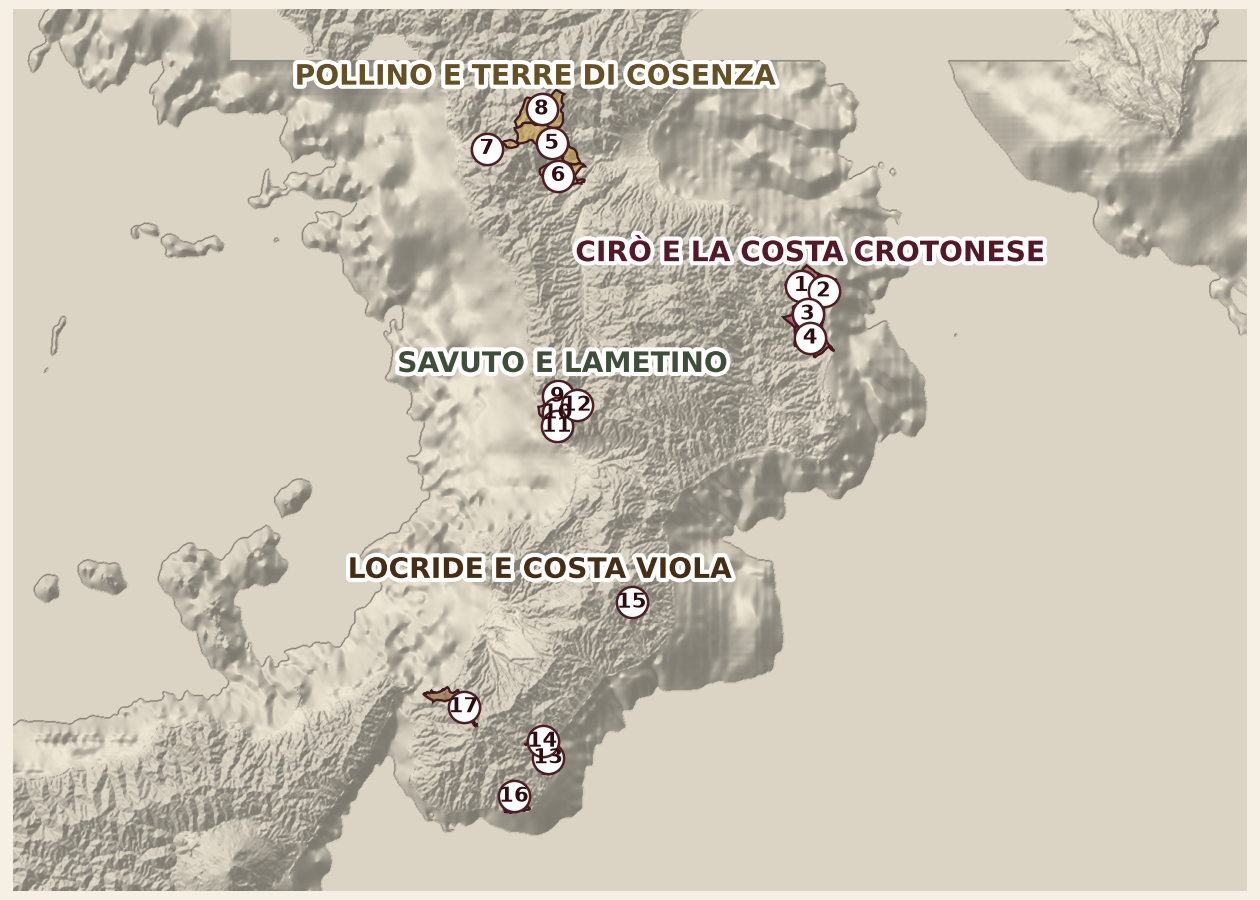
I quattro distretti del vino calabrese e diciassette comuni che ne disegnano il perimetro, dal Pollino allo Stretto.The four districts of Calabrian wine and seventeen municipalities that trace their outline, from Pollino to the Strait.
- 1 Cirò
- 2 Cirò Marina
- 3 Melissa
- 4 Strongoli
- 5 Saracena
- 6 Altomonte
- 7 Verbicaro
- 8 Morano Calabro
- 9 Cleto
- 10 Nocera Terinese
- 11 Falerna
- 12 Martirano Lombardo
- 13 Bianco
- 14 Casignana
- 15 Bivongi
- 16 Palizzi
- 17 Scilla
Zone e sottozoneZones and subzones
I vitigni del territorioThe grapes of the territory
Le denominazioniThe denominations
A tavolaAt the table
La tavola calabrese è fatta di conserva e di peperoncino, e chiede vini che non si facciano spegnere. Sui salumi — la 'nduja spalmabile del vibonese, il Capocollo e la Soppressata di Calabria DOP — il Cirò rosato è la risposta più semplice: il Gaglioppo vinificato in rosa ha poco tannino e un'acidità che ripulisce il grasso senza aggiungere peso al piccante. Sul Caciocavallo Silano DOP stagionato funziona meglio un rosso di media struttura, un Savuto o un Lamezia rosso.The Calabrian table is built on preserves and chilli, and it asks for wines that will not be silenced. With the cured meats — the spreadable 'nduja of the Vibo area, Capocollo and Soppressata di Calabria PDO — Cirò rosé is the simplest answer: Gaglioppo made pink has little tannin and an acidity that cleans away the fat without adding weight to the heat. With aged Caciocavallo Silano PDO a medium-bodied red works better: a Savuto or a red Lamezia.
Sul pesce la regione ha due strade. Il pesce azzurro sotto sale e la sardella vogliono un bianco sapido e diritto: il Cirò bianco da Greco bianco, o un Pecorello del cosentino. Il pesce spada alla ghiotta, più ricco per via di capperi, olive e pomodoro, regge bene lo stesso bianco ma anche un rosato di Gaglioppo. Con la Cipolla Rossa di Tropea Calabria IGP — nella licurdia, o cruda in insalata — meglio restare sui bianchi: la dolcezza della cipolla si scontra con il tannino.With fish the region offers two routes. Salted oily fish and sardella call for a taut, saline white: Cirò bianco from Greco bianco, or a Pecorello from the Cosenza area. Swordfish alla ghiotta, richer thanks to capers, olives and tomato, takes the same white well but also a Gaglioppo rosé. With Cipolla Rossa di Tropea Calabria PGI — in licurdia soup, or raw in salad — it is better to stay with whites: the sweetness of the onion clashes with tannin.
La carne è quella dell'interno: capra, maiale nero, il morzeddhu catanzarese di frattaglie. Qui si aprono i Cirò Rosso Classico Superiore Riserva, o un Magliocco delle Terre di Cosenza: struttura e tannino trovano nel piatto il grasso e il sapore deciso che li tengono a bada. In chiusura, i Fichi di Cosenza DOP e i dolci alla liquirizia — la Liquirizia di Calabria è anch'essa DOP — chiamano il Greco di Bianco: un passito che su questi dolci gioca in casa.The meat is that of the interior: goat, black pig, the offal-based morzeddhu of Catanzaro. This is where you open a Cirò Rosso Classico Superiore Riserva, or a Magliocco from Terre di Cosenza: structure and tannin find in the dish the fat and the bold flavour that keep them in check. To finish, Fichi di Cosenza PDO and liquorice sweets — Liquirizia di Calabria is a PDO too — call for Greco di Bianco: a sweet wine that with these desserts is on home ground.
La storiaHistory
Gli antichi chiamavano questa terra Enotria, e sull'origine del nome si discute ancora: c'è chi lo fa venire da oinos, il vino, e chi da oinotron, il palo che regge la vite. In entrambi i casi il nome dice la stessa cosa: qui la vite era già il paesaggio quando arrivarono i Greci.The ancients called this land Oenotria, and its etymology is still debated: some derive it from oinos, wine, others from oinotron, the stake that holds up the vine. Either way the name says the same thing: here the vine was already the landscape when the Greeks arrived.
Il documento ufficiale della DOCG Cirò Classico — quello depositato a Bruxelles, non una brochure — racconta questa storia per intero. Dove oggi sorge Cirò Marina c'era una colonia greca, Cremissa, con un tempio dedicato al dio del vino; e Krimisa si chiamava il vino che da quel nome derivava. La tradizione vuole che fosse offerto in dono agli atleti vincitori delle Olimpiadi, e che ne fosse estimatore Milone di Crotone, il lottatore che di edizioni dei giochi ne vinse sei. Il documento aggiunge un dettaglio che nessuno si aspetta di leggere in un atto normativo: «per rinnovare l'antica tradizione», il Cirò fu servito come vino ufficiale alle Olimpiadi di Città del Messico del 1968.The official document of the Cirò Classico DOCG — the one filed in Brussels, not a brochure — tells the whole story. Where Cirò Marina stands today there was a Greek colony, Cremissa, with a temple to the god of wine; and Krimisa was the name of the wine derived from it. Tradition holds that it was offered to the victorious athletes of the Olympic Games, and that Milo of Croton, the wrestler who won six editions, was fond of it. The document adds a detail nobody expects to find in a regulatory text: «to renew the ancient tradition», Cirò was served as the official wine of the 1968 Mexico City Olympics.
Quanto di tutto questo sia storia e quanto leggenda non lo decide un disciplinare — il testo stesso scrive «probabilmente» quando parla dell'etimologia. Ma il fatto che un mito fondativo sia finito dentro il fascicolo europeo di una denominazione dice quanto Cirò abbia legato la propria identità a quella storia, e con quanta ostinazione l'abbia difesa nei secoli in cui la Calabria del vino usciva dalle carte.How much of this is history and how much legend is not for a rulebook to decide — the text itself writes «probably» when it discusses the etymology. But the fact that a founding myth ended up inside the European dossier of a denomination says how firmly Cirò has tied its identity to that story, and how stubbornly it defended it through the centuries when Calabrian wine was slipping off the map.
Di quell'ostinazione resta anche una traccia più recente e più vicina. Nel 1964 lo scrittore Leonida Repaci scrisse ai fratelli Ippolito, a Cirò Marina, che dire Cirò significava ormai dire Calabria: la lettera è ancora esposta sul sito della cantina, che di anni ne dichiara oltre centosettanta. Sessant'anni dopo, quella frase è diventata una denominazione garantita.Of that stubbornness there is also a more recent trace. In 1964 the writer Leonida Repaci wrote to the Ippolito brothers, in Cirò Marina, that to say Cirò was by now to say Calabria: the letter is still displayed on the winery's website, and the house claims more than a hundred and seventy years of history. Sixty years on, that sentence has become a guaranteed denomination.
I conteggi (1 DOCG, 9 DOC, 10 IGT) sono verificati sugli elenchi ufficiali dei vini DOP e IGP del Masaf e sono riportati per intero: tutte e venti le denominazioni sono elencate. Le percentuali dei vitigni e le zone di produzione vengono dai disciplinari ufficiali; i dati su suoli, clima e storia della DOCG Cirò Classico dal documento unico pubblicato nella Gazzetta ufficiale dell'Unione europea. Il raggruppamento in distretti è una scelta editoriale, non una classificazione normativa. Nessun punteggio, nessun premio, nessuna classifica.The counts (1 DOCG, 9 DOC, 10 IGT) are verified against the official Masaf lists of PDO and PGI wines and are reported in full: all twenty denominations are listed. Grape percentages and production areas come from the official rulebooks; the data on soils, climate and history of the Cirò Classico DOCG from the single document published in the Official Journal of the European Union. The grouping into districts is an editorial choice, not a legal classification. No scores, no awards, no rankings.