Cento chilometri di valle incisa nello scisto, dalle colline dietro Peso da Régua fino al confine spagnolo: è la Região Demarcada do Douro, divisa in tre sotto-regioni — Baixo Corgo, Cima Corgo e Douro Superior — e coltivata a vite su 42.980 ettari (IVDP, dati di encepamento 2023). Qui nascono tre denominazioni e due vini molto diversi fra loro: il Porto, fortificato, e il Douro, non fortificato, che ha smesso di essere il fratello minore solo negli ultimi quarant'anni. L'IVDP considera questa la prima denominazione d'origine del mondo, nata con la Companhia Geral del Marquês de Pombal il 10 settembre 1756; dal 2001 l'Alto Douro Vinhateiro è patrimonio mondiale UNESCO come «paesaggio culturale evolutivo e vivo».A hundred kilometres of valley cut into schist, from the hills behind Peso da Régua to the Spanish border: this is the Região Demarcada do Douro, split into three sub-regions — Baixo Corgo, Cima Corgo and Douro Superior — with 42,980 hectares under vine (IVDP, 2023 planting figures). Three denominations are born here, and two very different wines: Port, fortified, and Douro, unfortified, which stopped being the junior partner only in the last forty years. The IVDP considers this the world's first denomination of origin, created with the Marquis of Pombal's Companhia Geral on 10 September 1756; since 2001 the Alto Douro Vinhateiro has been a UNESCO World Heritage site as an «evolving, living cultural landscape».
Il territorioThe territory
La terraThe land
Lo scisto è la materia prima del Douro: una roccia che si sfoglia in lamine verticali, dentro cui la radice scende a cercare l'acqua che d'estate in superficie non c'è. I versanti sono così ripidi che la vigna esiste solo perché qualcuno l'ha costruita — muretti a secco, terrazze strette, e le sistemazioni più recenti a patamares. Il clima è mediterraneo continentale, con inverni molto freddi e estati calde e asciutte, e diventa più caldo e più secco man mano che si risale il fiume verso est. Qui la terra non è uno sfondo: è un dato misurato. L'IVDP classifica ogni parcella con un punteggio che somma dodici elementi — fra cui altitudine, esposizione, pendenza, riparo, natura del terreno, pietrosità e età della vigna — e la colloca in una lettera da A a I.Schist is the Douro's raw material: a rock that splits into vertical plates, into which the root travels down for water that in summer is simply not there at the surface. The slopes are so steep that the vineyard exists only because someone built it — dry-stone walls, narrow terraces, and the more recent patamares. The climate is Mediterranean-continental, with very cold winters and hot dry summers, and it grows hotter and drier as you follow the river east. Here the land is not a backdrop: it is a measured figure. The IVDP scores every plot on twelve elements — among them altitude, aspect, gradient, shelter, soil type, stoniness and vine age — and files it under a letter from A to I.
Il vitignoThe grape
Il Douro non è una regione monovitigno: la Portaria che regola l'encepamento ammette 116 castas — 65 a bacca nera, 50 a bacca bianca e una rosata, con il Moscatel Galego Roxo aggiunto nel dicembre 2024 — e trenta sono raccomandate per la DOP Porto. Nei nuovi impianti però la scelta si è ristretta: nel 2023 la Touriga Franca da sola copriva un quarto del vigneto, seguita da Tinta Roriz, Touriga Nacional e Tinta Barroca; fra le bianche, Rabigato, Malvasia Fina, Síria e Moscatel Galego Branco. Le vinhas velhas pre-selezione raccontano l'altra storia: parcelle centenarie con venti, trenta, anche più di trentacinque varietà mescolate in mezzo alle stesse file, vendemmiate insieme perché nessuno sa più separarle.The Douro is not a single-variety region: the ordinance governing plantings admits 116 grape varieties — 65 black, 50 white and one pink-skinned, with Moscatel Galego Roxo added in December 2024 — and thirty are recommended for the Porto PDO. In new plantings, though, the choice has narrowed: in 2023 Touriga Franca alone covered a quarter of the vineyard, followed by Tinta Roriz, Touriga Nacional and Tinta Barroca; among the whites, Rabigato, Malvasia Fina, Síria and Moscatel Galego Branco. The pre-selection vinhas velhas tell the other story: century-old plots with twenty, thirty, sometimes more than thirty-five varieties interplanted in the same rows, picked together because nobody can tell them apart any more.
L'uomoThe human hand
Nel Douro la quantità di Porto che si può fare non la decide il produttore: la decide il benefício, l'autorizzazione annuale calcolata sulla lettera della parcella. Il metodo a punti lo mise a punto Álvaro Moreira da Fonseca fra il 1945 e il 1949, e regge ancora: sotto la lettera F — da 201 a 400 punti — non si accede al benefício. Le rese massime sono 55 hl/ha per i rossi e 65 per i bianchi, ma la media reale della regione sta intorno ai 30 hl/ha, perché su queste pendenze la vite non produce di più. La svolta recente è del 1986: con l'ingresso nella Comunità europea cade l'esclusiva della Barra do Douro per l'esportazione, e le quinte cominciano a imbottigliare e vendere in proprio invece di consegnare il vino ai magazzini di Vila Nova de Gaia. Il Douro non fortificato che si beve oggi nasce lì.In the Douro the producer does not decide how much Port to make: the benefício does, an annual allowance calculated from the plot's letter. Álvaro Moreira da Fonseca devised the points method between 1945 and 1949, and it still stands: below letter F — 201 to 400 points — there is no benefício at all. Maximum yields are 55 hl/ha for reds and 65 for whites, but the region's real average sits around 30 hl/ha, because on these gradients the vine gives no more. The recent turning point is 1986: on joining the European Community the Barra do Douro export monopoly fell away, and the quintas began bottling and selling for themselves instead of handing the wine to the lodges at Vila Nova de Gaia. The unfortified Douro we drink today was born there.
La mappaThe map
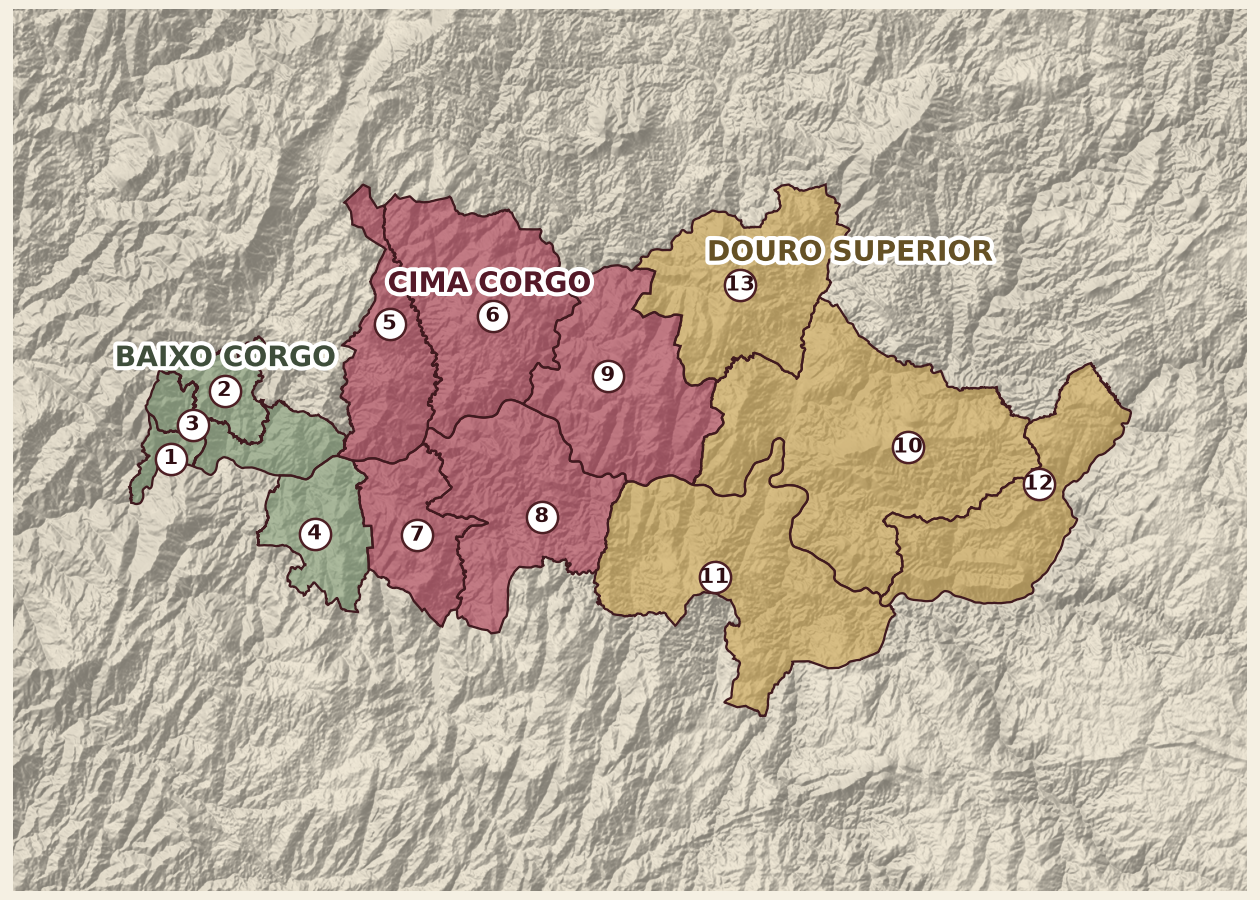
Tredici concelhi per leggere la valle da ovest a est, raggruppati nelle tre sotto-regioni del disciplinare: la fascia stretta e umida del Baixo Corgo, il cuore del Cima Corgo attorno a Pinhão, e la distesa del Douro Superior fino al confine con la Spagna. La prima cosa da guardare è la proporzione: il Douro Superior da solo occupa metà della regione.Thirteen municipalities to read the valley from west to east, grouped into the specification's three sub-regions: the narrow, damper Baixo Corgo belt, the Cima Corgo heartland around Pinhão, and the expanse of the Douro Superior stretching to the Spanish border. The first thing to look at is the proportion: the Douro Superior alone takes up half the region.
- 1 Mesão Frio
- 2 Santa Marta de Penaguião
- 3 Peso da Régua
- 4 Armamar
- 5 Sabrosa
- 6 Alijó
- 7 Tabuaço
- 8 São João da Pesqueira
- 9 Carrazeda de Ansiães
- 10 Torre de Moncorvo
- 11 Vila Nova de Foz Côa
- 12 Freixo de Espada à Cinta
- 13 Vila Flor
Zone e sottozoneZones and subzones
I vitigni del territorioThe grapes of the territory
Le denominazioniThe denominations
A tavolaAt the table
La cucina di questa parte del Portogallo è di montagna prima che di fiume, e la lista dei prodotti a denominazione lo dice meglio di qualunque descrizione: Carne Mirandesa DOP, Cabrito Transmontano DOP, Queijo Terrincho DOP di latte di pecora churra, Azeite de Trás-os-Montes DOP, Alheira de Mirandela IGP, Azeitona de conserva Negrinha de Freixo DOP, e perfino la mandorla, con l'Amêndoa Douro DOP e l'Amêndoa Coberta de Moncorvo IGP.The cooking of this part of Portugal belongs to the mountains before the river, and the list of protected products says it better than any description: Carne Mirandesa PDO, Cabrito Transmontano PDO, Queijo Terrincho PDO from churra ewe's milk, Azeite de Trás-os-Montes PDO, Alheira de Mirandela PGI, Azeitona de conserva Negrinha de Freixo PDO, and even the almond, with Amêndoa Douro PDO and Amêndoa Coberta de Moncorvo PGI.
La posta à mirandesa — un taglio spesso di manzo mirandês scottato e servito al sangue, con sale grosso e olio — chiede un rosso del Douro maturo e strutturato, con tannino serrato e buona persistenza: un Cima Corgo di vigne vecchie regge il gioco senza coprirla. Il cabrito assado no forno, capretto al forno con patate e un profumo di alloro, va con un rosso più giovane e fresco, sapido, di media struttura. L'alheira, l'insaccato di pane e carni bianche nato per non mangiare maiale, è grassa e fritta: qui serve acidità viva e bollicina, e l'espumante secco del Douro fa esattamente questo.Posta à mirandesa — a thick cut of Mirandesa beef seared and served rare, with coarse salt and olive oil — asks for a mature, structured Douro red with tight tannin and good length: an old-vine Cima Corgo holds its own without smothering it. Cabrito assado no forno, kid roasted with potatoes and a scent of bay, goes with a younger, fresher red, savoury and mid-bodied. Alheira, the bread-and-poultry sausage invented so as not to eat pork, is rich and fried: here you want lively acidity and bubbles, and the dry Douro sparkling does exactly that.
Alla fine, il capitolo dolce. Un Tawny invecchiato, con i suoi profumi di frutta secca e caramello, sta benissimo sulle mandorle di Moncorvo e sui formaggi stagionati; il Moscatel do Douro, floreale e dolce senza essere pesante, chiude su una crostata di frutta o semplicemente da solo, freddo, a fine tavola. E il Vintage giovane, tannico e potente, resta il vino del cioccolato fondente e del Terrincho più vecchio.Then the sweet chapter. An aged Tawny, with its dried-fruit and caramel scents, sits beautifully with Moncorvo almonds and aged cheeses; Moscatel do Douro, floral and sweet without being heavy, finishes on a fruit tart or simply on its own, chilled, at the end of the table. And young Vintage, tannic and powerful, remains the wine for dark chocolate and the oldest Terrincho.
La storiaHistory
Alla metà del Settecento il vino del Porto era già un affare enorme e stava per rovinarsi da solo. Il primo registro doganale che lo chiama così è del 1678; il trattato di Methuen del 1703 gli aprì il mercato inglese a dazi di favore, mentre la guerra fra Londra e Parigi teneva fuori i vini francesi. Il risultato fu che a Vila Nova de Gaia arrivava vino da mezzo Portogallo e bastava che uscisse dalla barra del Douro per chiamarsi «vinho do Porto». Per farlo somigliare a quello vero lo si correggeva: bacche di sambuco per il colore, vino spagnolo più carico, zucchero per coprire l'acquavite cattiva. Nel 1754 i mercanti inglesi smisero semplicemente di comprare.By the middle of the eighteenth century Port was already an enormous business and was on the point of ruining itself. The first customs record that calls it by that name dates from 1678; the Methuen Treaty of 1703 opened the English market to it at favourable duties, while war between London and Paris kept French wine out. The result was that wine from half of Portugal turned up at Vila Nova de Gaia, and it only had to leave by the Douro bar to be called «vinho do Porto». To make it resemble the real thing it was doctored: elderberry for colour, deeper-coloured Spanish wine, sugar to mask bad spirit. In 1754 the English merchants simply stopped buying.
La risposta arrivò il 10 settembre 1756, e fu di quelle che cambiano un mestiere: il Marquês de Pombal istituì la Companhia Geral da Agricultura das Vinhas do Alto Douro. L'alvará che la crea chiude la regione ai vini che vengono da fuori, obbliga a un catasto delle parcelle di vigna, fissa stock massimi e prezzi in base alla qualità accertata da funzionari, e vieta l'aggiunta di qualunque cosa alteri il profilo del vino. È per questo che l'IVDP considera il Douro la prima denominazione d'origine del mondo: è la prima volta che un prodotto agricolo di una zona precisa riceve regole, confini e un ente che li fa rispettare. Fra il 1757 e il 1761 arrivano le demarcazioni pombaline vere e proprie — la prima delimitazione fisica del vigneto duriense. Non fu un'operazione indolore: la Companhia nasceva monopolista, e il 23 febbraio 1757 scoppiò a Porto il primo di due moti popolari contro di essa, con in piazza i tavernieri, i bottai e i piccoli magazzinieri della città. La repressione fu esemplare: 462 sospetti, ventisei condanne a morte e diciassette esecuzioni il 14 ottobre di quello stesso anno.The answer came on 10 September 1756, and it was one of those that change a trade: the Marquis of Pombal established the Companhia Geral da Agricultura das Vinhas do Alto Douro. The charter that created it closed the region to wine from outside, required a cadastre of vineyard plots, set maximum stocks and prices according to quality assessed by officials, and banned the addition of anything that would alter the wine's profile. This is why the IVDP considers the Douro the world's first denomination of origin: it is the first time an agricultural product from a defined area was given rules, boundaries and a body to enforce them. Between 1757 and 1761 came the pombaline demarcations proper — the first physical delimitation of the Douro vineyard. It was not painless: the Companhia was a monopoly from the start, and on 23 February 1757 the first of two popular revolts against it broke out in Porto, with the city's tavern keepers, coopers and small warehousemen in the streets. The repression was exemplary: 462 suspects, twenty-six death sentences and seventeen executions on 14 October of that same year.
Da lì la valle si allunga verso est, un ostacolo alla volta. Nel 1792 finiscono i lavori di demolizione del Cachão da Valeira, la stretta di roccia che sbarrava la navigazione: da quel momento si risale il Douro fino alla Spagna, e la regione può crescere oltre la gola. Nel 1863 arriva la fillossera, e per due decenni il Douro si spopola — si emigra in Brasile, le vigne si abbandonano. La soluzione, l'innesto su radice americana, porta a ripiantare su terreni mai coltivati prima, sempre più a est: è così che nasce il Douro Superior di oggi. Nel pieno di quel disastro Dona Antónia Adelaide Ferreira, la «Ferreirinha», vedova a trentatré anni e diventata la più grande proprietaria terriera della regione, compra all'asta dal comune di Vila Nova de Foz Côa trecento ettari di terra incolta sul Monte Meão. Ci si arrivava in dodici giorni di barca da Porto, in mancanza di strade; lei scommetteva sulla ferrovia del Douro, che sarebbe arrivata a Pocinho dieci anni dopo. Il cantiere durò dal 1887 al 1895 e produsse una vigna, due cantine, la casa padronale, un piccolo ospedale, una scuola e due cappelle. Morì l'anno dopo.From there the valley stretches eastwards, one obstacle at a time. In 1792 the works to blast open the Cachão da Valeira, the rock narrows that blocked navigation, were finished: from then on the Douro could be sailed as far as Spain, and the region could grow beyond the gorge. In 1863 phylloxera arrived, and for two decades the Douro emptied — people emigrated to Brazil, vineyards were abandoned. The remedy, grafting onto American rootstock, meant replanting on land never cultivated before, further and further east: this is how today's Douro Superior came about. In the middle of that disaster Dona Antónia Adelaide Ferreira, «a Ferreirinha», widowed at thirty-three and by then the region's largest landowner, bought three hundred hectares of uncultivated land on Monte Meão at auction from the Vila Nova de Foz Côa town council. With no roads, it took twelve days by boat from Porto to get there; she was betting on the Douro railway, which reached Pocinho ten years later. The works ran from 1887 to 1895 and produced a vineyard, two cellars, the manor house, a small hospital, a school and two chapels. She died the following year.
Il resto è la storia di chi tiene le regole. Nel 1907-1908 il governo di João Franco riscrive la legislazione e allarga la regione a est, disegnando la demarcazione che vale ancora oggi. Fra il 1945 e il 1949 Álvaro Moreira da Fonseca costruisce il metodo a punti che classifica tutte le vigne dell'Alto Douro e da cui discende il benefício, cioè quanto Porto ciascuno può fare: è ancora quello. Nel 1986, con l'ingresso nella Comunità europea, cade l'esclusiva della barra del Douro per l'esportazione e nello stesso anno viene riconosciuta la denominazione d'origine Douro — le due cose insieme spiegano perché in quarant'anni il vino non fortificato di questa valle sia passato da comprimario a protagonista. Nel 2001 l'UNESCO iscrive l'Alto Douro Vinhateiro nella lista del patrimonio mondiale come paesaggio culturale evolutivo e vivo. Duecentosettant'anni dopo Pombal, il Douro è ancora una regione che si misura.The rest is the story of who keeps the rules. In 1907-1908 João Franco's government rewrote the legislation and extended the region eastwards, drawing the demarcation that still holds. Between 1945 and 1949 Álvaro Moreira da Fonseca built the points method that classifies every vineyard in the Alto Douro and from which the benefício derives — how much Port each grower may make. It is still the same one. In 1986, on joining the European Community, the Douro bar's export monopoly fell away, and in the same year the Douro denomination of origin was recognised: together the two explain why in forty years the unfortified wine of this valley went from supporting act to lead. In 2001 UNESCO inscribed the Alto Douro Vinhateiro on the World Heritage list as an evolving, living cultural landscape. Two hundred and seventy years after Pombal, the Douro is still a region that measures itself.
Numeri e denominazioni da fonti ufficiali verificate e archiviate: IVDP (cadernos de especificações delle DOP Porto e Douro e della IGP Duriense, sistema di classificazione delle parcelle, encepamento 2023, cronologia storica), registro UE eAmbrosia per le indicazioni geografiche del vino e per i prodotti alimentari a denominazione, Università di Porto (Memória U.Porto e rivista della Faculdade de Letras) per il moto popolare del 1757. La superficie vitata è quella dichiarata dall'IVDP per il 2023 e cambia di anno in anno. Le descrizioni delle cantine sono nostre, scritte a partire dai dati pubblicati dai produttori.Figures and denominations from verified, archived official sources: the IVDP (specifications for the Porto and Douro PDOs and the Duriense PGI, the plot classification system, 2023 planting data, historical timeline) and the EU eAmbrosia register for wine geographical indications and for protected food products, plus the University of Porto (Memória U.Porto and the Faculdade de Letras journal) for the popular revolt of 1757. The area under vine is the one the IVDP reports for 2023 and changes from year to year. The winery descriptions are our own, written from data published by the producers.